Anticipating Biopreservation Technologies that Pause Biological Time: Building Governance & Coordination Across Applications
Susan M. Wolf, Timothy L. Pruett, Claire Colby McVan, Evelyn Brister, Shawneequa L. Callier, Alexander M. Capron, James F. Childress, Michele Bratcher Goodwin, Insoo Hyun, Rosario Isasi, Andrew D. Maynard, Kenneth A. Oye, Paul B. Thompson, Terrence R. Tiersch

TL;DR
New biopreservation methods could pause biological time, enabling better storage of organs and tissues for medicine and conservation.
Contribution
The paper introduces emerging biopreservation technologies and emphasizes the need for governance and coordination across their applications.
Findings
Subzero biopreservation methods like supercooling and vitrification are advancing rapidly.
These technologies could enable large-scale banking of biomedical products.
Reanimating techniques such as nanoparticle infusion and laser rewarming are being developed.
Abstract
Advanced biopreservation technologies using subzero approaches such as supercooling, partial freezing, and vitrification with reanimating techniques including nanoparticle infusion and laser rewarming are rapidly emerging as technologies with potential to radically disrupt biomedicine, research, aquaculture, and conservation. These technologies could pause biological time and facilitate large-scale banking of biomedical products including organs, tissues, and cell therapies.
Genes, proteins, chemicals, diseases, species, mutations and cell lines named across the full text — each resolved to its canonical identifier and authoritative record.
Click any figure to enlarge with its caption.
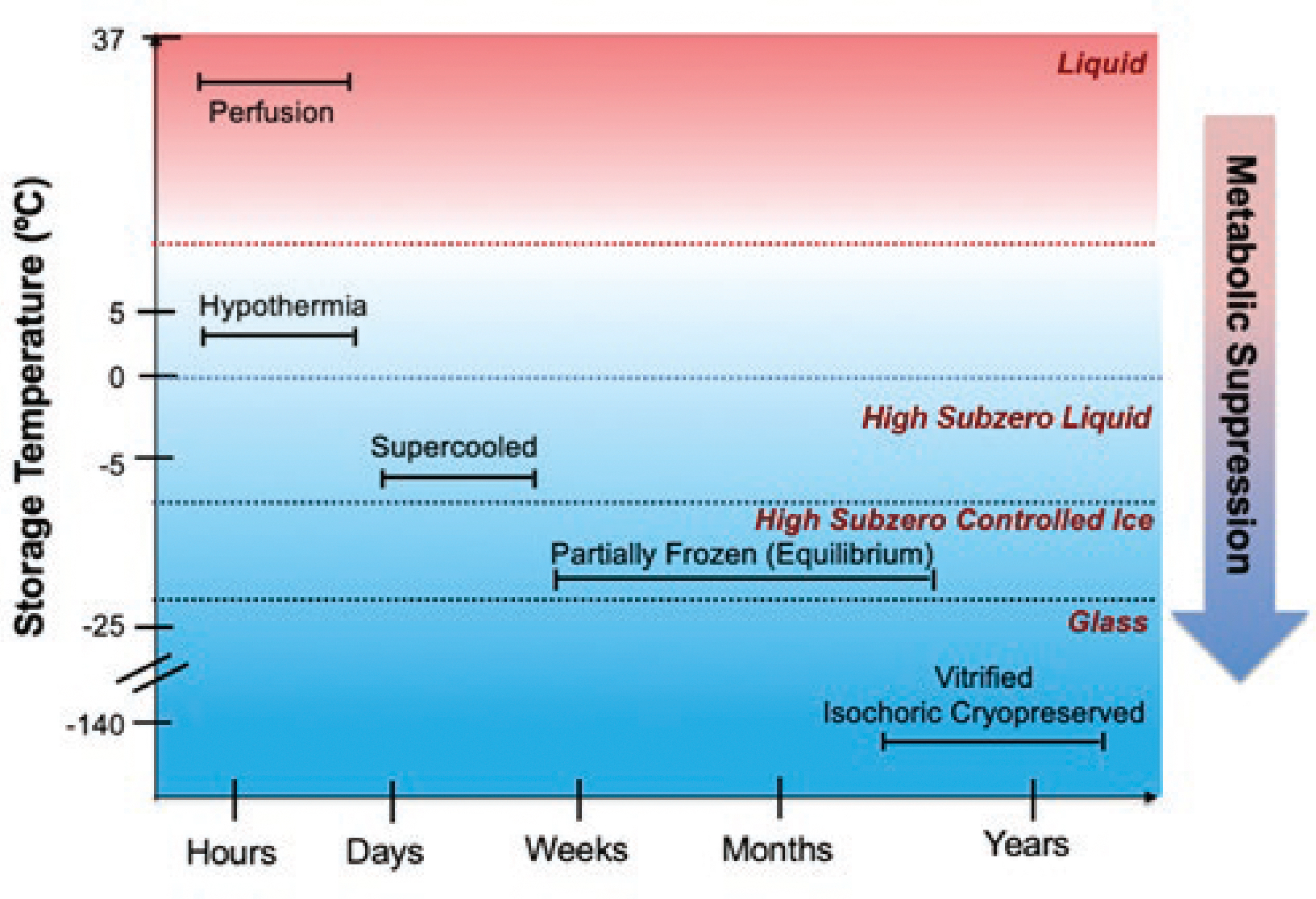 Figure 1
Peer Reviews
No public reviews on file for this paper yet. If you reviewed it on a platform where reviews are public (OpenReview, ICLR, NeurIPS, ICML), you can paste yours below so the community can read it here.
Videos
No videos yet. Explain this paper in a talk, walkthrough, or lecture? Add one.
Taxonomy
TopicsReproductive Health and Technologies