Tandem Cu(I)-Catalyzed Dipolar Cycloaddition–C–H Activation for the In-Flow Synthesis of N-Pyridyl-5-amino-1,2,3-triazole-4-carboxylates
Emanuela Donato, Martha C. Mayorquín-Torres, Alessandra Puglisi, Maurizio Benaglia, Mauro F. A. Adamo, Christian V. Stevens

TL;DR
Scientists developed a continuous flow method to efficiently synthesize complex organic molecules using copper-catalyzed reactions.
Contribution
A new continuous flow synthesis method combining CuAAC and C–H activation is introduced for making triazole derivatives.
Findings
The process uses a packed bed reactor for efficient Cu(I)-catalyzed reactions.
The method enables environmentally friendly synthesis of functionalized organic molecules.
The approach combines click chemistry with C–H activation in a single setup.
Abstract
A telescoped process under continuous flow conditions is described for the synthesis of N-pyridyl-5-amino-1,2,3-triazole-4-carboxylate derivatives catalyzed by copper salts in a packed bed reactor. The synthetic approach takes first advantage of click chemistry, specifically relying on Cu(I)-catalyzed 1,3-dipolar azide–alkyne cycloaddition (CuAAC), to achieve the efficient and selective assembly of a triazole ring, followed by a copper-mediated C–H activation, that substitutes an inert C–H bond with a C–N bond, providing an environmentally acceptable and cost-effective strategy for synthesizing highly functionalized organic molecules.
Click any figure to enlarge with its caption.
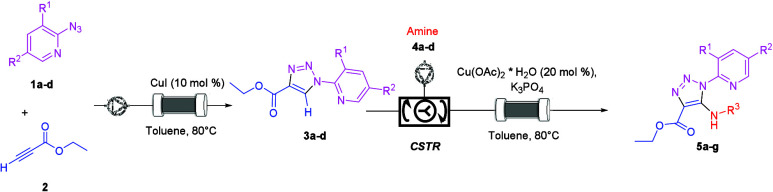 Figure 1
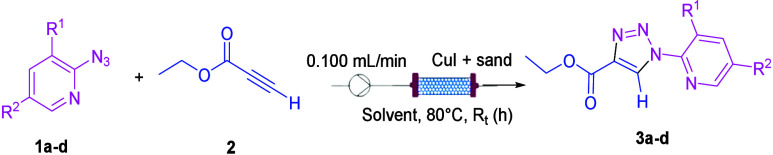 Figure 2
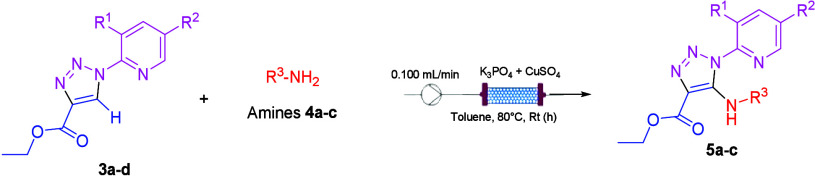 Figure 3
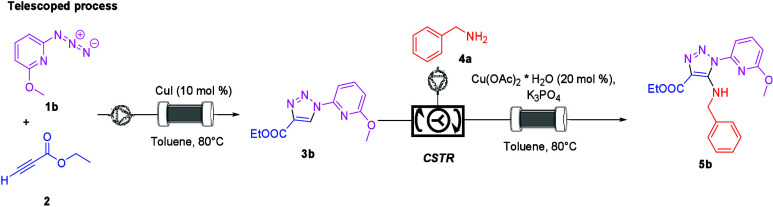 Figure 4
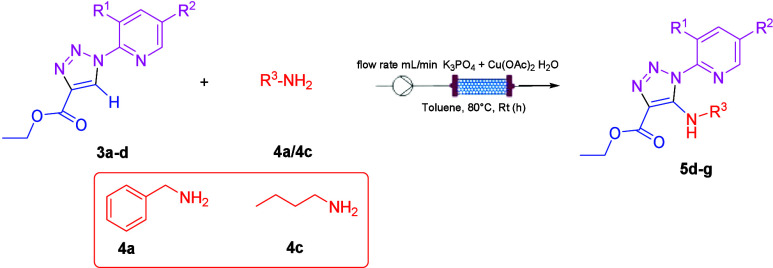 Figure 5
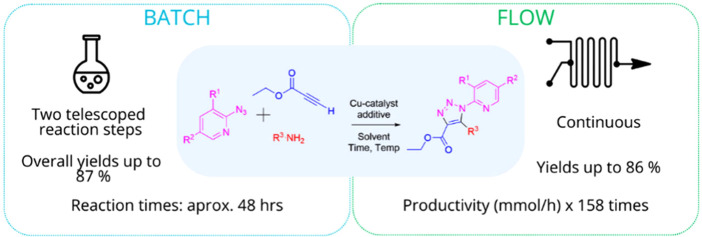 Figure 6
- —Horizon 2020 Framework Programme10.13039/100010661
- —Ministero Transizione EcologicaNA
- —NextGenerationEU10.13039/100031478
Peer Reviews
No public reviews on file for this paper yet. If you reviewed it on a platform where reviews are public (OpenReview, ICLR, NeurIPS, ICML), you can paste yours below so the community can read it here.
Videos
No videos yet. Explain this paper in a talk, walkthrough, or lecture? Add one.
Taxonomy
TopicsCatalytic C–H Functionalization Methods · Click Chemistry and Applications · Cyclopropane Reaction Mechanisms
In 2022, Professors Barry Sharpless, Morten Meldal, and Carolyn Bertozzi were awarded the Nobel Prize in Chemistry for their groundbreaking work on click reactions and biorthogonal transformations.^1^ Over the past 2 decades, “click chemistry”^2^ has become highly popular due to its high atom efficiency, rapid reaction rates, and robustness under various conditions, including the presence of oxygen and water.^3^ These innovations have greatly expanded the capabilities of synthetic and bioconjugate chemists, offering a versatile toolset for efficient chemical synthesis. Among several reactions that can be identified as “click reactions”, Huisgen 1,3-dipolar cycloaddition to obtain 1,2,3-triazoles particularly fits the definition.^4^
Moreover, the development of innovative techniques for directly converting C–H bonds to C–O, C–S, C–N, and C–C bonds remains an important goal in organic chemistry. The activation of inert C–H bonds represents the most significant challenge in C–H functionalization. Despite numerous studies in this subject, the concerns of reactivity and selectivity of C–H bonds prevent the wide applicability of this very valuable but challenging transformation.^5^ Recently, transition-metal-catalyzed C–H functionalization has emerged as an efficient and accessible synthetic method for the synthesis of a wide range of complex organic molecules.^6−8^ The published approaches demonstrated the importance of transition metals, such as Pd, Rh, Ru, and Ir, as catalysts in C–H functionalization.^9−12^ These metals were discovered to be extremely active in functionalizing C(sp^3^)–H, C(sp^2^)–H, and C(sp)–H bonds. However, the toxicity, poor abundance, and relatively high price of these metals slows down the widespread use of these catalysts.^13^
These disadvantages indicate the need to develop environmentally benign strategies for this type of reaction.^14,15^ Green chemistry prompted scientists to use less hazardous first row transition metals (such as Fe, Co, Ni, and Cu) as catalysts. Copper, for example, has received a lot of attention due to its low cost and abundance on Earth.^16^ One pioneer work about C–H activation using Cu for functionalization of aryl C–H bonds using O_2_ was reported by Yu and co-workers.^17^ The application of inexpensive Cu catalysts and O_2_ as the stoichiometric oxidant provides a considerable practical advantage. Moreover, the same researcher developed a copper(II)-mediated C–H amidation and amination reaction using a variety of sulfonamides, amides, and anilines. The amination reaction is extremely beneficial for the synthesis of medicinally relevant molecules.^18,19^
Chuprakov et al. reported an effective C5 arylation of 1,4-disubstituted 1,2,3-triazoles in good to excellent yields using palladium catalysis, tetrabutylammonium acetate (Bu_4_NOAc), and N-methylpyrrolidone (NMP) as the solvent. Furthermore, they demonstrated that this reaction is useful for the C5 regioselective arylation of 4,5-unsubstituted 1,2,3-triazoles (R_1_ = H), with the possibility of easily introducing aromatic electron-withdrawing (EW) substituents at the C5 position.^20^ Zhu et al. developed a Cu-catalyzed direct amination of 2-aryl-1,2,3-triazole N-oxides with primary and secondary amines.^21^
On the other hand, catalytic continuous flow processes are one of the most efficient, safe, and environmentally friendly techniques for producing active compounds. One strategy to perform efficient in-flow conversions is to use packed bed reactors.^22−25^
The aim of this study is to synthesize highly valuable compounds using a telescoped process under flow conditions. More specifically, using a packed-bed reactor and a copper salt as a catalyst, the N-pyridyl-1,2,3-triazole-4-carboxylate synthesis is developed under continuous flow conditions, followed by the in-flow introduction of an amino group by another packed-bed reactor filled with Cu(II) acetate (Scheme 1).
First, the process under batch conditions was investigated, and all results obtained are reported in the Supporting Information. Subsequently, the click reaction and C–H activation were optimized under flow conditions.
The Vaportec easy-MedChem E-Series depicted in the Supporting Information was used for this transformation. A solution of the two reagents, azido pyridine 1a–1d and ethyl propiolate 2, in the appropriate solvent, was charged in an Erlenmeyer flask equipped with a stirring bar and placed onto a stirring plate. A tube connected to the peristaltic pump was inserted inside the reaction mixture. A packed-bed reactor was realized with an Omnifit column (10 mm/100 mm, 1× F, 1× A) containing CuI (0.1 equiv with respect to azido pyridine 1a–1d) and sand (Scheme 1). The packed column was thermostated at 80 °C. The product was collected in vials for each residence time (Rt) to evaluate the nuclear magnetic resonance (NMR) yield after solvent removal under reduced pressure. Rt was calculated experimentally passing solvent through the column using a flow rate of 1 mL/min. The product was purified by column chromatography using 7:3 dichloromethane (DCM)/EtOAc as the eluent (Scheme 2).^26^ The click reaction was optimized testing different flow rates and consequently different residence times (Rt) (see the Supporting Information for all of the results). The best results using a flow rate of 0.100 mL/min are reported in Table 1, showing that yields in the range of 68–98% in dimethyl ether (DME) and the range of 89–93% in toluene were obtained. Productivity (P) and space–time yield (STY) were calculated for some selected results and are reported in Table 2.
Productivities (mmol/h) of in-flow reactions were typically 18–51 times higher than those of in-batch transformations, while space time yields (mmol mL^–1^ h^–1^) for the continuous flow process were significantly higher, typically 34–97 times higher than those for the batch transformations. The first preliminary tests for the C–H activation were performed using Vaportec easy-MedChem E-Series, described in the Supporting Information.
The reaction was performed in toluene as solvent because Cu(OAc)2 and CuBr_2_ were partially soluble in DME (Scheme 3). CuBr_2_ was used as a catalyst, but after 1 h, clogging of the reactor occurred; therefore, CuSO_4_ was selected as a copper catalyst. The results reported in Table 3 were evaluated first by ^1^H NMR using 1,3,5-trimethoxybenzene as the standard. Moreover, the NMR yield was confirmed by isolation of the product using column chromatography.
A new set of experiments was performed using ASIA Syrris as a flow device and Cu(OAc)2˙H_2_O as the catalyst. The setup used is shown in the Supporting Information. The reaction mixture was pumped through the packed-bed reactor (Omifit, 10 mm/100 mm, 1× F, 1× A) containing K_3_PO_4_ and Cu(OAc)2·H_2_O, showed in the Supporting Information. The temperature of the packed bed reactor was set at 80 °C. The yields are in the range of 89–93% using toluene. Productivity (mmol/h) and STY (mmol h^–1^ mL^–1^) were calculated, and the results were reported in Table 4. The productivity increased 43–69 times compared to batch, and the STY increased 14–23 times.
Next, a telescoped process was developed under flow conditions (Scheme 4). The setup and procedure used for the telescoped process were described in the Supporting Information.
The telescoped flow process gave an excellent result. The overall yield of the process is 86%. In crude ^1^H NMR, only traces of the starting material 5b were detected. Moreover, the productivity (mmol/h) is 158 times higher than that for the batch process, and a STY (mmol h^–1^ mL^–1^) is 79 times compared to the batch process (Table 5).
In conclusion, the synthesis of N-pyridyl-5-alkylamino-1,2,3-triazole-4-carboxylate derivatives was performed in batch and under flow conditions, obtaining excellent results using different azido pyridines 1a–1d and different amines 4a–4c. Moreover, the telescoped process was performed for the synthesis of product 5b, and an excellent result was obtained with an overall yield of 86%. The productivity (mmol/h) is 158 times higher that for the batch process, and the STY (mmol h^–1^ mL^–1^) is 79 times higher than that for the batch process.
The reference list from the paper itself. Each links out to its DOI / PubMed record.
- 1Kolb H. C.; Finn M. G.; Sharpless K. B. Click Chemistry: Diverse Chemical Function from a Few Good Reactions. Angew. Chem., Int. Ed. 2001, 40 (11), 2004–2021. 10.1002/1521-3773(20010601)40:11<2004::AID-ANIE 2004>3.0.CO;2-5.11433435 · doi ↗ · pubmed ↗
- 2Finn M. G.; Fokin V. V. Click Chemistry: Function Follows Form. Chem. Soc. Rev. 2010, 39 (4), 123110.1039/c 003740 k.20309482 · doi ↗ · pubmed ↗
- 3Moses J. E.; Moorhouse A. D. The Growing Applications of Click Chemistry. Chem. Soc. Rev. 2007, 36 (8), 1249–1262. 10.1039/B 613014 N.17619685 · doi ↗ · pubmed ↗
- 4Breugst M.; Reissig H. The Huisgen Reaction: Milestones of the 1,3-Dipolar Cycloaddition. Angew. Chem. Int. Ed 2020, 59 (30), 12293–12307. 10.1002/anie.202003115.PMC 738371432255543 · doi ↗ · pubmed ↗
- 5Hashiguchi B. G.; Bischof S. M.; Konnick M. M.; Periana R. A. Designing Catalysts for Functionalization of Unactivated C–H Bonds Based on the CH Activation Reaction. Acc. Chem. Res. 2012, 45 (6), 885–898. 10.1021/ar 200250 r.22482496 · doi ↗ · pubmed ↗
- 6Davies H. M. L.; Manning J. R. Catalytic C–H Functionalization by Metal Carbenoid and Nitrenoid Insertion. Nature 2008, 451 (7177), 417–424. 10.1038/nature 06485.18216847 PMC 3033428 · doi ↗ · pubmed ↗
- 7Henry M.; Mostafa M.; Sutherland A. Recent Advances in Transition-Metal-Catalyzed, Directed Aryl C–H/N–H Cross-Coupling Reactions. Synthesis 2017, 49 (20), 4586–4598. 10.1055/s-0036-1588536. · doi ↗
- 8Ackermann L.; Vicente R.; Born R. Palladium-Catalyzed Direct Arylations of 1,2,3-Triazoles with Aryl Chlorides Using Conventional Heating. Adv. Synth Catal 2008, 350 (5), 741–748. 10.1002/adsc.200800016. · doi ↗