Effect of dexmedetomidine on the median effective concentration of ropivacaine for postoperative analgesia in transversus abdominis plane block: an up-down sequential allocation study
Qin Ye, Hongchun Xu, Xiao Liu, Xujiao Wang, Fangjun Wang

TL;DR
Adding dexmedetomidine to ropivacaine lowers the effective concentration needed for postoperative pain relief in abdominal nerve blocks.
Contribution
This study demonstrates that dexmedetomidine reduces the effective concentration of ropivacaine in transversus abdominis plane blocks.
Findings
The EC50 of ropivacaine decreased from 0.207% to 0.165% with dexmedetomidine.
Quality of recovery scores improved in patients receiving dexmedetomidine.
No significant adverse reactions were observed with dexmedetomidine use.
Abstract
This study aimed to observe the effect of dexmedetomidine on the median effective concentration (EC50) of ropivacaine for postoperative analgesia in ultrasound-guided transversus abdominis plane block. Patients undergoing elective laparoscopic cholecystectomy were randomly divided into the RD group and the R group. In the RD group, 40 mL of ropivacaine with 1 μg/kg dexmedetomidine was injected into the transverse abdominis plane, while subjects in the R group received equal volumes of ropivacaine with normal saline. When the visual analogue scale (VAS) ≤ 3 within 6 h after surgery, postoperative analgesia was assessed as effective. The probit regression was used to calculate the EC50 and effective concentration in 95% of patients (EC95) of ropivacaine for ultrasound-guided transversus abdominis plane block. The Quality of Recovery-40 (QoR-40) Score on 24 h after surgery and the…
Genes, proteins, chemicals, diseases, species, mutations and cell lines named across the full text — each resolved to its canonical identifier and authoritative record.
Click any figure to enlarge with its caption.
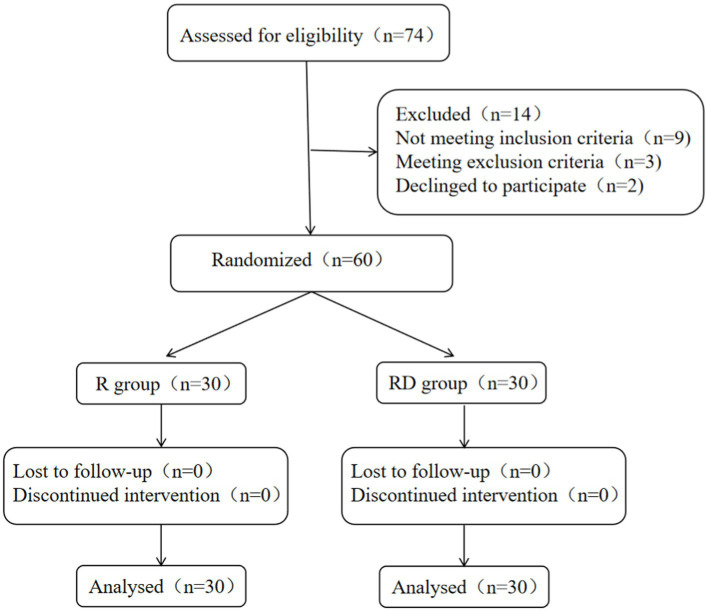 Figure 1
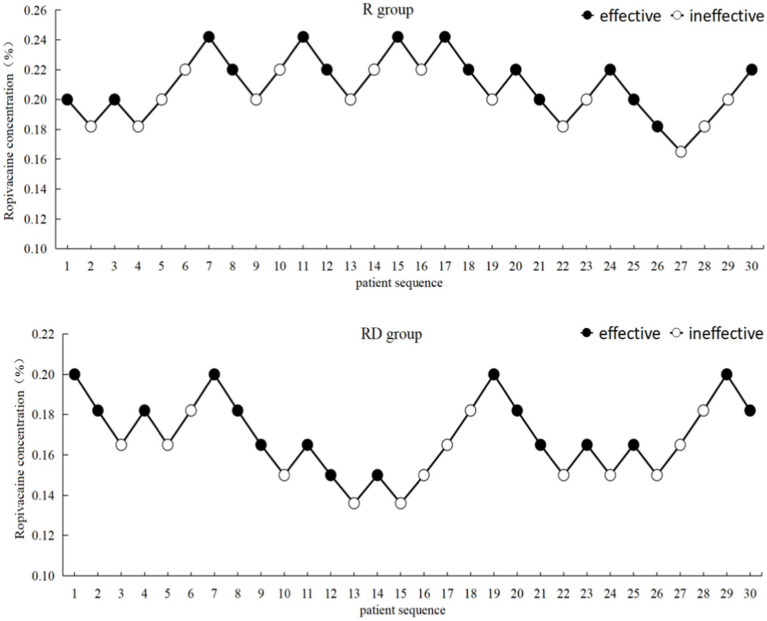 Figure 2
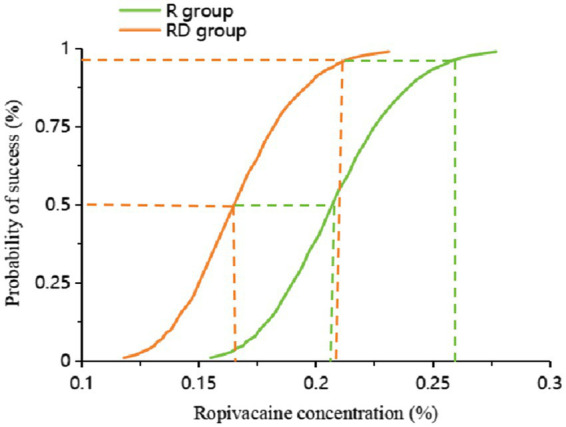 Figure 3
| Variables | R group ( | RD group ( | ||
|---|---|---|---|---|
| Age (years) | 47.8 ± 10.7 | 47.2 ± 8.1 | 0.259 | 0.796 |
| Gender | ||||
| Male, | 12 (40) | 13 (43.3) | 0.069 | 0.793 |
| Female, | 18 (60) | 17 (56.7) | ||
| ASA | ||||
| I, | 14 (46.7) | 15 (50) | 0.067 | 0.796 |
| II, | 16 (53.3) | 15 (50) | ||
| Height (cm) | 161.0 ± 9.1 | 163.0 ± 8.6 | 0.875 | 0.385 |
| Weight (kg) | 62.1 ± 11.8 | 65.5 ± 11.8 | 1.116 | 0.269 |
| Duration of anesthesia (min) | 67.8 ± 14.3 | 67.5 ± 16.5 | 0.059 | 0.953 |
| Duration of surgery (min) | 47.5 ± 14.8 | 46.1 ± 15.3 | 0.352 | 0.726 |
| QoR-40 | R group ( | RD group ( | ||
|---|---|---|---|---|
| Physical independence, median (IQR) | 25 (0) | 25 (0) | 0.000 | 1.000 |
| Physical comfort, median (IQR) | 52 (6.8) | 54 (5.5)* | −2.098 | 0.036 |
| Psychological support, median (IQR) | 35 (0) | 35 (0) | 0.000 | 1.000 |
| Emotional state, median (IQR) | 41 (4.0) | 43 (2.3)* | −2.109 | 0.035 |
| Pain, median (IQR) | 30 (3.5) | 32 (4.3)* | −2.202 | 0.027 |
| Global, median (IQR) | 183.5 (9.5) | 190 (12.3)* | −2.324 | 0.020 |
| Adverse effects | R group ( | RD group ( | ||
|---|---|---|---|---|
| Bradycardia, | 3 (10) | 7 (23.3) | 1.920 | 0.299 |
| Hypotension, | 6 (20) | 1 (3.3) | 4.043 | 0.103 |
| Skin itching, | 0 (0) | 0 (0) | 0.000 | 1.000 |
| Hematoma formation, | 0 (0) | 0 (0) | 0.000 | 1.000 |
| Classification of PONV, | ||||
| 0 | 16 (53.3) | 16 (53.3) | 3.000 | 0.434 |
| I | 2 (6.7) | 6 (20) | ||
| II | 2 (6.7) | 2 (6.7) | ||
| III | 10 (33.3) | 6 (20) | ||
Peer Reviews
No public reviews on file for this paper yet. If you reviewed it on a platform where reviews are public (OpenReview, ICLR, NeurIPS, ICML), you can paste yours below so the community can read it here.
Videos
No videos yet. Explain this paper in a talk, walkthrough, or lecture? Add one.
Taxonomy
TopicsAnesthesia and Pain Management · Anesthesia and Sedative Agents · Nausea and vomiting management
Introduction
1
Laparoscopic cholecystectomy is a common surgical procedure. Although it is less invasive than open cholecystectomy, it may lead to moderate-to-severe postoperative pain (1). After laparoscopic cholecystectomy, the most severe and common pain occurred in abdominal wall incisions, which occurred in 41.1% of patients and required analgesics in 73.8% of patients (2). Opioids are commonly used postoperative analgesics, which can effectively relieve postoperative pain. However, opioids have many adverse reactions, such as respiratory depression, nausea and vomiting, gastrointestinal paralysis, and urinary retention, which may outweigh the benefits of analgesia (3).
Transversus abdominis plane (TAP) block was used for postoperative analgesia in patients undergoing cholecystectomy, radical gastrectomy, and hepatectomy (4). The TAP is similar to the intercostal region, which belongs to the high blood perfusion plane. However, a large volume of local anesthetics was usually required to achieve satisfactory analgesic effects, which could cause local anesthetic systemic toxicity (LAST) (5). When ropivacaine was administered at doses of 2.5 mg/kg or 3 mg/kg for the TAP block, the patient’s plasma ropivacaine concentration approached or exceeded the local anesthetic potential toxic concentration (2.2 μg/mL), up to 4 μg/mL (5–7). A patient with renal dysfunction was given 1.8 mg/kg ropivacaine during TAP block; the plasma ropivacaine concentration reached 2.5 μg/mL, and the patient experienced local anesthetic intoxication (8). The ED_50_ (2.05 ~ 3.27 mg/kg) of ropivacaine in TAP blocks in reversal of ileostomy was close to the toxic threshold (3 mg/kg) (9). Therefore, it is necessary to reduce the dose of local anesthetics in TAP blocks to lower the risk of local anesthetic intoxication.
Adding adjuvants can improve the nerve-blocking effect of local anesthetics and reduce the dosage of local anesthetics (10). As a highly selective α_2_ adrenergic receptor agonist, dexmedetomidine combined with local anesthetics has been shown to enhance the analgesic effect of nerve blocks, prolong the action time, and reduce the dosage of postoperative analgesics (11, 12). A meta-analysis also showed the safety and efficacy of dexmedetomidine in combination with local anesthetics for nerve blocks (13). In a previous study (14), Mostafa et al. found that levobupivacaine combined with dexmedetomidine during TAP block in pediatric laparoscopic orchiopexy could attenuate postoperative pain, prolong analgesic time, reduce the dosage of analgesics, and have the highest postoperative satisfaction and minimal sedation. In lumbo-sciatic nerve block and transversal plane block, dexmedetomidine, as a local anesthetic adjuvant, prolonged sensory and motor block time and decreased postoperative pain score in a dose-dependent manner. However, the incidence of adverse reactions such as bradycardia and excessive sedation increased significantly after the dose of dexmedetomidine reached 2 μg/kg (15, 16). Another study (17) suggested that 1 μg/kg dexmedetomidine was recommended as an adjuvant to ropivacaine for TAP block, compared to 0.5 μg/kg and 1.5 μg/kg. Therefore, we chose 1 μg/kg dexmedetomidine as an adjuvant to ropivacaine for TAP block in our study.
However, there has been no report on the effect of dexmedetomidine as an adjuvant on the local anesthetic dosage for postoperative analgesia in the TAP block. We hypothesized that the addition of dexmedetomidine as an adjuvant could reduce the local anesthetic dosage for postoperative analgesia in the TAP block. Therefore, we conducted this study to investigate the effect of 1 μg/kg of dexmedetomidine as a local anesthetic adjuvant on the EC_50_ of ropivacaine for postoperative analgesia in the TAP block.
Materials and methods
2
Ethics and patients
2.1
This trial was approved by the Medical Ethics Committee of the Affiliated Hospital of North Sichuan Medical College (number 2020ER081-1) and registered in the Chinese Clinical Trial Registry (registration number ChiCTR2000032991, registration date: 17 May 2020). Patients who underwent elective laparoscopic cholecystectomy at the Affiliated Hospital of North Sichuan Medical College were enrolled. All patients signed a written informed consent form. The inclusion criteria were age 18 to 65 years old, American Society of Anesthesiologists (ASA) physical classification status of I–II, and 18 kg/m^2^ ≤ body mass index (BMI) ≤ 30 kg/m^2^. The exclusion criteria included patients with preoperative coagulation abnormalities, skin infection, and breakage at the puncture site, and recent use of sedatives and opioids. The withdrawal criteria included intraoperative massive bleeding, failure of TAP block, a change in the surgical plan, placement of a drainage tube and local anesthetic toxicity, a request from the patient or relative to withdraw from the study, and incomplete data collection.
Randomization and blinding
2.2
A computer-generated randomized sequence was used for randomization. Sixty patients who underwent elective laparoscopic cholecystectomy were randomized into two groups: R group with ropivacaine only and the RD group with ropivacaine and 1 μg/kg dexmedetomidine. Prepared 60 cards marked with different numbers (generated by a computer-generated random number) and put the cards in identical and opaque sealed envelopes. When the patient arrived in the operating room, the anesthesia nurse, who did not participate in the trial, randomly selected an envelope and prepared the drugs according to the groups corresponding to the numbers in the envelope. The drugs in both groups were diluted to 40 mL with 0.9% normal saline. The anesthesiologists, patients, statisticians, and data collectors did not know the group allocation. After the study was completed, the data collectors reported the data back to the statisticians. The statisticians analyzed the results and obtained the concentration of ropivacaine for the next patient. When severe local anesthetic toxicity occurred, the patient was unblinded midway and excluded.
Design
2.3
Based on the results of previous studies (18, 19) and the preliminary experiment, the concentration of ropivacaine for the first patient in each group was 0.2%. The concentration of ropivacaine for the following patients was determined by the up-down allocation methodology, and the ratio of adjacent concentrations was 1.1 (20). If the analgesia was ineffective, the next patient would be received at a higher concentration. If the analgesia was effective, the next patient would be received with a lower concentration. The effectiveness of analgesia was determined according to the visual analogue scale (VAS) score (0, no pain; 1–3, slight but tolerable pain; 4–6, medium-level pain with groaning and requiring medical treatment; and 7–10, severe completely intolerable pain) (21) within 6 h after surgery. A VAS score ≤ 3 within 6 h after surgery was defined as effective analgesia. If the VAS score > 3 within 6 h after surgery, the postoperative analgesia was ineffective, and 1 mg/kg of tramadol was administered each time for analgesia (22). Pain is an important problem after laparoscopic cholecystectomy, especially the most significant pain in patients within 6 h after surgery (23). When the VAS score was above 3, it affected patient comfort, recovery, potential for same-day discharge, and overall satisfaction (24). Therefore, we set the inflection point as a VAS score > 3 or a VAS score ≤ 3 within 6 h after surgery.
Anesthetic procedure
2.4
One day prior to surgery, we thoroughly explained the research protocol to both patients and their families, and familiarized the patients with the VAS and QoR-40 scoring systems. All patients fasted from solid food for 8 h and clear liquids for 4 h before surgery. After entering the anesthesia preparation room, the peripheral vein was accessed, and 10 mL/kg/h Ringer lactate solution was administered intravenously. Electrocardiography (ECG), non-invasive blood pressure (NIBP), and oxygen saturation (SpO_2_) were monitored. Oxygen inhalation through nasal cannula was 2 L/min. After sterilizing the skin, a 5–15 MHz linear high-frequency ultrasound probe was used to perform the subcostal transversus abdominis plane block, which was performed by an experienced anesthesiologist. First, the linear probe was placed below the xiphoid and then paralleled to the costal margin and scanned obliquely along the lower costal margin to identify the rectus abdominis, the transversus abdominis muscle, the internal oblique muscles, and the external oblique muscles. Part of the transversus abdominis muscle extends underneath the rectus abdominis muscle. An 80-mm plexus stimulation needle was used to insert 1 to 2 cm in front of the mark point of the probe with the in-plane technique. When the needle tip was between the rectus abdominis and the transverse abdominis muscles, the aspiration was free of blood and air. Then, 1 ~ 2 mL of the test drug was injected to confirm its location. When a convex lens-shaped dark fluid area appeared between the rectus abdominis and the transversus abdominis muscles, it proved that the needle tip was accurately positioned. The mixed solution of local anesthetic and dexmedetomidine was administered at a speed of 20 mL/30s. All patients underwent bilateral TAP blocks, and 20 mL of the mixed solution was administered to each side. This procedure was completed within 15 min, and then alcohol swabs were used to identify the plane every 5 min. When the cold sensation disappeared or weakened from T_6_ to T_10_ after 20 min of the TAP block, the block was considered successful.
After patients entered the operating room, ECG, NIBP, SpO_2_, end-tidal carbon dioxide partial pressure (PETCO_2_), and bispectral index (BIS) were monitored. The induction of general anesthesia was administered by intravenous propofol (1.5 ~ 2 mg/kg), sufentanil (0.4 μg/kg), and rocuronium (0.6 mg/kg). Then, tracheal intubation was performed, followed by mechanically controlled ventilation. The pure oxygen flow was 2 L/min, the tidal volume was 8 mL/kg, the respiratory rate was 14 times/min, and the inhalation/exhalation ratio was 1:2. Respiratory parameters were adjusted according to PETCO_2_ maintained at 35 ~ 45 mmHg, and SpO_2_ remained above 98%. Intraoperative anesthesia was maintained by intravenous infusion of propofol (4 ~ 8 mg/kg^/^h) and remifentanil (0.1 ~ 0.2 μg/kg/min), which were adjusted according to BIS values (40 ~ 60). Muscle relaxants were added as needed during the operation and discontinued 45 min before the end of the surgery, while propofol and remifentanil were discontinued 5 min before the end of the surgery. When the patient suffers from local anesthetic intoxication, the drug should be stopped immediately, and oxygen should be provided through a mask. Mildly excited patients were given midazolam (0.05 ~ 0.1 mg/kg). Patients who experienced convulsions received intravenous propofol (1 ~ 2 mg/kg). Severe cases were intubated, and vasoactive drugs were used to maintain hemodynamic stability. When the blood pressure decreased by more than 20% of the base value or the systolic blood pressure (SBP) was below 90 mmHg, ephedrine (6 ~ 10 mg) was administered immediately. When the heart rate (HR) was less than 50 beats per minute, atropine 0.5 mg was given. The body temperature of the patients was maintained intraoperatively at approximately 36°C. All patients were positioned with their head elevated at 30° and a leftward inclination of 15°, while abdominal pressure was maintained at 12 ~ 14 mmHg during surgery. Laparoscopic cholecystectomy was performed using a three-port procedure, and all patients underwent the same technique and incision.
After surgery, the patients met the indications for extubation (call for open eyes and tidal volume >5 mL/kg), and then the catheter was extracted and transferred to the post-anesthesia care unit (PACU). If postoperative nausea and vomiting (PONV) required medication, ondansetron 4 mg was administered intravenously. When the patient’s VAS >3, intravenous tramadol 1 mg/kg was administered.
Measurements
2.5
The primary outcome of the study included the number of “effective” and “ineffective” responses for each concentration category for each group, which was used to calculate the median effective concentration (EC_50_) and effective concentration in 95% of patients (EC_95_) of ropivacaine. The secondary outcomes included the QoR-40 score of patients 24 h after surgery and adverse reactions. The QoR-40 score includes five parts: physical independence, physical comfort, psychological support, emotional state, and pain. Adverse reactions such as hypotension, bradycardia, postoperative nausea and vomiting, skin itching, and hematoma formation were also recorded. There are four levels of postoperative nausea and vomiting (0 grade: no nausea or vomiting, I grade: nausea but no vomiting, II grade: vomiting once or twice, and III grade: vomiting on more than two occasions) (25).
Statistical analysis
2.6
A previous study (20, 26) has shown that an up-down sequential allocation study usually requires 20–40 samples to obtain 6 or more inflection points to calculate the EC_50_ of the drug. The study was conducted with 30 patients in each group with an expected loss of follow-up rate of 10%.
Data analysis was performed using GraphPad Prism version 5.0 and IBM SPSS 23.0 statistical software. Continuous variables with normal distribution were expressed as mean±standard deviation (X ± SD), and comparison between groups was performed by two independent samples *t-*tests. Non-normally distributed data were presented as median (interquartile range) M (IQR), and the Mann–Whitney U-test was used for comparison between groups. Categorical data were determined using the χ^2^ test or Fisher’s exact test. The EC_50_, EC_95,_ and 95% CI of ropivacaine were calculated according to the probit regression. Overlapping CI methodology, where differences in group means were considered statistically significant when the 83% CIs did not overlap, was also used to test the differences in EC_50_ values between groups as a sensitivity test (20, 26). A *p-*value of <0.05 was considered statistically significant.
Results
3
A total of 74 patients were recruited for the study; 9 patients did not meet the inclusion criteria, and 3 patients were excluded. In addition, two patients declined to participate. A total of 60 patients completed the study as shown in Figure 1.
Flow diagram of the study.
There were no significant differences in age, gender, ASA, height, weight, anesthesia time and operation time between the two groups (p = 0.796, 0.793, 0.796, 0.385, 0.269, 0.953 and 0.726, respectively) as shown in Table 1.
The up-down sequential allocation results are shown in Figure 2. According to the probit regression, the EC_50_ of ropivacaine was 0.207% (95% CI, 0.188% ~ 0.228%), and EC_95_ was 0.255% (95% CI, 0.230% ~ 0.499%) in the R group. The EC_50_ of ropivacaine was 0.165% (95% CI, 0.146% ~ 0.182%), and EC_95_ was 0.209% (95% CI, 0.187% ~ 0.430%) in the RD group, as shown in Figure 3.
Up-down sequential allocation results.
Dose–response curve of the probability of ropivacaine concentration. The values of the EC50 and EC95 derived from probit analysis were 0.207% (95% CI, 0.188% ~ 0.228%) and 0.255% (95% CI, 0.230% ~ 0.499%) in the R group. The EC50 of ropivacaine was 0.165% (95% CI, 0.146% ~ 0.182%), and the EC95 was 0.209% (95% CI, 0.187% ~ 0.430%) in the RD group.
The physical comfort score, emotional state score, pain score, and total score of the QoR-40 score in the RD group were significantly higher than those in the R group (p = 0.036, 0.035, 0.027 and 0.020, respectively), as presented in Table 2. There were no differences between the two groups in the physical independence score and psychological support score of the QoR-40 score (p = 1.000 and 1.000), as presented in Table 2.
There were no differences in the incidence of hypotension, bradycardia, skin itching, hematoma formation and PONV between the two groups (p = 0.103, 0.299, 1.000, 1.000 and 0.434, respectively), as shown in Table 3.
Discussion
4
In this up-down sequential allocation study, we found that dexmedetomidine as a local anesthetic adjuvant for TAP block can significantly reduce the EC_50_ and EC_95_ of ropivacaine while improving the quality of postoperative recovery in patients undergoing laparoscopic cholecystectomy.
Laparoscopic cholecystectomy can cause moderate to severe postoperative pain in patients. The TAP block can significantly reduce postoperative pain, lower opioid consumption, and decrease pain scores (27). However, TAP block usually requires a high-volume local anesthetic to dilate the plane and block the nerves that travel through this plane to achieve the analgesic effect. However, the analgesic time of low-concentration local anesthetics is limited for a single TAP block, while high-concentration local anesthetics are associated with the risk of local anesthetic intoxication. Therefore, adding adjuvants to local anesthetics, enhancing the analgesic effect of local anesthetics, and reducing the risk of local anesthetic poisoning have been the focus of research in recent years. Studies (28, 29) have shown that local anesthetic adjuvants fentanyl, sufentanil, clonidine, and dexamethasone can enhance the blocking effect of local anesthesia, but dexmedetomidine has a stronger analgesic effect, which shortens the blocking onset time, prolongs the analgesic time, and reduces postoperative adverse reactions.
In this study, we investigated the EC_50_ and EC_95_ of ropivacaine using the sequential method, which is a simple and scientific approach to assessing the dose–effect relationship of the drug. The EC_50_ and EC_95,_ respectively, represent the concentration of the drug that is effective in 50 and 95% of individuals. In clinical practice, the EC_50_ and EC_95_ of the drug can be used to guide rational drug use. A previous study showed that the ED_50_ (2.05 ~ 3.27 mg/kg) of ropivacaine in TAP blocks in reversal of ileostomy is close to the toxic threshold (3 mg/kg) (9). Therefore, local anesthetic intoxication can easily occur. Raof et al. (30) showed that the EC_50_ of bupivacaine combined with dexmedetomidine was 0.055% for TAP block in children, while the EC_50_ of bupivacaine alone was 0.0839%. In labor epidural analgesia, the EC_50_ of ropivacaine alone was 0.083%, and when ropivacaine was combined with 0.5 ug/ml of dexmedetomidine, the EC_50_ value decreased to 0.062% (31). In these studies, dexmedetomidine was used as an adjuvant for local anesthetics, reducing the EC_50_ of local anesthetics by 34 and 25%, respectively. These are consistent with the results of our study. This study revealed that the EC_50_ of ropivacaine combined with dexmedetomidine for TAP block in adults was 0.165%, whereas the EC_50_ of ropivacaine alone was 0.207%. The combination of ropivacaine with dexmedetomidine resulted in a 20% reduction in EC_50_ compared to ropivacaine alone. A recent study (32) found that the intranasal administration of 1 μg/kg and 2 μg/kg of dexmedetomidine decreased the EC50 of ropivacaine for the caudal block, and there was a specific dose-dependent effect. However, the incidence of hypotension and bradycardia was higher with 2 μg/kg dexmedetomidine as a local anesthetic adjuvant (13, 15, 16). This may be derived from the anti-sympathetic effects of dexmedetomidine, which may inhibit the sympathetic nerve terminal to release norepinephrine and enhance the activity of the vagus nerve (33). There was no difference in the incidence of hypotension or bradycardia between the two groups in our study. However, it is necessary to strengthen the monitoring of the patient’s cardiovascular system to actively prevent and treat complications in clinical applications.
The mechanism by which dexmedetomidine enhances the analgesic effect of local anesthetics has been poorly understood. Current studies have found that dexmedetomidine can inhibit neuronal excitability and A-α and C fibers that control pain perception by blocking hyperpolarization-activated cyclic nucleotide-gated (HCN) channels or hyperpolarization-activated cation channel current (I_h_ current), delay rectifier K^+^ current (IK(DR)) and Na^+^ current (INa) (34–37). The enhancement of sensory and motor blocks with intraneural dexmedetomidine may be related to the anti-inflammatory and neuroprotective properties of dexmedetomidine as a local anesthetic adjuvant. Kim et al. (38) revealed that interleukin (IL)-6 and IL-1β levels, scores of axon, myelinated fiber degeneration, and demyelinated fiber percentages were lower in the ropivacaine plus dexmedetomidine group than in the ropivacaine group. Huang et al. (39) found dexmedetomidine pretreatment elevated brain-derived neurotrophic factor (BDNF) expression by reducing miR-10b-5p expression, thereby alleviating ropivacaine-induced neurotoxicity. Dexmedetomidine can also prevent the absorption of the local anesthetic by vasoconstriction at the injection area and enforce the activity of the peripheral nerve to increase analgesia intensity and duration (40). Meanwhile, the release of peripheral norepinephrine is inhibited, which induces the hyperpolarization of cells and inhibits the transmission of pain signals to the brain center (41). Dexmedetomidine enhances the analgesic effect of anesthetics through these mechanisms. It has also been proven in clinical applications. In brachial plexus block, dexmedetomidine combined with ropivacaine can significantly shorten the onset time of ropivacaine block and extend its block time (42). A meta-analysis (43) showed that local anesthetics combined with dexmedetomidine significantly reduced postoperative pain intensity at 12 h, 24 h, and 48 h, and reduced opioid dosage in femoral nerve block.
The QoR-40 score was used to globally measure the quality of postoperative recovery from five dimensions involving emotional state, physical comfort, psychological support, physical independence, and pain in many clinical trials (44). The results of this study showed that the combination of dexmedetomidine and ropivacaine significantly increased the scores of physical comfort, emotional state, pain, and total score in the 24 h QoR-40 score of patients after surgery more than ropivacaine alone. This suggests that ropivacaine with dexmedetomidine (1 μg/kg) can meet superior pain relief in the early postoperative period, increase patient satisfaction, and improve the quality of postoperative recovery. Similar results were found in Yu Wu et al.’s study of dexmedetomidine combined with ropivacaine was used in deep serratus anterior plane block to improve postoperative recovery quality in patients undergoing modified radical mastectomy (45). Another study (46) discovered that 1 μg/kg (not 0.5 μg/kg) dexmedetomidine combined with ropivacaine in a deep serratus anterior plane block could provide superior postoperative analgesia for patients undergoing modified radical mastectomy. Although a study (47) showed that general anesthesia combined with spinal anesthesia, TAP block, or systemic administration of lidocaine, the quality of recovery on the first day after surgery did not differ from baseline. However, it is not known whether adding dexmedetomidine to the TAP block would have produced different results because clonidine was used in this study. In addition, although local anesthesia in the TAP block was confirmed by ultrasonography to spread at the correct level, the clinical effect could not be evaluated because the block was implemented after the induction of anesthesia.
There are several limitations to our study. First, the plasma concentration of ropivacaine was not detected. However, the concentration of ropivacaine used in this study was low and did not exceed the maximum dose. The median peak venous plasma ropivacaine concentrations were below the reported toxic threshold, even though the concentrations of ropivacaine were up to 0.25% (less than 0.25% in our study) in a previous study (48). Therefore, no patient experienced local anesthesia intoxication during the perioperative period. Second, the sample size of this study is small, and a larger sample study will be needed in the future to confirm the effect of dexmedetomidine on patients’ QoR-40 scores. Third, dexmedetomidine at different doses is used as a local anesthetic adjuvant for TAP block in the clinic, but this study only investigated the effect of 1 μg/kg of dexmedetomidine on the EC_50_ of ropivacaine. We needed to explore whether different doses of dexmedetomidine would have the same effects. Finally, there is a potential bias due to the single-center design and the lack of long-term follow-up.
Conclusion
5
In the ultrasound-guided TAP block, the EC_50_ of ropivacaine combined with dexmedetomidine was 0.165% (95% CI, 0.146% ~ 0.182%), and the EC_50_ of ropivacaine alone was 0.207% (95% CI, 0.188% ~ 0.228%). Dexmedetomidine can significantly reduce the EC_50_ of ropivacaine and improve the quality of postoperative recovery for patients undergoing laparoscopic cholecystectomy. Similar results may be achieved in other upper abdominal procedures, such as radical gastrectomy and hepatectomy. However, further research is needed.
The reference list from the paper itself. Each links out to its DOI / PubMed record.
- 1Jiang B Ye S. Pharmacotherapeutic pain management in patients undergoing laparoscopic cholecystectomy: a review. Adv Clin Exp Med. (2022) 31:1275–88. doi: 10.17219/acem/151995, PMID: 36000879 · doi ↗ · pubmed ↗
- 2Ure BM Troidl H Spangenberger W Dietrich A Lefering R Neugebauer E. Pain after laparoscopic cholecystectomy. Intensity and localization of pain and analysis of predictors in preoperative symptoms and intraoperative events. Surg Endosc. (1994) 8:90–6. doi: 10.1007/BF 00316616, PMID: 8165491 · doi ↗ · pubmed ↗
- 3Toleska M Dimitrovski A Shosholcheva M Kartalov A Kuzmanovska B Dimitrovska NT. Pain and multimodal analgesia in laparoscopic cholecystectomy. Pril. (2022) 43:41–9. doi: 10.2478/prilozi-2022-0017, PMID: 35843915 · doi ↗ · pubmed ↗
- 4Chen Y Shi K Xia Y Zhang X Papadimos TJ Xu X. Sensory assessment and regression rate of bilateral oblique subcostal transversus abdominis plane block in volunteers. Reg Anesth Pain Med. (2018) 43:174–9. doi: 10.1097/AAP.0000000000000715, PMID: 29278604 · doi ↗ · pubmed ↗
- 5Hessian EC Evans BE Woods JA Taylor DJ Kinkel E Bjorksten AR. Plasma ropivacaine concentrations during bilateral transversus abdominis plane infusions. Br J Anaesth. (2013) 111:488–95. doi: 10.1093/bja/aet 065, PMID: 23562932 · doi ↗ · pubmed ↗
- 6Toju K Shiraishi K Hakozaki T Isosu T Murakawa M. Plasma ropivacaine concentration following ultrasound-guided subcostal transversus abdominis plane block in adults. J Anesth. (2015) 29:146–8. doi: 10.1007/s 00540-014-1864-0, PMID: 24935748 · doi ↗ · pubmed ↗
- 7Griffiths JD Barron FA Grant S Bjorksten AR Hebbard P Royse CF. Plasma ropivacaine concentrations after ultrasound-guided transversus abdominis plane block. Br J Anaesth. (2010) 105:853–6. doi: 10.1093/bja/aeq 255, PMID: 20861094 · doi ↗ · pubmed ↗
- 8Ishida T Tanaka S Sakamoto A Hirabayashi T Kawamata M. Plasma ropivacaine concentration after TAP block in a patient with cardiac and renal failure. Local Reg Anesth. (2018) 11:57–60. doi: 10.2147/LRA.S 173877, PMID: 30288098 PMC 6159791 · doi ↗ · pubmed ↗