A dualist theory of experience
Bradford Saad

TL;DR
This paper proposes a new dualist theory of experience that explains how mental states can influence physical effects without violating physical laws.
Contribution
The paper introduces delegatory dualism, a novel dualist framework that satisfies five stringent constraints for a coherent theory of experience.
Findings
Delegatory dualism allows experiences to cause physical effects without violating causal closure.
The theory avoids overdetermination and ensures functional duplication preserves phenomenology.
It specifies psychophysical laws that link experiences to physical states.
Abstract
Dualism holds that experiences somehow arise from physical states, despite being neither identical with nor grounded in such states. This paper motivates a stringent set of constraints on constructing a dualist theory of experience. To meet the constraints, a dualist theory must: (1) construe experiences as causes of physical effects, (2) ensure that experiences do not cause observable violations of the causal closure of the physical domain, (3) avoid overdetermination, (4) specify a set of psychophysical laws that yield experiences as a function of physical states, and (5) ensure that functional duplication preserves phenomenology. After motivating these constraints and explaining why existing dualist theories satisfy only some of them, I construct a dualist theory that satisfies all of them. On the resulting theory—which I call delegatory dualism—experiences uphold causal…
Genes, proteins, chemicals, diseases, species, mutations and cell lines named across the full text — each resolved to its canonical identifier and authoritative record.
Click any figure to enlarge with its caption.
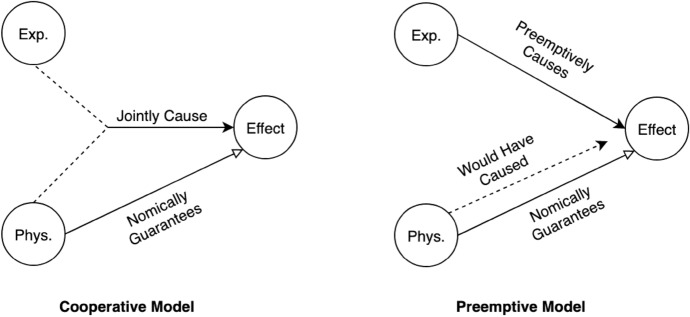 Figure 1
Peer Reviews
No public reviews on file for this paper yet. If you reviewed it on a platform where reviews are public (OpenReview, ICLR, NeurIPS, ICML), you can paste yours below so the community can read it here.
Videos
No videos yet. Explain this paper in a talk, walkthrough, or lecture? Add one.
Taxonomy
TopicsPhilosophy and Theoretical Science · Embodied and Extended Cognition · Quantum Mechanics and Applications