Whole-genome sequencing of the first Candida auris clinical isolate from a patient with sepsis in Palestine
Rasmi Abu-Helu, Faiza Tebbji, Ahmad Al Bishawi, Hanaa Baniodeh, Antony T. Vincent, Adnane Sellam

TL;DR
Scientists sequenced a drug-resistant yeast from a sepsis patient in Palestine and found genetic markers linked to resistance.
Contribution
The study provides the first whole-genome sequence of Candida auris from Palestine and identifies resistance-related SNPs.
Findings
The isolate C. auris Pal1 belongs to geographical Clade I.
Two SNPs (Erg11Y132F and Mrr1T647N) are associated with azole resistance.
Abstract
An isolate of the multidrug-resistant yeast Candida auris (Pal1) was identified in the urine of a patient with sepsis and sequenced using both Oxford Nanopore and Illumina sequencing technologies. Phylogenetic analysis placed C. auris Pal1 in the geographical Clade I, with distinct SNPs linked to azole resistance (Erg11Y132F and Mrr1T647N).
Genes, proteins, chemicals, diseases, species, mutations and cell lines named across the full text — each resolved to its canonical identifier and authoritative record.
Click any figure to enlarge with its caption.
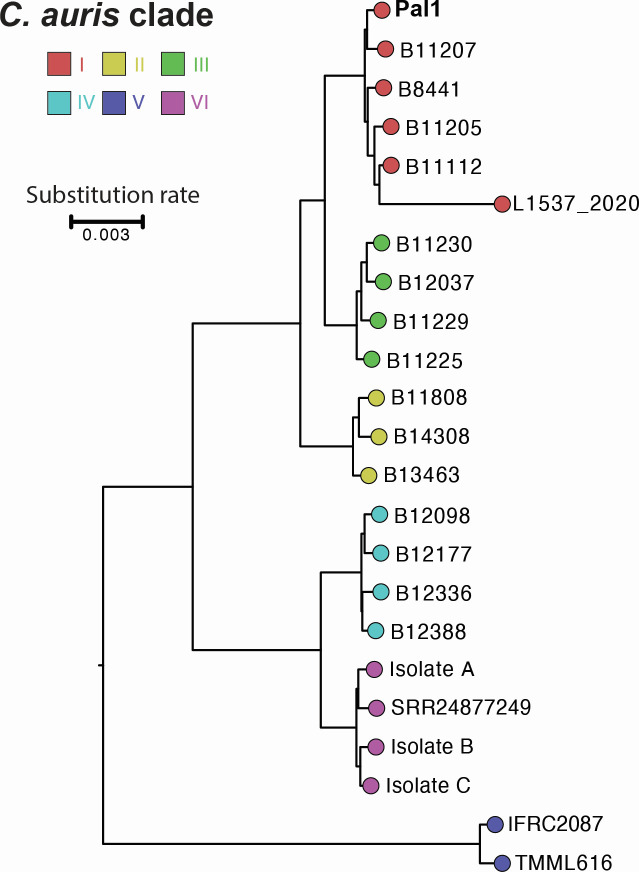 Fig 1
Fig 1Peer Reviews
No public reviews on file for this paper yet. If you reviewed it on a platform where reviews are public (OpenReview, ICLR, NeurIPS, ICML), you can paste yours below so the community can read it here.
Videos
No videos yet. Explain this paper in a talk, walkthrough, or lecture? Add one.
Taxonomy
TopicsAntifungal resistance and susceptibility · Fungal Infections and Studies · Probiotics and Fermented Foods
ANNOUNCEMENT
Candida auris has emerged as a significant healthcare-associated pathogen due to its multidrug-resistant nature, and it is listed in the WHO critical priority group due to its serious global health threat. In the first prevalence study of Candida infections in Palestine, many isolates of Candida spp. were not identified at the species level (1). As many of these isolates were resistant to fluconazole, we decided to specifically screen for C. auris. C. auris Pal1 was isolated from the urine of a patient with severe sepsis admitted at Ibn Sina Hospital (Jenin, Palestine) using CHROMagar Candida medium (CHROMagar, Paris, France). Pal1 isolate was initially identified as C. auris by the VITEK2 Compact system. A single colony of this isolate was inoculated into YPD (1% Yeast extract, 2% Peptone, 2% Dextrose, and 50 µg/mL uridine) medium and incubated at 30°C overnight. The cells were then harvested by centrifugation, and genomic DNA was extracted using the YeaStar kit (Zymo Research). Genomic DNA was first subjected to Sanger sequencing of the ITS2 region (2) (PQ578863) that confirmed this isolate as a C. auris species. Whole-genome sequencing was performed at Plasmidsaurus (Eugene, OR, USA) using both Oxford Nanopore Technology (ONT) long-read and Illumina NextSeq2000 short-read sequencing technologies. The Nanopore library was prepared using v14 library prep chemistry without fragmentation or size selection and sequenced on the PromethION P24 platform (Oxford Nanopore Technologies), equipped with R.10.4.1 flow cells. The Illumina library was made using the SeqWell ExpressPlex 96 library prep kit and sequenced on an Illumina NextSeq2000 (2 × 150 bp).
Illumina sequencing reads were filtered with Fastp version 0.23.2 (3) and those from Nanopore were filtered using Filtlong version 0.2.1 (https://github.com/rrwick/Filtlong) by keeping the best 90% of reads above 1,000 bp. Read quality was verified with FastQC version 0.12.1 (https://www.bioinformatics.babraham.ac.uk/projects/fastqc/). After filtration, 2.25 million Illumina reads were retained, totaling 354 Mb (96% > Q20, 85% > Q30). For Nanopore reads, 286,335 reads (N50 ~11 kb) were retained, totaling 2.4 Gb. Nanopore reads were assembled with Flye version 2.9.5-b1801 (4) at an average coverage of 200×. The assembly was then polished with Polypolish version 0.6.0 (5). The final assembly resulted in eight contigs, corresponding to the seven chromosomes and the mitochondrial genome. Annotation was performed with Funannotate version 1.8.17 (https://github.com/nextgenusfs/funannotate/) using default parameters and the Candida albicans SC5314 model (http://www.candidagenome.org), which is the closest available species.
C. auris Pal1 relatedness to different isolates that are representative of the six known geographical clades (6) was evaluated using the average nucleotide identity method (7). This analysis showed that Pal1 is closely related to isolate B11207 (8) that belongs to the geographical Clade I (9) (Fig. 1). Pal1 isolate harbors different SNPs associated with azole resistance, including Erg11^Y132F^ and Mrr1^T647N^.
Average nucleotide identity (ANI) analysis showing genetic relatedness of the C. auris Pal1 isolate with the genomes of 22 C. auris isolates representative of the six geographical clades (B11205: SRX1939460, B11207: SRX1939463, L1537_2020: SRX10155110, B8441: SRX7522312, B11112: SRX1939497, B11808: SRX7155656, B14308: SRX7155771, B13463: SRX7155759, B11229: SRX1939486, B11230: SRX1939487, B11225: SRX1939487, B12037: SRX7155666, B12388: SRX4745454, B12177: SRX7155717, B12336: SRX4060912, B12098: SRX7155671, IFRC2087: SRX5786024, TMML616: SRX14462689, SRR24877249: SRX20641053, Isolate A: SRX21188005, Isolate B: SRX21188006, and Isolate C: SRX21188007). The scale bar indicates the mean number of nucleotide substitutions per site.
The reference list from the paper itself. Each links out to its DOI / PubMed record.
- 1Baniodeh H, Abu-Helu R, Abulihya M, Awwad MY, Dawoud A, Tebbji F, Sellam A. 2024. The first prevalence and antifungal susceptibility profile of Candida infections in Palestine, 2022. BMC Infect Dis 24:1142. doi:10.1186/s 12879-024-10062-339394071 PMC 11468082 · doi ↗ · pubmed ↗
- 2Nilsson RH, Anslan S, Bahram M, Wurzbacher C, Baldrian P, Tedersoo L. 2019. Mycobiome diversity: high-throughput sequencing and identification of fungi. Nat Rev Microbiol 17:95–109. doi:10.1038/s 41579-018-0116-y 30442909 · doi ↗ · pubmed ↗
- 3Chen S, Zhou Y, Chen Y, Gu J. 2018. fastp: an ultra-fast all-in-one FASTQ preprocessor. Bioinformatics 34:i 884–i 890. doi:10.1093/bioinformatics/bty 56030423086 PMC 6129281 · doi ↗ · pubmed ↗
- 4Lin Y, Yuan J, Kolmogorov M, Shen MW, Chaisson M, Pevzner PA. 2016. Assembly of long error-prone reads using de Bruijn graphs. Proc Natl Acad Sci USA 113. doi:10.1073/pnas.1604560113 PMC 520652227956617 · doi ↗ · pubmed ↗
- 5Wick RR, Holt KE. 2022. Polypolish: short-read polishing of long-read bacterial genome assemblies. PLOS Comput Biol 18:e 1009802. doi:10.1371/journal.pcbi.100980235073327 PMC 8812927 · doi ↗ · pubmed ↗
- 6Suphavilai C, Ko KKK, Lim KM, Tan MG, Boonsimma P, Chu JJK, Goh SS, Rajandran P, Lee LC, Tan KY, et al.. 2024. Detection and characterisation of a sixth Candida auris clade in Singapore: a genomic and phenotypic study. Lancet Microbe 5:100878. doi:10.1016/S 2666-5247(24)00101-039008997 · doi ↗ · pubmed ↗
- 7Kurtz S, Phillippy A, Delcher AL, Smoot M, Shumway M, Antonescu C, Salzberg SL. 2004. Versatile and open software for comparing large genomes. Genome Biol 5:R 12. doi:10.1186/gb-2004-5-2-r 1214759262 PMC 395750 · doi ↗ · pubmed ↗
- 8Lockhart SR, Etienne KA, Vallabhaneni S, Farooqi J, Chowdhary A, Govender NP, Colombo AL, Calvo B, Cuomo CA, Desjardins CA, Berkow EL, Castanheira M, Magobo RE, Jabeen K, Asghar RJ, Meis JF, Jackson B, Chiller T, Litvintseva AP. 2017. Simultaneous emergence of multidrug-resistant Candida auris on 3 continents confirmed by whole-genome sequencing and epidemiological analyses. Clin Infect Dis 64:134–140. doi:10.1093/cid/ciw 69127988485 PMC 5215215 · doi ↗ · pubmed ↗