Self-Reported SARS-CoV-2 Infections among National Blood Donor Cohort, United States, 2020–2022
Bryan R. Spencer, Akintunde Akinseye, Eduard Grebe, Mars Stone, Karla G. Zurita, David J. Wright, James M. Haynes, Susan L. Stramer, Michael P. Busch

TL;DR
Blood donor data shows patterns of first and repeat SARS-CoV-2 infections in the U.S. from 2020–2022, aligning with public health reports and highlighting reinfection trends.
Contribution
This study uses blood donor data to track SARS-CoV-2 reinfections, offering a novel approach to infectious disease surveillance.
Findings
Self-reported first and repeat SARS-CoV-2 infections in blood donors matched public health case counts.
Reinfection incidence among blood donors peaked in 2022.
Blood donor data can complement traditional surveillance systems for emerging infectious diseases.
Abstract
SARS-CoV-2 case surveillance in the United States did not distinguish first infections from reinfections. In a large blood donor cohort, self-reported first infections and reinfections during 2020–2022 mirrored public health case count surveillance, and reinfection incidence peaked in 2022. Blood donor data could aid in SARS-CoV-2 and emerging infectious disease surveillance.
Genes, proteins, chemicals, diseases, species, mutations and cell lines named across the full text — each resolved to its canonical identifier and authoritative record.
Click any figure to enlarge with its caption.
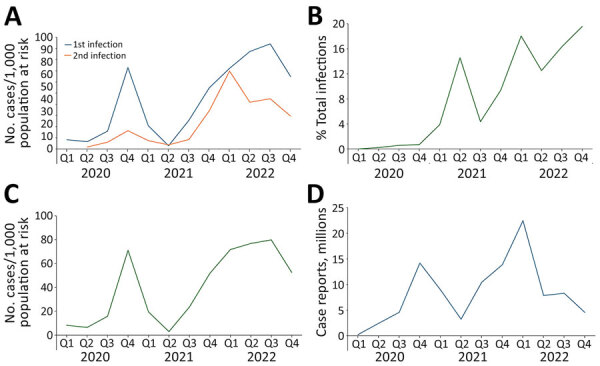 Figure 1
Peer Reviews
No public reviews on file for this paper yet. If you reviewed it on a platform where reviews are public (OpenReview, ICLR, NeurIPS, ICML), you can paste yours below so the community can read it here.
Videos
No videos yet. Explain this paper in a talk, walkthrough, or lecture? Add one.
Taxonomy
TopicsCOVID-19 Clinical Research Studies · SARS-CoV-2 and COVID-19 Research · SARS-CoV-2 detection and testing