A review shows that ATG10 has been identified as a potential prognostic marker and therapeutic target for cancer patients based on real-world studies
Ke Shi, Di Ke, Feng Li, Rong-Shu Shi, Tao Liu, Dan Li, Qun-Xian Zhang

TL;DR
This review highlights how ATG10 contributes to cancer progression and could help predict outcomes or guide treatments for cancer patients.
Contribution
The paper systematically reviews ATG10's role in multiple cancers and its potential as a prognostic marker and therapeutic target.
Findings
ATG10 overexpression is linked to poor prognosis and cancer progression in several malignancies.
ATG10 promotes cancer growth by affecting cell cycle regulators and epithelial-mesenchymal transition.
Multiple factors and microRNAs can inhibit ATG10 activity, offering potential therapeutic strategies.
Abstract
Autophagy-related genes (ATGs) play a crucial role in tumorigenesis and cancer progression. ATG10, a member of the ATG family, has been implicated in various malignancies, including endometrial cancer, hepatocellular carcinoma, acute leukemia, nasopharyngeal carcinoma, gastric cancer and colorectal cancer. Its overexpression is frequently associated with poor prognosis and increased disease progression. ATG10 promotes cancer growth and metastasis by modulating epithelial-mesenchymal transition and cell cycle regulators such as cyclin B1, CDK1 and CDK2. However, its activity can be inhibited by several factors, including DDX10, PTBP1, sodium orthovanadate, podofilox, SIRT6, FAT1, SOX2 and multiple microRNAs (e.g., miR-369-3p, miR-100-3p, miR-27b-3p, miR-197-3p, let-7i-5p and miR-552). This review explores the functional and clinical significance of ATG10 across various cancers,…
Genes, proteins, chemicals, diseases, species, mutations and cell lines named across the full text — each resolved to its canonical identifier and authoritative record.
Click any figure to enlarge with its caption.
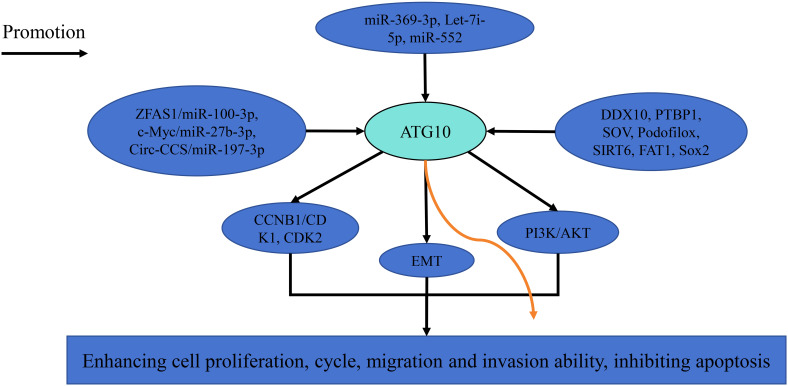 Figure 1
Peer Reviews
No public reviews on file for this paper yet. If you reviewed it on a platform where reviews are public (OpenReview, ICLR, NeurIPS, ICML), you can paste yours below so the community can read it here.
Videos
No videos yet. Explain this paper in a talk, walkthrough, or lecture? Add one.
Taxonomy
TopicsAutophagy in Disease and Therapy · MicroRNA in disease regulation · Circular RNAs in diseases