Synteny Enabled Upgrade of the Galapagos Giant Tortoise Genome Improves Inferences of Runs of Homozygosity
Evelyn L. Jensen, Chiara Marchisio, Alexander Ochoa, Rachel Gray, Vanessa Parra, Joshua M. Miller, F. Gözde Çilingir, Adalgisa Caccone

TL;DR
Scientists improved the genome of a Galapagos giant tortoise using a related species' genome, leading to better inbreeding estimates.
Contribution
A synteny-based genome upgrade for the Galapagos giant tortoise enhances ROH inference without new sequencing.
Findings
The upgraded genome (CheloAbing_2.0) has an N50 two orders of magnitude longer than the previous assembly.
Inbreeding estimates like FROH, NROH, and SROH differ significantly when using the improved genome.
Synteny-based scaffolding is effective for generating contiguous genomes in species with limited high-quality DNA.
Abstract
The utility and importance of whole‐genome sequences are recognized across various fields, including evolution and conservation. However, for some taxa, like extinct species, using methods to generate contiguous genomes that rely on high‐quality DNA is impossible. In such cases, an alternative may be to employ synteny‐based methods using a genome from a closely related taxon to generate more complete genomes. Here we update the reference genome for the Pinta Island Galapagos giant tortoise ( Chelonoidis abingdonii ) without conducting additional sequencing through rescaffolding against the most closely related chromosome‐level genome assembly, the Aldabra giant tortoise ( Aldabrachelys gigantea ). This effort resulted in a much more contiguous genome, CheloAbing_2.0, with an N50 that is two orders of magnitude longer and large reductions in L50 and the number of gaps. We then examined…
Genes, proteins, chemicals, diseases, species, mutations and cell lines named across the full text — each resolved to its canonical identifier and authoritative record.
Click any figure to enlarge with its caption.
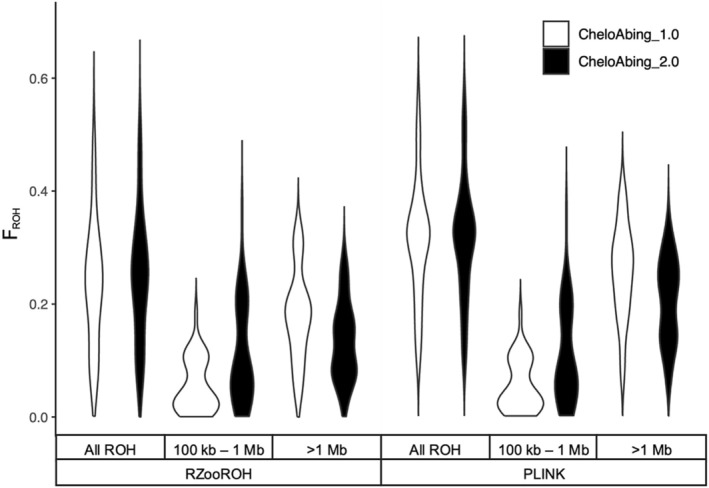 Figure 1
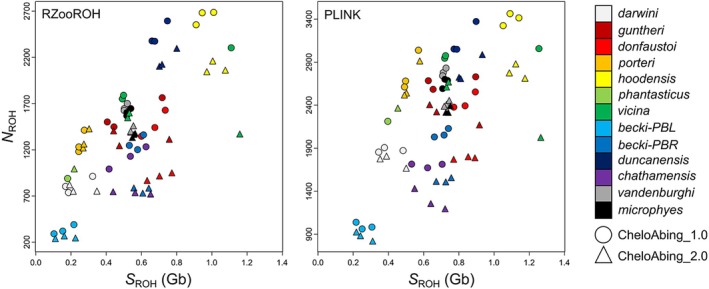 Figure 2
 Figure 3
Peer Reviews
No public reviews on file for this paper yet. If you reviewed it on a platform where reviews are public (OpenReview, ICLR, NeurIPS, ICML), you can paste yours below so the community can read it here.
Videos
No videos yet. Explain this paper in a talk, walkthrough, or lecture? Add one.
Taxonomy
TopicsGenomics and Phylogenetic Studies · Genetic diversity and population structure · Turtle Biology and Conservation