Applications and status of gene drive in plants
Bruce A. Hay

TL;DR
Gene drive in plants can help address issues from globalization and climate change, but plant biology makes it challenging, and self-limiting methods offer a safer approach.
Contribution
The paper discusses the application of gene drive in plants and proposes self-limiting methods as a controlled alternative.
Findings
Gene drive can be used to modify or suppress plant populations for addressing global challenges.
Plant biology features complicate the use of gene drive.
Self-limiting methods offer a controlled and reversible solution.
Abstract
Gene drive can modify or suppress plant populations, offering solutions to challenges associated with globalization and climate change. However, common features of plant biology complicate its application. Self-limiting methods provide a controlled, reversible path forward. Gene drive can modify or suppress plant populations, offering solutions to challenges associated with globalization and climate change. However, common features of plant biology complicate its application. Self-limiting methods provide acontrolled, reversible path forward.
Genes, proteins, chemicals, diseases, species, mutations and cell lines named across the full text — each resolved to its canonical identifier and authoritative record.
Click any figure to enlarge with its caption.
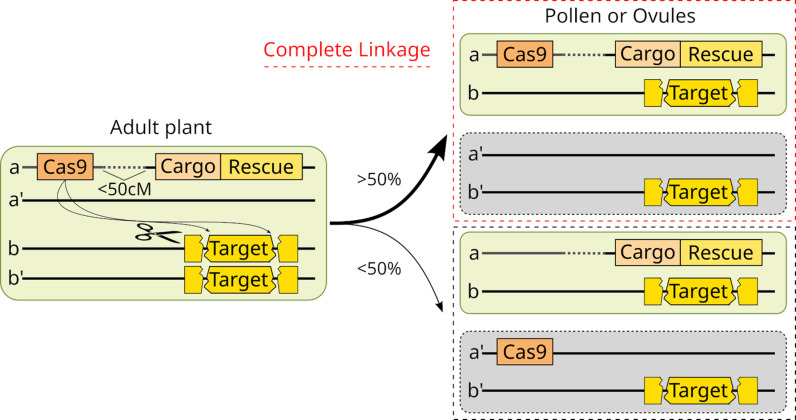 Figure 1
Peer Reviews
No public reviews on file for this paper yet. If you reviewed it on a platform where reviews are public (OpenReview, ICLR, NeurIPS, ICML), you can paste yours below so the community can read it here.
Videos
No videos yet. Explain this paper in a talk, walkthrough, or lecture? Add one.
Taxonomy
TopicsCRISPR and Genetic Engineering · Plant tissue culture and regeneration · Transgenic Plants and Applications