No evidence of positive causal effects of maternal and paternal age at first birth on children’s test scores at age 10 years
Michael Grätz, Felix C. Tropf, Fartein Ask Torvik, Ole A. Andreassen, Torkild H. Lyngstad

TL;DR
This study finds no evidence that older maternal or paternal age at first birth improves children's test scores at age 10.
Contribution
The novel use of Mendelian randomization with polygenic indices provides causal insights into parental age effects on children's education.
Findings
No positive causal effects of maternal age at first birth on children's test scores.
No positive causal effects of paternal age at first birth on children's test scores.
Findings contradict sociological theories predicting benefits of older parental age on child education.
Abstract
Research has shown that higher maternal and paternal age is positively associated with children’s education. Debate continues as to whether these relationships are causal. This is of great interest given the postponement of first births in almost all developed countries during the twentieth century. Here we use an instrumental variable approach (Mendelian randomization) using maternal and paternal polygenic indices (PGIs) for age at first birth—while conditioning on the child’s PGI for age at first birth—to identify the causal effects of maternal and paternal age at first birth on children’s test scores based on data from the Norwegian Mother, Father and Child Cohort study. We do not find evidence of positive causal effects of both maternal and paternal age at first birth on children’s test scores at age 10 years once the children’s PGI and correlations among different PGIs are…
Genes, proteins, chemicals, diseases, species, mutations and cell lines named across the full text — each resolved to its canonical identifier and authoritative record.
Click any figure to enlarge with its caption.
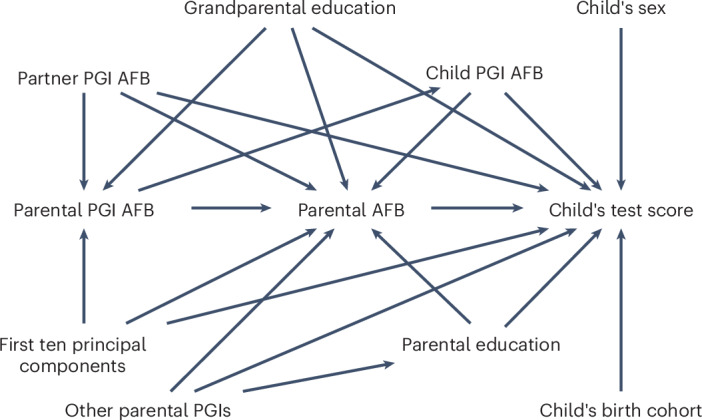 Figure 1
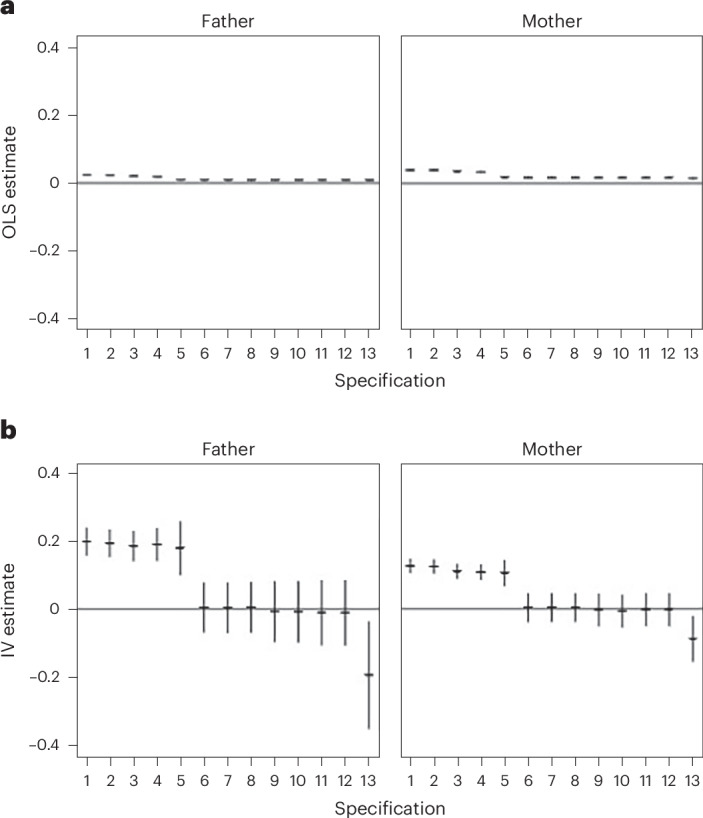 Figure 2
Peer Reviews
No public reviews on file for this paper yet. If you reviewed it on a platform where reviews are public (OpenReview, ICLR, NeurIPS, ICML), you can paste yours below so the community can read it here.
Videos
No videos yet. Explain this paper in a talk, walkthrough, or lecture? Add one.
Taxonomy
TopicsBirth, Development, and Health · Cognitive Abilities and Testing · Demographic Trends and Gender Preferences