Exploring the Roles of Body Dissatisfaction, Cognitive Distraction, and Age in Sexual Distress Related to Sexual Function and Sexual Satisfaction in Men: An Extended Understanding Using a Moderated Mediation Model
Ivanilda B. Costa, Pedro J. Rosa, Patrícia M. Pascoal

TL;DR
This study explores how body dissatisfaction and cognitive distraction affect sexual distress and satisfaction in heterosexual men, finding that age reduces these negative effects.
Contribution
The study extends cognitive models by showing how body dissatisfaction and cognitive distraction relate to sexual outcomes in men, with age as a moderating factor.
Findings
Cognitive distraction mediates the link between body dissatisfaction and sexual distress and satisfaction in men.
The effect of cognitive distraction decreases with age, suggesting age acts as a protective factor.
Body dissatisfaction in heterosexual men has significant negative effects on sexual outcomes.
Abstract
Background/Objectives: Self-objectification theory posits that objectification of people’s bodies, as a synonym for self-worth, translates into body surveillance and dissatisfaction, which has a negative impact on both social and emotional adjustment. According to empirical data based on cognitive models, body dissatisfaction translates into cognitive distraction during sexual activity, affecting sexual response. However, the association of body dissatisfaction with other sexual outcomes, such as satisfaction and distress, in heterosexual men is understudied in comparison to women. Methods: This observational, cross-sectional, and correlational study used a convenience sample of 597 heterosexual males with a mean age of 35.52 (SD = 8.78) obtained through a web survey. Results: Results suggested that cognitive distraction mediated the association between body dissatisfaction, sexual…
Genes, proteins, chemicals, diseases, species, mutations and cell lines named across the full text — each resolved to its canonical identifier and authoritative record.
Click any figure to enlarge with its caption.
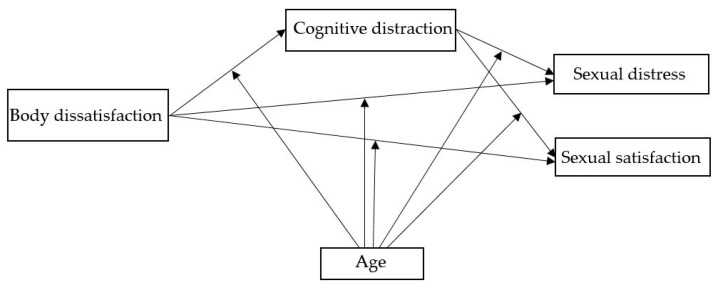 Figure 1
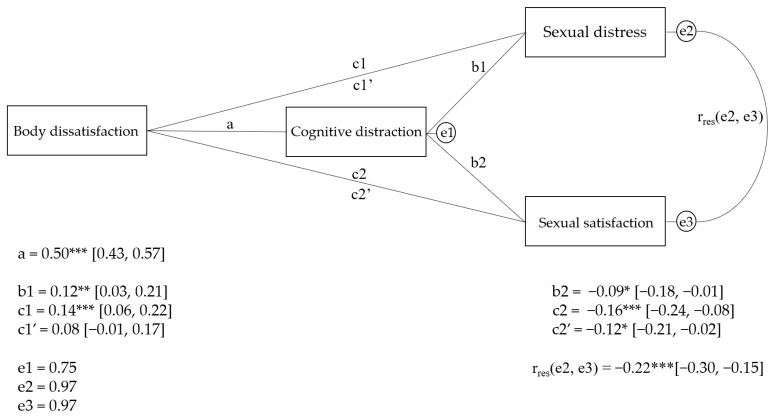 Figure 2
Peer Reviews
No public reviews on file for this paper yet. If you reviewed it on a platform where reviews are public (OpenReview, ICLR, NeurIPS, ICML), you can paste yours below so the community can read it here.
Videos
No videos yet. Explain this paper in a talk, walkthrough, or lecture? Add one.
Taxonomy
TopicsSexual function and dysfunction studies · Sexuality, Behavior, and Technology · Eating Disorders and Behaviors