Autophagy-deficient budding yeast cells are sensitive to freeze-thaw stress
Maria James, Grace K. Klain, Stacey O. Brito, Lupita Trejo, Teresa M. A. Okello, Verónica A. Segarra

TL;DR
This study shows that yeast cells without autophagy are more vulnerable to freeze-thaw stress, highlighting a new role for autophagy in stress survival.
Contribution
The study reveals that autophagy is crucial for yeast survival under freeze-thaw stress, a previously unexplored stress condition.
Findings
Autophagy-deficient yeast cells show increased sensitivity to freeze-thaw stress.
Wild type yeast cells survive freeze-thaw stress better than atg1Δ and atg5Δ mutants.
Abstract
Autophagy enables eukaryotes to recycle damaged and unneeded materials to ensure survival in times of stress such as starvation. However, the full range of cellular stress responses that activate and require autophagy remains unknown. This study has compared the survival of wild type, atg1Δ, and atg5Δ budding yeast cells following freeze-thaw stress. The results indicate that cells deficient in autophagy exhibit enhanced sensitivity to freeze-thaw stress.
Genes, proteins, chemicals, diseases, species, mutations and cell lines named across the full text — each resolved to its canonical identifier and authoritative record.
Click any figure to enlarge with its caption.
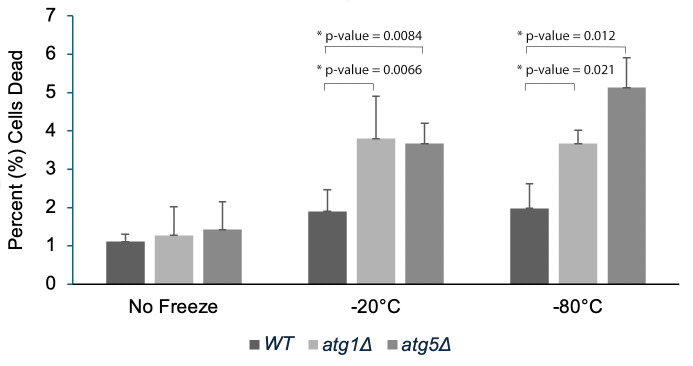 Figure 1
|
|
|
|
|
WT |
|
Giaever et al., 2002 |
|
|
|
Segarra et al., 2015 |
|
|
|
Giaever et al., 2002 |
Peer Reviews
No public reviews on file for this paper yet. If you reviewed it on a platform where reviews are public (OpenReview, ICLR, NeurIPS, ICML), you can paste yours below so the community can read it here.
Videos
No videos yet. Explain this paper in a talk, walkthrough, or lecture? Add one.
Taxonomy
TopicsSoybean genetics and cultivation · Biofuel production and bioconversion · Plant Virus Research Studies
Description
Autophagy is an internal cellular recycling system that helps clear away damage within the cell and repurpose unneeded materials to ensure survival in times of stress. While a role has been identified for autophagy in the responses to nutrient, oxidative, Endoplasmic Reticulum, redox, and hypoxic stress among a few others (Kroemer et al., 2010), the full range of cellular stress responses that rely on autophagy remains unknown. This study has compared the survival of wildtype, atg1Δ , and atg5Δ budding yeast cells following freeze-thaw stress. ATG1 codes for the Atg1p serine/threonine kinase responsible for autophagy induction, which leads to the formation of autophagosomes, the large vesicles unique to autophagy (Matsuura et al., 1997; Straub et al., 1997). ATG5 codes for Atg5p, a component of a conjugation system that is unique to autophagy and plays a role in the expansion and completion of autophagosomes (Mizushima et al., 1998). Null mutations in ATG1 have been shown to abrogate autophagy and are frequently used as a control for the absence of autophagy (Matsuura et al., 1997; Segarra et al., 2015). Null mutations in ATG5 have also been shown to block autophagy in budding yeast (Kim et al., 2016).
The results indicate that mutant cells deficient in autophagy exhibit increased sensitivity to freeze-thaw stress. Figure 1 shows that both atg1Δ and *atg5Δ * yeast cells exhibit increased cell death relative to wildtype yeast upon freeze-thaw stress. This data suggests that autophagy is a contributing factor in yeast cells surviving freeze-thaw stress. Based on these findings, we hypothesize that autophagy is one of the cellular mechanisms used by cells to rid themselves of damage caused by freeze-thaw stress (Cabrera et al. 2020; Brito et al., 2024). Our findings are synergistic with observations by others where autophagic structures were associated with freezing stress in the aquatic Lemna sp. and nival (rocky habitats) *Ranunculus glacialis * plants, as well as *Acer saccharinum * (silver maple) samples *, * as determined by transmission electron microscopy (Steiner et al., 2020; Wesley-Smith et al. 2015). Additional studies are needed to ascertain the relationship between freeze-thaw stress and the triggering of autophagy.
Methods
Manipulation and growth of budding yeast. Standard methods were used for manipulating and growing yeast (Guthrie and Fink 1991). The S. cerevisiae strains used in this study are listed in Table 1 below.
**Table 1. ** Yeast strains used in this study
**: **
*Freeze-thaw stress sensitivity assays. * The protocol was adapted from Chen and Gibney (2022). In short, overnight yeast cultures in rich media (YEPD) were diluted to 3.0 OD 600 units/mL, and 500 μL of yeast cell aliquots were transferred to microcentrifuge tubes. To assess viability before freezing, trypan blue staining was carried out (Strober 2015). Additional aliquots were pelleted by microcentrifugation, and cell pellets were frozen at either −20°C or −80°C. After 8 days at −20°C or −80°C, frozen cell pellets were resuspended in YEPD and stained with trypan blue to determine cell viability. The percentage of dead cells (% dead) was calculated and graphed (Figure 1).
*Statistical analyses. * Four individual biological replicates were carried out. The number of technical replicates within each biological replicate varied between one and three. The average of the biological replicates was calculated and plotted. Standard deviation was calculated and included in the graph as error bars. The p-value to assess statistical significance of difference between WT, atg1Δ, and
- atg5Δ * was calculated using a two-tailed Student’s t-test.
The reference list from the paper itself. Each links out to its DOI / PubMed record.
- 1Brito Stacey Klain Grace Trejo Lupita Okello Teresa Segarra Veronica 202431 Abstract 2045 A role for autophagy in freeze-thaw stress survival Journal of Biological Chemistry 30030021-925810669910669910.1016/j.jbc.2024.106699 · doi ↗
- 2Cabrera E Welch LC Robinson MR Sturgeon CM Crow MM Segarra VA 2020722 Cryopreservation and the Freeze-Thaw Stress Response in Yeast.Genes (Basel)11810.3390/genes 1108083532707778 PMC 7463829 · doi ↗ · pubmed ↗
- 3Chen A Gibney PA 2022720 Intracellular trehalose accumulation via the Agt 1 transporter promotes freeze-thaw tolerance in Saccharomyces cerevisiae.J Appl Microbiol 13341364-50722390240210.1111/jam.1570035801661 · doi ↗ · pubmed ↗
- 4Giaever G Chu AM Ni L Connelly C Riles L Véronneau S Dow S Lucau-Danila A Anderson K AndréB Arkin AP Astromoff A El-Bakkoury M Bangham R Benito R Brachat S Campanaro S Curtiss M Davis K Deutschbauer A Entian KD Flaherty P Foury F Garfinkel DJ Gerstein M Gotte D Güldener U Hegemann JH Hempel S Herman Z Jaramillo DF Kelly DE Kelly SL Kötter P La Bonte D Lamb DC Lan N Liang H Liao H Liu L Luo C Lussier M Mao R Menard P Ooi SL Revuelta JL Roberts CJ Rose M Ross-Macdonald P Scherens B Schimmack G Shafer B Shoemaker DD Sookhai-Mahadeo S Storms RK Strather · doi ↗ · pubmed ↗
- 51991 Guide to yeast genetics and molecular biology.Methods Enzymol 1940076-687918632005781 · pubmed ↗
- 6Kim M Sandford E Gatica D Qiu Y Liu X Zheng Y Schulman BA Xu J Semple I Ro SH Kim B Mavioglu RN Tolun A Jipa A Takats S Karpati M Li JZ Yapici Z Juhasz G Lee JH Klionsky DJ Burmeister M 2016126 Mutation in ATG 5 reduces autophagy and leads to ataxia with developmental delay.Elife 510.7554/e Life.1224526812546 PMC 4786408 · doi ↗ · pubmed ↗
- 7Kroemer G Mariño G Levine B 20101022 Autophagy and the integrated stress response.Mol Cell 4021097-276528029310.1016/j.molcel.2010.09.02320965422 PMC 3127250 · doi ↗ · pubmed ↗
- 8Matsuura A Tsukada M Wada Y Ohsumi Y 1997619 Apg 1p, a novel protein kinase required for the autophagic process in Saccharomyces cerevisiae.Gene 19220378-111924525010.1016/s 0378-1119(97)00084-x 9224897 · doi ↗ · pubmed ↗