Genome sequence of cluster F1 Mycobacterium smegmatis phage Fastidio
Matthew N. Jackson, Hyunbi Hwang, Payson C. Danielson, Ethan Walbom, Jayden Longhurst, Bartel Van Oostendorp, Christopher C. Harrell, Austin M. Johnson, Natalie A. Olsen, Parker Danielson, Thomas Wilhite, Jeffrey K. Schachterle, Staci Avery, Donald P. Breakwell, Brett E. Pickett

TL;DR
This paper presents the genome sequence of a new bacteriophage called Fastidio that infects a specific strain of Mycobacterium smegmatis.
Contribution
The study contributes a newly annotated genome of a Mycobacterium smegmatis phage with potential novel genes.
Findings
Fastidio's genome is 55,839 base pairs long.
The genome contains several putative novel open reading frames.
The study enhances understanding of phage diversity in Mycobacterium smegmatis.
Abstract
Fastidio is an F1 subcluster bacteriophage in the Caudoviricetes class, infecting Mycobacterium smegmatis strain mc²155. The genome is 55,839 base pairs in length and contains several putative novel open reading frames. The isolation, annotation, and analysis of Fastidio, together with other bacteriophages, improve our knowledge of phage diversity.
Genes, proteins, chemicals, diseases, species, mutations and cell lines named across the full text — each resolved to its canonical identifier and authoritative record.
Click any figure to enlarge with its caption.
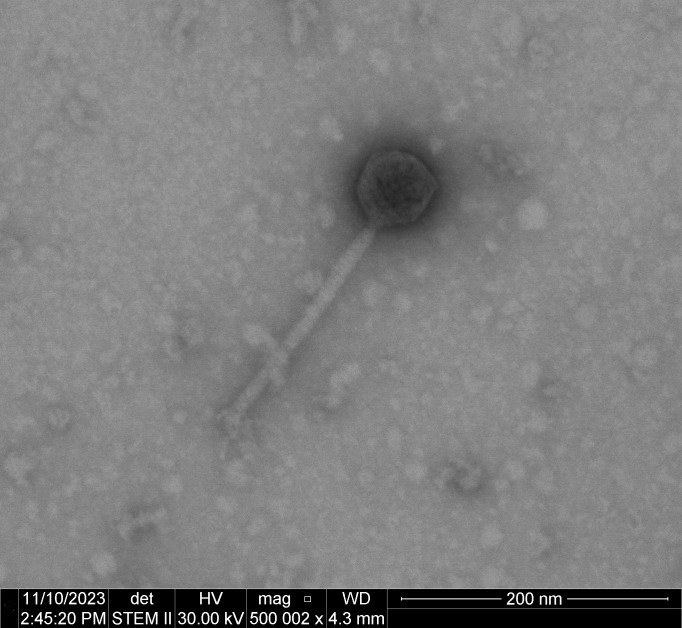 Fig 1
Fig 1Peer Reviews
No public reviews on file for this paper yet. If you reviewed it on a platform where reviews are public (OpenReview, ICLR, NeurIPS, ICML), you can paste yours below so the community can read it here.
Videos
No videos yet. Explain this paper in a talk, walkthrough, or lecture? Add one.
Taxonomy
TopicsBacteriophages and microbial interactions · Mycobacterium research and diagnosis · Genomics and Phylogenetic Studies
ANNOUNCEMENT
Fastidio was isolated from a soil sample collected in Provo, UT, USA (GPS: 40.214582 N, 111.618295 W). The sample was suspended in 7H9 broth and filtered through a 0.22 µm filter. An aliquot was used to infect host cells, mixed with top agar and then plated on 7H10 agar prior to incubation at 37°C. Resulting plaques were picked using a sterile micropipette tip, and high-titer lysates were prepared following three rounds of purification. High-titer lysate was sent to CD Genomics (Beverly, NY, USA), where 0.5 µg DNA was extracted using the Phage DNA Isolation Kit (Norgen) protocol prior to DNA sequencing. NEBNext Ultra DNA Library Prep Kit for Illumina (NEB, USA) was used following the manufacturer’s recommendations, and indices were used. DNA samples were sonicated to 350 bp, end-polished, A-tailed, and ligated with the full-length adaptor for sequencing. The product was purified (AMPure XP system) and quantified with an Agilent 2100 Bioanalyzer and qPCR. Approximately 1.3 million 150-bp paired-end reads were generated using the Illumina NovaSeq X instrument. TrimGalore was applied with a minimum length of 20 bases and a minimum Phred score of 20 (1). Then, de novo assembly of the reads was performed using CONSED 2.9 (2) with Unicycler version 0.5.0 (3), resulting in a 55,839 base pair genome (3,593× coverage) with 61.6% G + C content.
Fastidio is predicted to be a temperate phage by cluster sequence homology and has siphovirus-like morphology. It has a long, non-contractile tail with an icosahedral head (Fig. 1), which is characteristic of the Caudoviricetes class. This phage generally forms cloudy plaques within 2–3 days of isolation. The genome is predicted to replicate through a 10 base pair 3′ sticky overhang. The Fastidio phage was assigned to the F1 phage subcluster by phagesDB (4) (https://phagesdb.org/) through best-match nucleotide sequence homology searches.
Negative-stained transmission electron micrograph of the Fastidio phage (500,000× magnification and 20 kV accelerating voltage, Tecnai TF-20).
The genome of Fastidio was initially auto-annotated using Glimmer version 3.0 and GeneMark 2.5 (5, 6) and then refined in DNA Master (7). Briefly, this refinement entailed using Starterator, Phamerator (8), PhageScope (9), tRNAscanSE (10), HHPRED (11), and BLASTp (12) (with default parameters) to capture data that support the presence, location, and start/stop sites for putative open reading frames using criteria specified by the Science Education Alliance-Phage Hunters Advancing Genomics and Evolutionary Science program. The genome contained 105 putative protein-coding genes and a single tRNA gene. We also compared genes across the F1 subcluster and identified a total of three potentially novel open reading frames in this genome, including gp26, gp100, and gp105.
The reference list from the paper itself. Each links out to its DOI / PubMed record.
- 1Felix Krueger/Trim Galore: a wrapper around cutadapt and Fast QC to consistently apply adapter and quality trimming to Fast Q files, with extra functionality for RRBS data. 2025 Git Hub. https://github.com/Felix Krueger/Trim Galore.
- 2Gordon D, Green P. 2013. Consed: a graphical editor for next-generation sequencing. Bioinformatics 29:2936–2937. doi:10.1093/bioinformatics/btt 51523995391 PMC 3810858 · doi ↗ · pubmed ↗
- 3Wick RR, Judd LM, Gorrie CL, Holt KE. 2017. Unicycler: resolving bacterial genome assemblies from short and long sequencing reads. P Lo S Comput Biol 13:e 1005595. doi:10.1371/journal.pcbi.100559528594827 PMC 5481147 · doi ↗ · pubmed ↗
- 4Russell DA, Hatfull GF. 2017. Phages DB: the actinobacteriophage database. Bioinformatics 33:784–786. doi:10.1093/bioinformatics/btw 71128365761 PMC 5860397 · doi ↗ · pubmed ↗
- 5Delcher AL, Bratke KA, Powers EC, Salzberg SL. 2007. Identifying bacterial genes and endosymbiont DNA with Glimmer. Bioinformatics 23:673–679. doi:10.1093/bioinformatics/btm 00917237039 PMC 2387122 · doi ↗ · pubmed ↗
- 6Besemer J, Borodovsky M. 2005. Gene Mark: web software for gene finding in prokaryotes, eukaryotes and viruses. Nucleic Acids Res 33:W 451–4. doi:10.1093/nar/gki 48715980510 PMC 1160247 · doi ↗ · pubmed ↗
- 7Pope WH, Jacobs-Sera D. 2018. Annotation of bacteriophage genome sequences using DNA master: an overview. Methods Mol Biol 1681:217–229. doi:10.1007/978-1-4939-7343-9_1629134598 · doi ↗ · pubmed ↗
- 8Cresawn SG, Bogel M, Day N, Jacobs-Sera D, Hendrix RW, Hatfull GF. 2011. Phamerator: a bioinformatic tool for comparative bacteriophage genomics. BMC Bioinformatics 12:395. doi:10.1186/1471-2105-12-39521991981 PMC 3233612 · doi ↗ · pubmed ↗