Closed genome sequence of Fretibacterium fastidiosum, a potential contributor to periodontal disease
Asuka Mori, Mashu Kudoh, Masae Kuboniwa, Christian Rückert-Reed, Tobias Busche, Marion Eisenhut, Eiichiro Fukusaki, Andrea Bräutigam, Bianca Laker

TL;DR
This paper presents the complete genome sequence of Fretibacterium fastidiosum, a newly identified oral bacterium linked to periodontal disease.
Contribution
The study provides the first closed genome sequence of Fretibacterium fastidiosum, enabling further research into its role in oral health.
Findings
The closed genome sequence of Fretibacterium fastidiosum was successfully obtained.
This bacterium is a recently identified member of the human oral microbiome.
The genome data may help understand its potential contribution to periodontal disease.
Abstract
Human oral microbiome consists of diverse bacteria. Not all oral bacteria are well characterized due to challenges in cultivation in vitro. In this study, we report the closed genome sequence of one of the recently identified oral bacteria, Fretibacterium fastidiosum.
Genes, proteins, chemicals, diseases, species, mutations and cell lines named across the full text — each resolved to its canonical identifier and authoritative record.
Click any figure to enlarge with its caption.
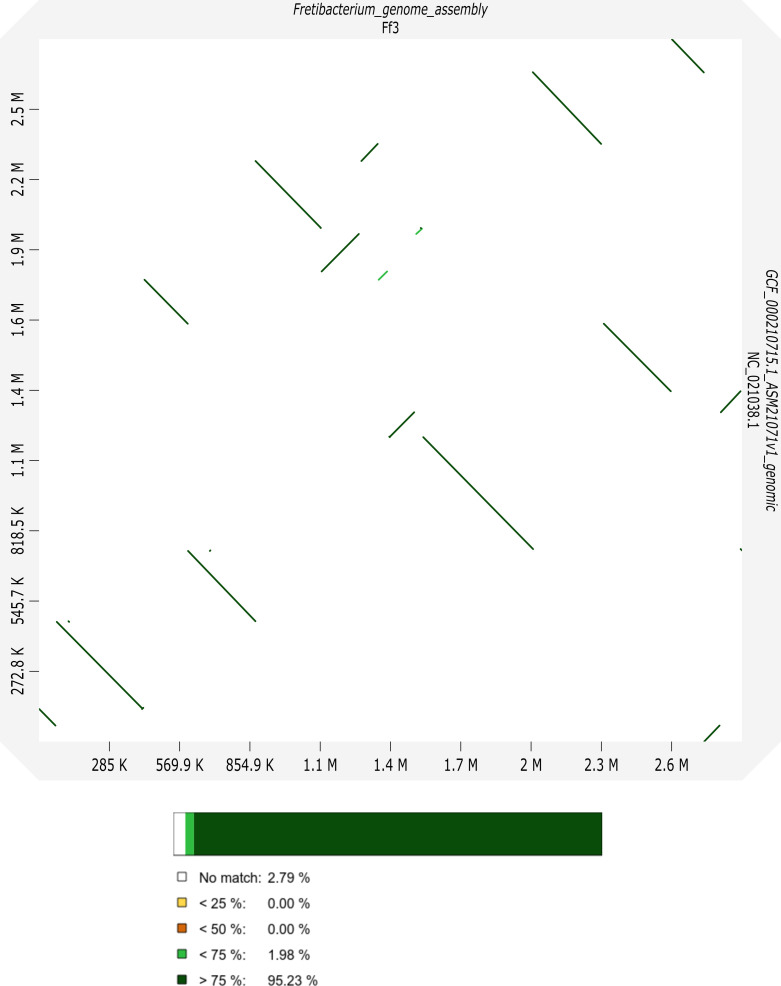 Fig 1
Fig 1| Parameter | Finding for | |
|---|---|---|
| Number of contigs | 1 | 1 |
| Length (bp) | 2,849,698 | 2,166,339 |
| GC content (%) | 63.17 | 27.12 |
| Genome coverage (x) | 109 | 584 |
| Total no. of genes | 2,477 | 2,068 |
| No. of protein-coding genes | 2,418 | 2,005 |
| No. of rRNAs | 9 | 15 |
| No. of tRNAs | 49 | 47 |
| No. of transfer messenger RNAs | 1 | 1 |
| BUSCO results (%) | ||
| Complete | 82.3 | 99.2 |
| Single copy | 81.5 | 99.2 |
| Duplicated | 0.8 | 0.0 |
| Fragmented | 0.3 | 0.2 |
| Missing | 17.4 | 0.6 |
Peer Reviews
No public reviews on file for this paper yet. If you reviewed it on a platform where reviews are public (OpenReview, ICLR, NeurIPS, ICML), you can paste yours below so the community can read it here.
Videos
No videos yet. Explain this paper in a talk, walkthrough, or lecture? Add one.
Taxonomy
TopicsGenomics and Phylogenetic Studies · Enzyme Production and Characterization · Bacteriophages and microbial interactions
ANNOUNCEMENT
Oral microbiome comprises more than 700 bacterial species (1). Over a third of these are yet uncultivated (2). Fretibacterium fastidiosum, previously uncultivated, requires stimulation by other oral bacteria for growth in broth culture and is possibly linked to periodontal disease (3–7). To further understand the association of this bacterium to periodontal disease, we here provide a contiguous genome sequence of F. fastidiosum SGP1. The existing reference strain genome, deposited under GenBank accession number GCA_000210715.1, consists of 362 contigs with 9.95% Ns.
F. fastidiosum SGP1 was obtained from the Japan Collection of Microorganisms (JCM:16858) and was cultivated using the same method proposed by Vartoukian et al. with some modifications (8). Briefly, F. fastidiosum was first cultured on blood agar plates cross-streaked with Fusobacterium nucleatum ATCC 25586 (from JCM:8532) to stimulate its growth. Colonies were transferred into Nutrient Broth no. 2 supplemented with 1% yeast extract, 0.1% l-cysteine hydrochloride hydrate, and filtered culture supernatants (50%, v/v) from broth cultures of F. nucleatum. Then, 2 × 10^9^ cells were collected by centrifugation. DNA was isolated using the Maxwell RSC Cultured Cells DNA Kit (Promega, Madison, Wisconsin, US) and Maxwell RSC Instrument (Promega). The DNA quality and quantity were assessed with the Tape Station (Agilent) and the Qubit fluorometer (Invitrogen). Sequencing libraries were prepared with the Ligation sequencing gDNA - Native Barcoding Kit 24 V14 (SQK-NBD114.24; Oxford Nanopore Technologies [ONT], Oxford, UK) following the manufacturer’s protocol. In the clean-up step, the long fragment buffer was used. One R10.4.1 flow cell was run for 19.5 h on a GridION (ONT). Bases were called using Dorado v7.2.13 with model [email protected] (ONT), producing 410,040 raw reads with an N50 of 6,365 bp. All programs were run with default parameters unless otherwise specified.
Adapter trimming was performed with cutadapt v4.8 setting “-e 0.2 --trimmed-only” with “-g AAGGTTAANNNNNNNNNNNNNNNNNNNNNNNNCAGCACCT” for 5′ adapter and “-a AGGTGCTGNNNNNNNNNNNNNNNNNNNNNNNNTTAACCTTAGCAAT” for 3′ adapter (9). A genome assembly was calculated with Flye v2.9.5 in assembly mode meta (10) and polished with racon v1.5.0 (11) and minimap v2.26 setting parameter “-ax map-ont” (12) and Medaka v2.0.1 setting “-m r1041_e82_400bps_sup_v4.2.0” (ONT). Overhangs were trimmed with Berokka v0.2.3 (https://github.com/tseemann/berokka), duplicated sequences were discarded with Circlator clean v1.5.5 (13), and sequences were adjusted to start at dnaA with Circlator fixstart. Phylogenetic classification was performed with the Type (Strain) Genome Server (TYGS) (14) and with BLASTN v2.16.1+ (WebBLAST) using the database core_nt (15, 16). Genome completeness was measured with benchmarking universal single-copy orthologs (BUSCO) v5.6.1 in mode geno (17). Genes were annotated with Prokka v1.14.6 (18), and dot plots were created with D-Genies v1.5.0 (19).
The genome of F. fastidiosum SGP1 and of F. nucleatum ATCC 25586 were both circularly assembled and have a high number of BUSCO genes for Synergistota (F. fastidiosum) or Fusobacteriales (F. nucleatum), classifying them as complete genome sequences. Relevant statistics are listed in Table 1. Figure 1 shows the comparison between the reported genome of F. fastidiosum SGP1 and the gapped reference genome sequence of the same strain (GenBank accession number GCA_000210715.1).
Sequence comparison between the reported circular genome contig of F. fastidiosum SGP1 (x-axis) and the gapped reference genome sequence of the same strain (GenBank accession number GCA_000210715.1; y-axis). The color code for the dot plot with alignment identities in percent is shown as a bar graph.
The reference list from the paper itself. Each links out to its DOI / PubMed record.
- 1Baker JL, Mark Welch JL, Kauffman KM, Mc Lean JS, He X. 2024. The oral microbiome: diversity, biogeography and human health. Nat Rev Microbiol 22:89–104. doi:10.1038/s 41579-023-00963-637700024 PMC 11084736 · doi ↗ · pubmed ↗
- 2Vartoukian SR, Adamowska A, Lawlor M, Moazzez R, Dewhirst FE, Wade WG. 2016. In vitro cultivation of “unculturable” oral bacteria, facilitated by community culture and media supplementation with siderophores. P Lo S One 11:e 0146926. doi:10.1371/journal.pone.014692626764907 PMC 4713201 · doi ↗ · pubmed ↗
- 3Vartoukian SR, Palmer RM, Wade WG. 2010. Cultivation of a synergistetes strain representing a previously uncultivated lineage. Environ Microbiol 12:916–928. doi:10.1111/j.1462-2920.2009.02135.x 20074237 PMC 2916210 · doi ↗ · pubmed ↗
- 4Park O-J, Yi H, Jeon JH, Kang S-S, Koo K-T, Kum K-Y, Chun J, Yun C-H, Han SH. 2015. Pyrosequencing analysis of subgingival microbiota in distinct periodontal conditions. J Dent Res 94:921–927. doi:10.1177/002203451558353125904141 · doi ↗ · pubmed ↗
- 5Oliveira R, Fermiano D, Feres M, Figueiredo LC, Teles FRF, Soares GMS, Faveri M. 2016. Levels of candidate periodontal pathogens in subgingival biofilm. J Dent Res 95:711–718. doi:10.1177/002203451663461926936213 PMC 4924544 · doi ↗ · pubmed ↗
- 6Mc Cracken BA, Nathalia Garcia M. 2021. Phylum synergistetes in the oral cavity: a possible contributor to periodontal disease. Anaerobe 68:102250. doi:10.1016/j.anaerobe.2020.10225032791127 · doi ↗ · pubmed ↗
- 7Chen T, Marsh PD, Al-Hebshi NN. 2022. SMDI: an index for measuring subgingival microbial dysbiosis. J Dent Res 101:331–338. doi:10.1177/0022034521103577534428955 PMC 8982011 · doi ↗ · pubmed ↗
- 8Vartoukian SR, Downes J, Palmer RM, Wade WG. 2013. Fretibacterium fastidiosum gen. nov., sp. nov., isolated from the human oral cavity. Int J Syst Evol Microbiol 63:458–463. doi:10.1099/ijs.0.041038-022493171 · doi ↗ · pubmed ↗