Amplicon microbiome sequencing of compost from conventional and redesigned compost buckets
Elizabeth Klosko, Elizabeth Hutchison, Ahmad Almomani

TL;DR
This study compares the microbial communities in compost from two types of buckets and finds no significant difference based on bucket shape.
Contribution
The novelty lies in using amplicon sequencing to evaluate the impact of compost bucket design on microbial communities.
Findings
Proteobacteria and Firmicutes were the dominant bacterial phyla in the compost.
Ascomycota was the primary fungal phylum identified.
Bucket shape had no significant effect on microbial community composition.
Abstract
Here, we report using amplicon sequencing to assess microbial growth in both conventional and pyramid-shaped compost buckets. Proteobacteria and Firmicutes were the primary bacterial phyla present, and Ascomycota the primary fungal phylum present. Bucket shape did not significantly affect microbial community composition.
Genes, proteins, chemicals, diseases, species, mutations and cell lines named across the full text — each resolved to its canonical identifier and authoritative record.
Click any figure to enlarge with its caption.
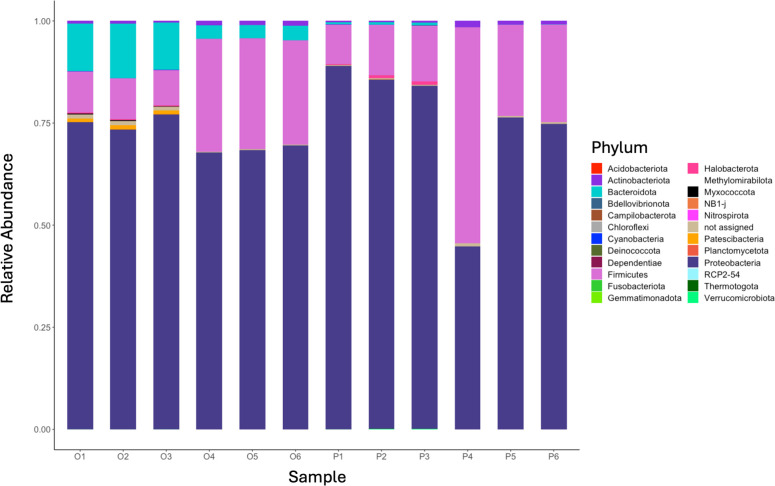 Fig 1
Fig 1| Sequencing type | Sample | Total read pairs | % Basepairs > Q30 | Average read lengths (bp) |
|---|---|---|---|---|
| Bacterial | 1O | 322,697 | 88.3 | 301 |
| 2O | 358,503 | 88.6 | 301 | |
| 3O | 342,570 | 89 | 301 | |
| 4O | 192,907 | 92.6 | 301 | |
| 5O | 222,850 | 92.6 | 301 | |
| 6O | 197,928 | 93 | 301 | |
| 1P | 274,715 | 87.5 | 301 | |
| 2P | 363,238 | 89.3 | 301 | |
| 3P | 316,438 | 88.8 | 301 | |
| 4P | 119,773 | 93.1 | 301 | |
| 5P | 139,270 | 88.6 | 301 | |
| 6P | 204,874 | 93 | 301 | |
| Fungal | 1O | 249,971 | 88.4 | 301 |
| 5O | 86,781 | 88.9 | 301 | |
| 2P | 272,943 | 89.1 | 301 | |
| 5P | 116,380 | 88.6 | 301 |
Peer Reviews
No public reviews on file for this paper yet. If you reviewed it on a platform where reviews are public (OpenReview, ICLR, NeurIPS, ICML), you can paste yours below so the community can read it here.
Videos
No videos yet. Explain this paper in a talk, walkthrough, or lecture? Add one.
Taxonomy
TopicsComposting and Vermicomposting Techniques · Biofuel production and bioconversion · Anaerobic Digestion and Biogas Production
ANNOUNCEMENT
Composting is the controlled decomposition of organic wastes into nutrient-rich biological metabolites, and it has many environmental benefits (1). One barrier to increasing composting use is compost odor (2). Microbes are integral to composting and produce waste products that contribute to compost odors (3). Previous studies indicated potentially reduced microbial growth on compost if contained in a pyramid shape (4, 5). We designed a new, pyramid-shaped compost bucket for the SUNY Geneseo campus (14454, NY). DNA extracted from compost was used to assess microbial composition in conventional and pyramid-shaped buckets.
Poll data from campus compost bucket users informed our ingredient ratios: banana (45.8%), stewed vegetables (28.5%), tomato (23.1%), compostable take-out container (1.93%), and napkin (0.67%). Compost was blended with sterile water (1:1 wt/vol) after 4 weeks and flash frozen at −80°C in 0.5 g aliquots. Bead beating (1 min, 0.25 g of 0.5 mm glass beads) using a mini bead beater (BioSpec) and 10 min of vortexing was performed prior to extraction. DNA was extracted using a Qiagen DNeasy PowerSoil Kit according to the manufacturer’s protocol. Three extractions were pooled for each sample to maximize DNA yield. Three samples were extracted for each bucket type and sent to SeqCenter (Pittsburgh, PA) for 16S rRNA and ITS sequencing. The entire experiment was repeated once for an additional biological replicate.
SeqCenter prepared samples using Zymo Research’s Quick-16S kit with primers targeting the 16S gene V3/V4 regions for bacterial sequencing (forward: CCTACGGGDGGCWGCAG, CCTAYGGGGYGCWGCAG; reverse: GACTACHVGGGTATCTAATCC, GACTACNVGGGTMTCTAATCC). Fungal samples were prepared using Zymo Research’s Quick-ITS kit with primers targeting the ITS2 region (forward: GCATCGATGAAGAACGCAGC; reverse: TCCTCCGCTTATTGATATGC). After clean-up and normalization, samples were sequenced on a P1 600 cycle NextSeq2000 flowcell to generate 2 × 301 bp paired-end reads, and outputs are summarized in Table 1. For 16S rRNA data, primers were removed using cutadapt (v.4.4) (6), and analyzed using the pipeline described in Lee ( 7). DADA2 (v.1.32.0) (8) was used to generate amplicon sequence variants (ASVs) and taxonomy assigned using the SILVA v138 database (9). Data were imported into phyloseq (v.1.48.0) (10) for additional analysis, and DeSeq2 (v.1.44.0) was used to test for differences in ASV abundance (11). The pipeline was carried out in R (v.4.4.0) (12), and ggplot2 (v. 3.5.1) (13) was used for data visualization. Fungal ITS analysis was performed via SeqCenter using bcl-convert (v.4.1.5) and Qiime2 (v.2021.11) (14). For all software, default parameters were used unless otherwise noted.
Major bacterial phyla observed were Proteobacteria and Firmicutes (Fig. 1), and the major fungal phylum observed was Ascomycota. Results are consistent with previous observations of compost microbiomes (15, 16), and significant differences were not observed between bucket types.
Relative ASV abundance in original (O) and pyramid (P) shaped compost buckets. Samples 1–3 are from the first biological replicate, and samples 4–6 are from the second biological replicate.
The reference list from the paper itself. Each links out to its DOI / PubMed record.
- 1Rynk R, Black G, Gilbert J, Biala J, Bonhotal J, Schwarz M. 2021. The composting handbook: a how-to and why manual for farm, municipal, institutional and commercial composters. Academic Press, Cambridge (MA).
- 2Allison AL, Lorencatto F, Michie S, Miodownik M. 2022. Barriers and enablers to food waste recycling: a mixed methods study amongst UK citizens. Int J Environ Res Public Health 19:2729. doi:10.3390/ijerph 1905272935270421 PMC 8910430 · doi ↗ · pubmed ↗
- 3Insam H, Seewald MSA. 2010. Volatile organic compounds (VO Cs) in soils. Biol Fertil Soils 46:199–213. doi:10.1007/s 00374-010-0442-3 · doi ↗
- 4Gopinath R, Nagaraja PA, Nagendra H. 2008. The effect of pyramids on preservation of milk. Indian Journal of Traditional Knowledge 7:233. http://nopr.niscpr.res.in/handle/123456789/1582.
- 5Abdelsamie MAA, Rahman RA, Mustafa S. 2014. Pyramid shape power as a new halal-compliant food preservation and packaging technique. Procedia - Social and Behavioral Sciences 121:232–242. doi:10.1016/j.sbspro.2014.01.1124 · doi ↗
- 6Martin M. 2011. Cutadapt removes adapter sequences from high-throughput sequencing reads. EM Bnet j 17:10. doi:10.14806/ej.17.1.200 · doi ↗
- 7Lee Michael. 2019. Happy Belly Bioinformatics: an open-source resource dedicated to helping biologists utilize bioinformatics. JOSE 2:53. doi:10.21105/jose.00053 · doi ↗
- 8Callahan BJ, Mc Murdie PJ, Rosen MJ, Han AW, Johnson AJA, Holmes SP. 2016. DADA 2: High-resolution sample inference from Illumina amplicon data. Nat Methods 13:581–583. doi:10.1038/nmeth.386927214047 PMC 4927377 · doi ↗ · pubmed ↗