Trends, key contributors, and emerging issues in honey and breast cancer: A bibliometric analysis from 2014 to 2024
Andi Nilawati Usman, Fendi Fendi, Zafitri Nulandari, Dinah Inrawati Agustin, Mogana Das Murtey

TL;DR
This study explores how honey might help in breast cancer treatment by analyzing scientific research trends from 2014 to 2024.
Contribution
The paper introduces a bibliometric analysis of honey's role in breast cancer, highlighting emerging research directions and key journals.
Findings
Nine distinct research clusters were identified, showing diverse approaches to honey's anticancer potential.
Key journals like the Journal of Ethnopharmacology have driven interdisciplinary research in this area.
Emerging topics include cerium oxide nanoparticles and selenium nanoconstructs for cancer treatment.
Abstract
Honey, a natural product with diverse bioactive compounds, has been increasingly explored for its potential anticancer properties. This study aims to comprehensively analyze the scientific literature on the relationship between honey and breast cancer. A bibliometric analysis was conducted using the ScienceDirect database to identify publications from 2014 to 2024. Data on publication trends, author collaboration, and keyword analysis were extracted to gain insight into the research landscape. Keyword analysis identified nine distinct clusters, indicating diverse research directions regarding the role of honey in breast cancer treatment. Key journals such as the Journal of Ethnopharmacology and Food Chemistry have been at the forefront of disseminating research findings in this domain, demonstrating a strong interdisciplinary approach that bridges traditional medicine and modern…
Genes, proteins, chemicals, diseases, species, mutations and cell lines named across the full text — each resolved to its canonical identifier and authoritative record.
Click any figure to enlarge with its caption.
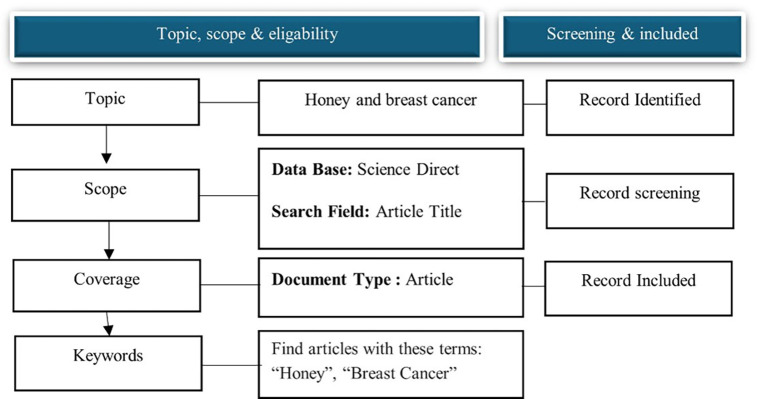 Figure 1
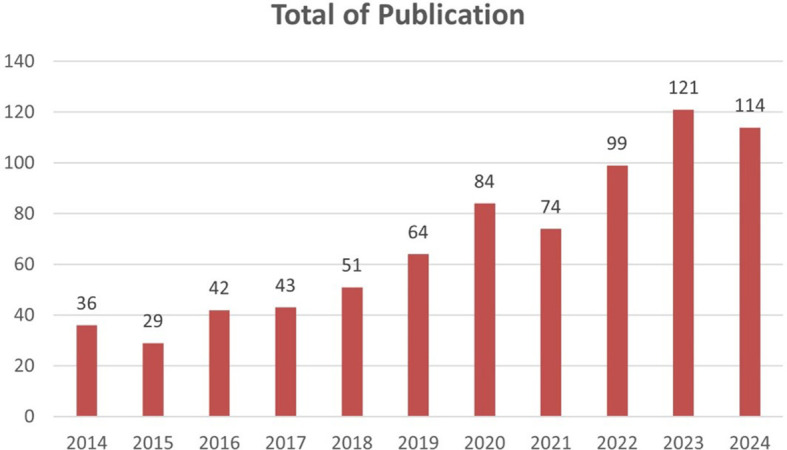 Figure 2
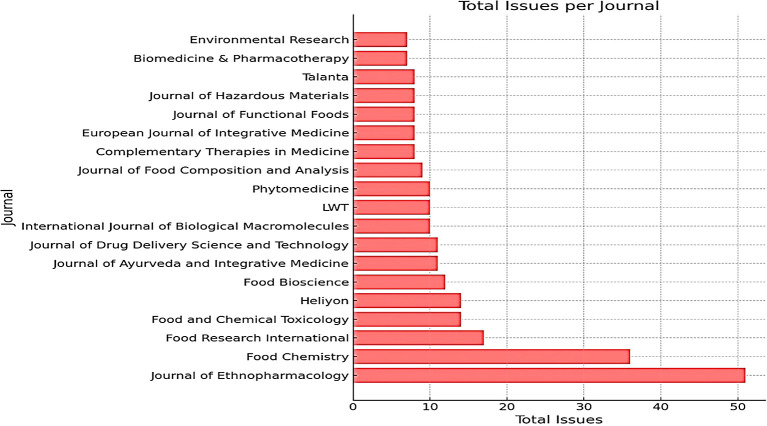 Figure 3
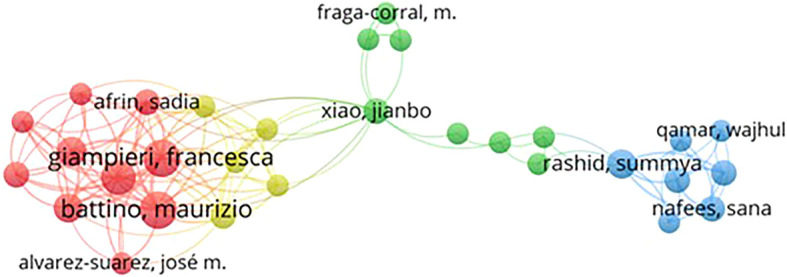 Figure 4
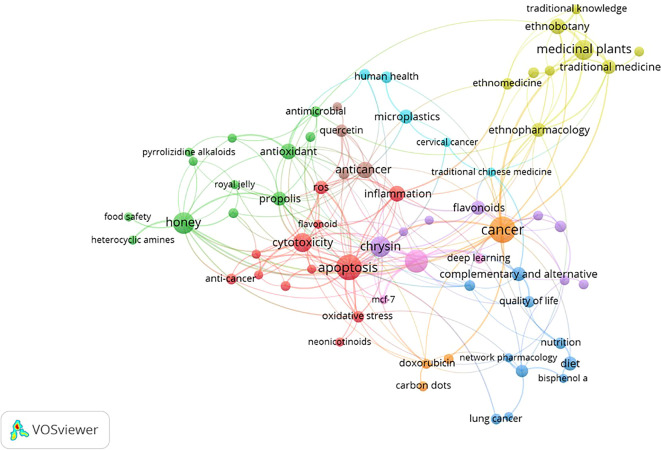 Figure 5
| Journal | Total number of issues |
|---|---|
| Journal of Ethnopharmacology | 51 |
| Food Chemistry | 36 |
| Food Research International | 17 |
| Food and Chemical Toxicology | 14 |
| Heliyon | 14 |
| Food Bioscience | 12 |
| Journal of Ayurveda and Integrative Medicine | 11 |
| Journal of Drug Delivery Science and Technology | 11 |
| International Journal of Biological Macromolecules | 10 |
| LWT | 10 |
| Phytomedicine | 10 |
| Journal of Food Composition and Analysis | 9 |
| Complementary Therapies in Medicine | 8 |
| European Journal of Integrative Medicine | 8 |
| Journal of Functional Foods | 8 |
| Journal of Hazardous Materials | 8 |
| Talanta | 8 |
| Biomedicine & Pharmacotherapy | 7 |
| Environmental Research | 7 |
| Label | Total Link Strength | Links | Documents | Cluster |
|---|---|---|---|---|
| Arifin, Sadia | 24 | 14 | 3 | 1 |
| Alvarez-suarez, jose m | 9 | 6 | 2 | 1 |
| Battino, Maurizio | 44 | 15 | 7 | 1 |
| Cianciosi, Danila | 39 | 15 | 6 | 1 |
| Giampieri, Francesca | 44 | 15 | 7 | 1 |
| Xiao, Jianbo | 14 | 14 | 3 | 2 |
| Rashid, Summya | 17 | 9 | 4 | 2 |
| Fraga-corral, m. | 5 | 3 | 2 | 2 |
| Nafees, Sana | 14 | 6 | 3 | 3 |
| Qamar, wajhul | 5 | 5 | 2 | 3 |
| Cluster | Keywords (Color) | Connections | Reference |
|---|---|---|---|
|
|
|
|
|
|
|
|
|
|
|
|
|
|
|
| Label | Total link strength | Links | Occurrences | Cluster |
|---|---|---|---|---|
| Anti-cancer | 4 | 5 | 7 | 1 |
| Apoptosis | 26 | 24 | 37 | 1 |
| Inflammation | 9 | 13 | 14 | 1 |
| Oxidative stress | 7 | 10 | 8 | 1 |
| Anti-inflammatory | 4 | 5 | 5 | 2 |
| Antimicrobial | 5 | 8 | 7 | 2 |
| Antioxidant | 10 | 15 | 14 | 2 |
| Honey | 16 | 15 | 26 | 2 |
| Propolis | 9 | 15 | 11 | 2 |
| Antibacterial activity | 2 | 2 | 5 | 3 |
| Chemotherapy | 5 | 10 | 7 | 3 |
| Quality of life | 3 | 4 | 8 | 3 |
| Lung cancer | 2 | 2 | 7 | 3 |
| Ethnopharmacology | 9 | 11 | 11 | 4 |
| Traditional healers | 3 | 5 | 7 | 4 |
| Traditional medicine | 10 | 7 | 12 | 4 |
| Bioavailability | 2 | 3 | 5 | 5 |
| Pharmacology | 1 | 1 | 6 | 5 |
| Phytochemicals | 5 | 7 | 6 | 5 |
| Cervical cancer | 3 | 3 | 5 | 6 |
| Human health | 5 | 3 | 8 | 6 |
| Toxicity | 5 | 5 | 7 | 6 |
| Microplastics | 4 | 4 | 12 | 6 |
| Drug delivery | 3 | 2 | 6 | 7 |
| Cancer | 24 | 25 | 39 | 7 |
| Carbon dots | 1 | 1 | 6 | 7 |
| Antibacterial | 5 | 6 | 7 | 8 |
| Anticancer | 10 | 14 | 15 | 8 |
| Breast cancer | 20 | 15 | 31 | 9 |
| No | Analyzing Research Trends and Future Innovations | Key Research Trends | Reference |
|---|---|---|---|
| 1 |
|
|
|
|
|
| ||
|
|
| ||
| 2 |
|
|
|
|
|
| ||
|
|
| ||
| 3 |
|
|
|
|
|
| ||
|
|
| ||
|
|
| ||
| 4 |
|
|
|
|
|
| ||
|
|
| ||
|
|
|
- —Ministry of Education, Culture, Research, and Technology of Indonesia (Kemdikbudristek)
Peer Reviews
No public reviews on file for this paper yet. If you reviewed it on a platform where reviews are public (OpenReview, ICLR, NeurIPS, ICML), you can paste yours below so the community can read it here.
Videos
No videos yet. Explain this paper in a talk, walkthrough, or lecture? Add one.
Taxonomy
TopicsBee Products Chemical Analysis · Insect and Pesticide Research · Healthcare and Venom Research
Introduction
Breast cancer is the type of cancer that most frequently affects women and has a rather high death rate. Particularly in developing nations, the prevalence rate tends to rise annually, which frequently leads to deaths from delayed identification and treatment, which frequently detects the disease in its terminal stages. ^ 1 ^ The malignant growth known as breast cancer (carcinoma mammae) develops in the breast tissue. This cancer starts to spread across the breast’s connective tissue, fatty tissue, and mammary glands. ^ 2 ^
Breast cancer is the most often diagnosed disease and the fifth largest cause of cancer mortality worldwide, with a projected 2.3 million diagnoses and 685,000 deaths in 2020, rising to 4.4 million by 2070. Breast cancer accounts for roughly 24.5% of all cancer cases and 15.5% of cancer deaths in women, making it the leading cause of death and incidence in the majority of countries by 2020. ^ 3 ^ Approximately half of all breast cancers arise in women who have no known risk factors other than gender and age. Breast cancer will be the most frequent cancer among women in 157 of 185 nations by 2022. Breast cancer affects every country in the world. Men account for around 0.5-1% of all breast cancer cases. ^ 4 ^
One of the reasons for the increasing number of cancer cases in Indonesia is that environmental circumstances continue to create harmful substances, such as air, soil, and air pollution, as well as the effects of cigarettes and fast food. ^ 5, 6 ^ Other factors that influence this include sleeping too late, a lack of physical activity, and consuming fast food. ^ 7– 9 ^
In recent years, numerous items made from different plants, consumables (including fruits, vegetables, and herbs), marine life, and microorganisms have been discovered to be effective in treating a range of human illnesses. ^ 10 ^ It has been demonstrated that the efficacy of conventional therapy is increased when they are combined with natural items. ^ 11 ^
Traditionally, honey has been used for ages to heal various illnesses. Honey is one of these substances that has gained more attention recently because of its abundance of bioactive chemicals, which are thought to offer several health advantages, including anticancer effects. ^ 12 ^ Honey has been discovered to have biological properties such as antioxidant, antibacterial, anticancer, and antiproliferative properties. ^ 13 ^ The study of natural substances as potential therapeutic agents in the treatment of cancer has gained significant traction, particularly in the case of breast cancer. ^ 14 ^
Bibliometric analysis provides a quantitative and qualitative overview of the scientific literature. ^ 15 ^ Through this analysis, we will explore key trends in research by focusing on publications from 2014 to 2024, identify leading contributors in the field, and uncover emerging issues that require further investigation. By systematically examining published research, we seek to provide a comprehensive overview of the current state of knowledge and identify areas that require additional research to fully understand the potential role of honey in breast cancer prevention and treatment.
Methods
Bibliometric analysis
Bibliometric analysis is a quantitative methodology that facilitates in-depth mapping, analysis, and interpretation of scientific literature. ^ 15, 16 ^ Through this approach, we can identify research trends over time, reveal collaborative networks between researchers, and identify key topics of research focus. Thus, bibliometric analysis provides a comprehensive picture of the research landscape of a field, including the most dominant journals and the most frequently occurring keywords in the related literature.
Data collection
Data collection Data was retrieved from the Science Direct database on November 10, 2024. Science Direct was chosen because it is one of the largest searchable databases of abstracts and citations of academic publications compared to other databases, such as Web of Science and Google Scholar, and is continuously expanded and updated. Over 4111 source titles are from over 700 publishers in the Science Direct database. The search terms “honey” and “breast cancer” in the article title were used to search for relevant articles. We refined the search for publication years from 2014 to 2024 to capture current honey and breast cancer research trends. We included published and reviewed articles in English that have appeared in journals, as this visualizes and maps the honey and breast cancer research literature over a decade ( Figure 1).
Flow diagram of the search strategy.
Results
Research results
Total of publications
Based on Figure 2 there is a significant increase in the number of publications from year to year. Starting from 2014 to 2024, there is a consistent upward trend. The most drastic increase occurred in 2023, with the number of publications reaching 121, an increase of more than three times compared to 2014.
Growth of scientific article publications related to honey and breast cancer published from 2014 to 2024.
The journal that publishes most frequently
The Journal of Ethnopharmacology is the most frequently published journal, with 51 publications. This journal is very relevant because it often publishes research on traditional medicines, including honey, which has potential as an alternative or complementary treatment for various diseases, including cancer. Food Chemistry occupies the second position with several publications 36. This journal is relevant because honey is a natural product with complex chemical content. Research in this field can reveal honey components with antioxidant or antitumor activity. Food Research International is in third place with 17 publications, followed by Food and Chemical Toxicology with 14 publications; both journals focus on food research in general, including functional foods such as honey that have potential health benefits. In seventh place is the Journal of Ayurveda and Integrative Medicine, which is particularly relevant as Ayurveda, the traditional Indian system of medicine, often uses honey to treat various diseases, including cancer. This can also be seen in Table 1.
Based on the data presented in Table 1, the Journal of Ethnopharmacology emerged as the most productive journal in publishing research related to traditional and natural medicines such as honey and breast cancer. This indicates that ethnopharmacology is undergoing rapid development and attracting the interest of many researchers.
In addition, the high number of publications in food-related journals, such as Food Chemistry and Food Research International, indicates that research in the field of food is also very active.
Co-authorship
Based on Figure 4, authors Battino, Maurizio, and Giampieri, Francesca appear to be two authors with a total link strength of 44. Their high link strength indicates that they have produced many honey and breast cancer publications and have a wide collaboration network in their research field.
Publishing co-authors who published honey and breast cancer from 2014 to 2024 resulted in 4514 authors. We removed articles with more than 4000 co-authors to avoid considering negligible contributions in the network map. By applying a minimum threshold of 2 published articles per author, 30 authors were identified. Still, only 10 authors were visually mapped in the Figure because some were disconnected.
In Figure 4, the lines between authors represent their collaborative relationships, while 3 different colors represent the authors’ collaboration groups. Although all the top 10 authors listed in Table 2 belong to different groups, their close and strong interconnections indicate a fairly strong research relationship relating to honey and breast cancer. For example, Arifin, Sadia. Alvarez-Suarez, Jose m. Battino, Maurizio. Cianciosi, Danila. Giampieri, Francesca in Cluster 1 (Red), Xiao, Jianbo. Rashid, Summya. Fraga-corral, m. (Green), and Nafees, Sana. Qamar and Wajhul in Cluster 3 (Blue) are closely interlinked, as shown in Figure 3.
Growth of journals most frequently publishing honey and breast cancer from 2014 to 2024.
Co-authorship network map of authors publishing on honey and breast cancer from 2014 to 2024.
Most frequently occurring keywords
The network appears dense and interconnected, with several clusters forming around the center. This suggests a complex relationship between honey and breast cancer, with many factors contributing to the overall understanding. This co-occurrence network map provides a valuable overview of the current research landscape on honey and breast cancer. The map highlights the potential of honey as a natural remedy for cancer prevention and treatment. The Table 3 shows the Key Clusters and Connections.
The co-occurrence analysis of author keywords was conducted from 2014 to 2024 ( Table 4). For the analysis, a threshold of a minimum number of 5 keyword occurrences was set. The analysis yielded 2818 keywords out of 68. The results showed 9 distinct clusters ( Figure 5). Each cluster or combination of clusters represents a subfield of honey and breast cancer research. In particular, as shown in the green, yellow, red, blue, and light blue clusters, keywords such as “Anti-cancer,” “Apoptosis,” and “Inflammation.” “Oxidative stress” is related to Honey as a Cancer Agent. Next, in the green cluster, there are keywords such as “Anti-inflammatory,” “Antimicrobial,” “Antioxidant,” “Honey,” and “Propolis,” which are associated with the antimicrobial effects of honey. in the light blue cluster, the respective keywords are related to the nature of cancer treatment. in the yellow cluster, the respective keys are related to the types of treatment. in the light blue cluster, the respective keys are related to drug development.
Co-occurrence network map of keywords from articles published on honey and breast cancer from 2014 to 2024.
This visualization presents a comprehensive overview of research topics related to natural products and their health benefits. The network structure, with nodes representing keywords and edges indicating co-occurrence, reveals the interconnectedness of these concepts. Overall, the VOSviewer visualization provides a valuable overview of current research trends in natural products and their health benefits. It highlights the potential of these compounds to address various health challenges and underlines the need for further research to unlock their full potential ( Table 5).
The following table describes the VOSviewer visualization, which provides a valuable overview of research trends and potential future directions in natural products and their health benefits.
Discussion
The findings indicate a robust interest in exploring honey as a complementary treatment for breast cancer. The increase in publications suggests that researchers increasingly recognize honey’s potential benefits due to its antioxidant and anti-inflammatory properties. The dominance of specific journals indicates a focused interest in ethnopharmacology and food science disciplines. Collaborative networks among top authors demonstrate an active community engaged in this research area, which may lead to more comprehensive studies and innovative therapeutic strategies.
The last decade has witnessed significant evolution in cancer research, particularly in the exploration of natural products as potential therapeutic agents. ^ 94 ^ The rich biodiversity in nature provides a variety of unique chemical compounds with promising biological activities. ^ 95 ^ In addition, the long history of the use of medicinal plants and the assumption that natural products are safer with fewer side effects further encourage research. ^ 96 ^ The active compounds in natural products also serve as inspiration for the development of new synthetic drugs while supporting the principle of cessation. ^ 97 ^ Thus, exploring natural products offers new hope in the pharmaceutical world. Among others, honey has attracted attention due to its rich composition of bioactive compounds, which are believed to provide a variety of health benefits. ^ 98 ^ According to a growing body of research, honey is not cytotoxic to normal cells but is highly and particularly cytotoxic to tumor cells, suggesting that honey may exhibit anticancer effects. ^ 99 ^ From 2014 to 2024, the scientific community is increasingly focused on understanding the essence of honey in breast cancer treatment, reflecting a broader trend towards integrating traditional medicine with modern medical practice.
In 2014, research on honey and its effects on cancer was still emerging, with only a handful of studies investigating its therapeutic potential. However, as awareness of the adverse side effects associated with conventional cancer treatments grew, so did interest in alternative therapies. In 2023, this interest culminated in a marked surge in publications, indicating a paradigm shift toward exploring natural substances such as honey as adjuncts to conventional cancer therapies.
This analytical period highlights the increase in published research and the diversification of study methodologies and interdisciplinary collaborations. Researchers from diverse fields-from pharmacology to nutrition, have begun to converge on this topic, fostering a rich environment for innovation and discovery. This ten-year analysis of publications reveals key trends in authorship, journal contributions, and thematic focus areas, providing insight into how Honey is positioned within the broader context of breast cancer research. ^ 100– 102 ^ As we delve deeper into this analysis, it becomes clear that the intersection of traditional knowledge and scientific inquiry is paving the way for new therapeutic approaches. ^ 103 ^ The growing body of literature underscores honey’s potential role as a valuable resource in breast cancer treatment strategies and emphasizes the need for continued research to elucidate its mechanisms and efficacy fully. ^ 104, 105 ^
The period from 2014 to 2024 has witnessed a tremendous increase in publications related to honey and breast cancer. Initially, research in this field was still limited, but a significant surge in interest became apparent in 2023 when the number of publications jumped to 121- more than three times the 2014 results. the 2014 results trend reflects the growing recognition of the potential therapeutic properties of honey, including its antioxidant and anti-inflammatory effects, which are particularly important in the fight against cancer. This analysis highlights that key journals such as the Journal of Ethnopharmacology and Food Chemistry have been at the forefront of disseminating findings in this domain, indicating the involvement of the findings in this domain and indicating a strong engagement from ethnopharmacology and food science perspectives.
The co-authorship network identifies key contributors to this field, highlighting leading researchers such as Maurizio Battino and Francesca Giampieri. Their collaboration and extensive publication record underscore the importance of collective efforts in advancing knowledge on the therapeutic effects of honey. The analysis also reveals that leading journals such as the Journal of Ethnopharmacology and Food Chemistry have played an important role in disseminating research findings, demonstrating a strong interdisciplinary approach that bridges traditional medicine and modern scientific inquiry.
Furthermore, this bibliometric analysis investigates emerging issues in the research landscape, identifying important themes through keyword co-occurrence analysis. Key terms such as “anticancer,” “apoptosis,” “inflammation,” and “oxidative stress” reflect the multifaceted nature of honey’s role in cancer treatment. Identifying different research groups suggests that research increasingly focuses on different aspects of honey’s biological activity, including its antimicrobial properties and potential applications in drug development.
Conclusion
This bibliometric analysis highlights the growing interest in honey as a potential adjunctive therapy for breast cancer. The increasing number of publications indicates a promising future for honey research. Moreover, this analysis emphasizes the potential of plant-based compounds, especially those derived from honey, as promising therapeutic agents for cancer. Integrating traditional knowledge with modern scientific methods is essential to unlock the full potential of these compounds. Further research is needed to elucidate their mechanism of action, assess their safety and efficacy, and develop evidence-based interventions. By bridging the gap between traditional knowledge and scientific research, we can harness the power of nature to improve human health.
Author contributions
ANU, FF, ZN, and DIA contributed to the literature review, data extraction from various databases, conceptualization, development of the economic models on Microsoft Excel Software, formal analysis, findings interpretation, and manuscript writing. All authors approved the final version of the paper.
Ethic and consent
Ethical approval and consent were not required.
The reference list from the paper itself. Each links out to its DOI / PubMed record.
- 1Amens JN Bahçecioglu G Zorlutuna P : Immune System Effects on Breast Cancer. Cell. Mol. Bioeng. 2021;14(4):279–292. 10.1007/s 12195-021-00679-8 34295441 PMC 8280260 · doi ↗ · pubmed ↗
- 2Barzaman K Moradi-Kalbolandi S Hosseinzadeh A : Breast cancer immunotherapy: Current and novel approaches. Int. Immunopharmacol. 2021;98(November 2020):107886. 10.1016/j.intimp.2021.107886 34153663 · doi ↗ · pubmed ↗
- 3Lei S Zheng R Zhang S : Global patterns of breast cancer incidence and mortality: A population-based cancer registry data analysis from 2000 to 2020. Cancer Commun. 2021;41(11):1183–1194. 10.1002/cac 2.12207 34399040 PMC 8626596 · doi ↗ · pubmed ↗
- 4World Health Organization: World Health Organization. Breast cancer. 2024.
- 5Boy, H. E. K, S., FIS-PH FIS: Buku Ajar Kesehatan Lingkungan. umsu press;2022; vol.1.
- 6Hamzah B Akbar H SKMF : Teori Epidemiologi Penyakit Tidak Menular. Yayasan Penerbit Muhammad Zaini;2021.
- 7Daly AA Rolph R Cutress RI : A review of modifiable risk factors in young women for the prevention of breast cancer. Breast Cancer Targets Ther. 2021;13:241–257. 10.2147/BCTT.S 268401 33883932 PMC 8053601 · doi ↗ · pubmed ↗
- 8Friedenreich CM Ryder-Burbidge C Mc Neil J : Physical activity, obesity and sedentary behavior in cancer etiology: epidemiologic evidence and biologic mechanisms. Mol. Oncol. 2021;15(3):790–800. 10.1002/1878-0261.12772 32741068 PMC 7931121 · doi ↗ · pubmed ↗