Unravelling drivers of the future Mediterranean precipitation paradox during cyclones
Marco Chericoni, Giorgia Fosser, Alessandro Anav, Emmanouil Flaounas, Marco Gaetani

TL;DR
The Mediterranean region is expected to become drier overall but experience more intense cyclone-related rainfall, increasing flood risks.
Contribution
High-resolution climate models reveal that moisture advection and convection processes are critical in cyclone-related precipitation.
Findings
High-resolution models show moisture advection and convection are key for cyclone precipitation.
Low-resolution models fail to capture realistic ocean dynamics and air-sea interactions.
Increased cyclone-related rainfall is expected despite overall drying in the Mediterranean.
Abstract
Climate models indicate that the Mediterranean region is projected to experience both general drying and increased cyclone-related precipitation, intensifying flood risks, especially under high-emission scenarios. The use of high-resolution atmosphere-ocean coupled climate models allows to identify the key role of moisture advection and convection processes in cyclone-related precipitation thanks to the more realistic representation of ocean dynamics and air-sea interactions, that low-resolution global models struggle to capture.
Genes, proteins, chemicals, diseases, species, mutations and cell lines named across the full text — each resolved to its canonical identifier and authoritative record.
Click any figure to enlarge with its caption.
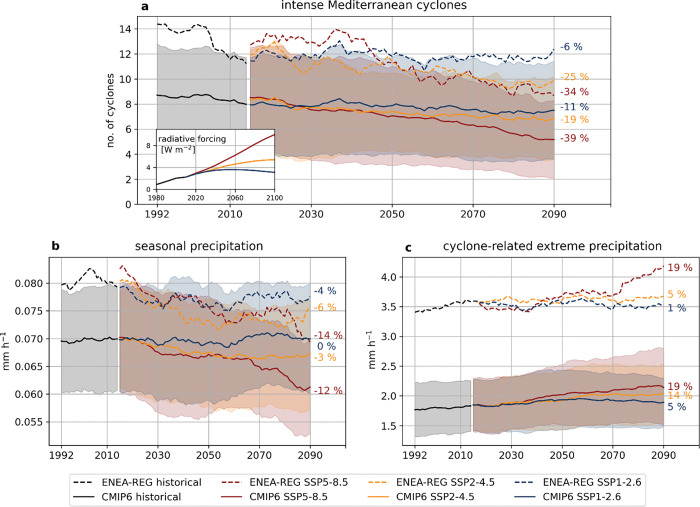 Figure 1
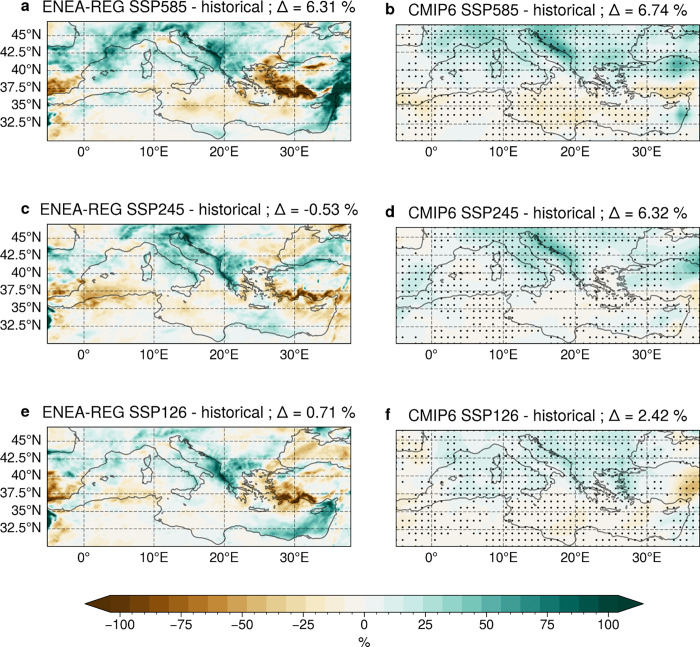 Figure 2
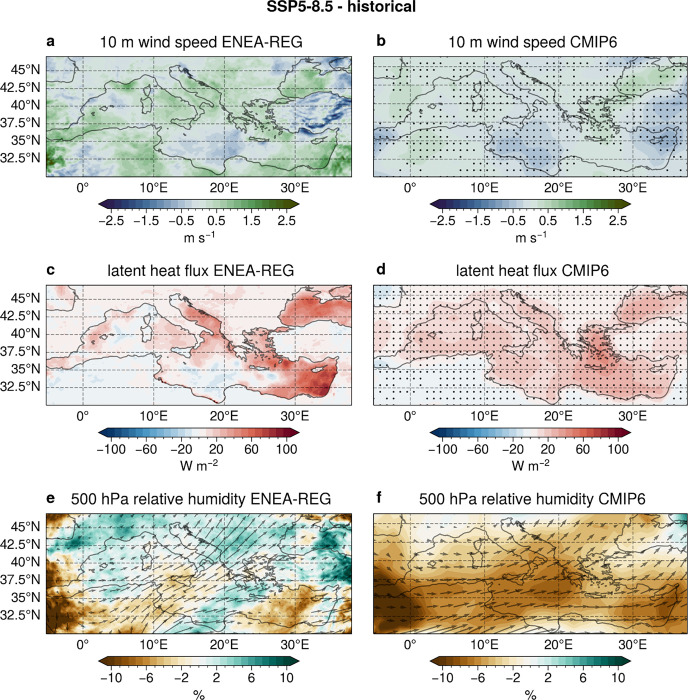 Figure 3
Peer Reviews
No public reviews on file for this paper yet. If you reviewed it on a platform where reviews are public (OpenReview, ICLR, NeurIPS, ICML), you can paste yours below so the community can read it here.
Videos
No videos yet. Explain this paper in a talk, walkthrough, or lecture? Add one.
Taxonomy
TopicsClimate variability and models · Meteorological Phenomena and Simulations · Tropical and Extratropical Cyclones Research