Children and divorce: A rapid review targeting cognitive dissonance, in the context of narrative therapy
Christopher Lie Ken Jie, Joanne Jessen Yramategui, Richard Huang

TL;DR
This paper explores how narrative therapy can help children aged 3-12 cope with the emotional conflict of parental divorce by addressing cognitive dissonance.
Contribution
The study introduces a novel application of narrative therapy to reduce children's cognitive dissonance during divorce by focusing on their conflicting beliefs.
Findings
Children's loyalty conflicts during divorce can be both harmful and helpful in adjusting to new family dynamics.
Narrative therapy helps children reframe conflicting beliefs about their parents, shifting moral obligations to themselves.
Therapists can use children's stories to repair family relationships and improve emotional adjustment.
Abstract
Today, for divorcing parents, the social norms of “good” parenting appear to impose obligations to “fight” for shared custody of their children. However, this may intensify conflicts experienced by their children in the form of cognitive dissonance. Authors conducted a rapid review to explore children’s experiences of divorce (ages three to 12 years old) in the context of narrative therapy, in order to uncover the mechanism of cognitive dissonance. Four databases of Scopus, PsychINFO, Family and Societies Studies Worldwide, and PubMed were searched for literature in the last 10 years. Results included 11 study articles, one policy brief, and one book chapter, representing the experiences of 1169 children from seven developed countries/regions. Our findings suggest four themes associated with cognitive dissonance, whereby the first three represent the formation of harmful perceptions of…
Genes, proteins, chemicals, diseases, species, mutations and cell lines named across the full text — each resolved to its canonical identifier and authoritative record.
Click any figure to enlarge with its caption.
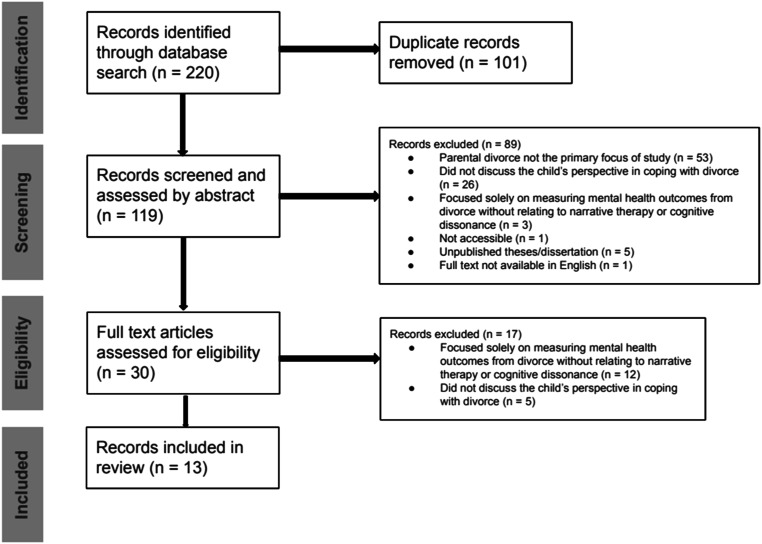 Figure 1
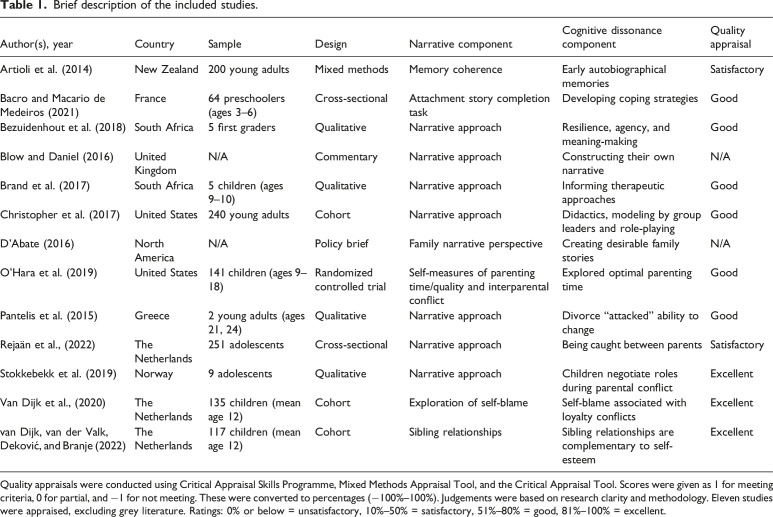 Figure 2
Peer Reviews
No public reviews on file for this paper yet. If you reviewed it on a platform where reviews are public (OpenReview, ICLR, NeurIPS, ICML), you can paste yours below so the community can read it here.
Videos
No videos yet. Explain this paper in a talk, walkthrough, or lecture? Add one.
Taxonomy
TopicsAttachment and Relationship Dynamics · Family Support in Illness · Family Dynamics and Relationships