Virtual Reality Training for Pediatric Sedation Challenges: A Cross-Sectional Study
Nadia Shaikh, Fiona S Gruzmark, Francesca Rios, Curie Subramanian, Keith Hanson, Teresa Riech

TL;DR
This paper explores using virtual reality to train medical professionals in handling pediatric sedation challenges, showing that learners felt more confident and prepared after the training.
Contribution
The study introduces a novel VR-based training method for pediatric sedation management, demonstrating its effectiveness in improving learner confidence.
Findings
All 35 participants completed a blinded survey after VR training and reported high confidence in managing pediatric sedation challenges.
Self-reported preparedness and confidence improved significantly after completing the VR modules.
VR training was well-received and considered effective for preparing medical trainees in a specialized field.
Abstract
Background Teaching the management of pediatric sedation-related airway concerns is challenging due to the time-sensitive interventions required and their infrequent occurrence. Recognizing this educational gap in the sedation experience, virtual reality (VR) was utilized to prepare learners and provide an immersive training experience in a controlled environment. Methods We describe simulation-based training using a VR environment, Enduvo Inc., an innovative software for medical trainees. This two-hour course creates a problem-based learning experience, allowing learners to apply their knowledge and develop a framework for managing these stressful and less commonly encountered situations. Results From 2019 to 2022, 35 learners participated in the sedation course. After completing the VR modules, all learners completed a blinded survey on their experience and preparation for…
Genes, proteins, chemicals, diseases, species, mutations and cell lines named across the full text — each resolved to its canonical identifier and authoritative record.
Click any figure to enlarge with its caption.
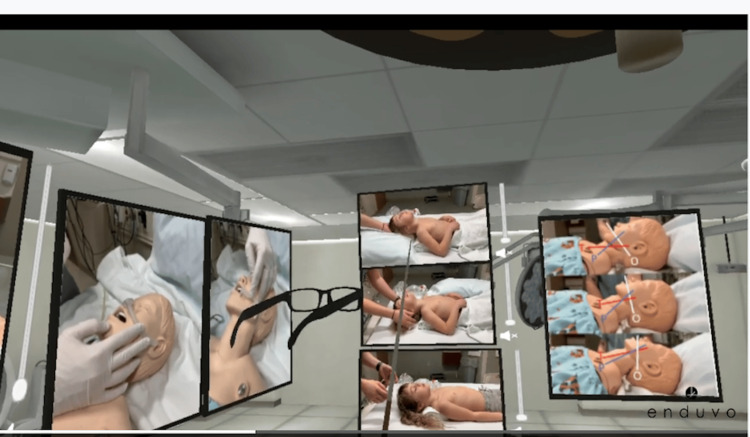 Figure 1
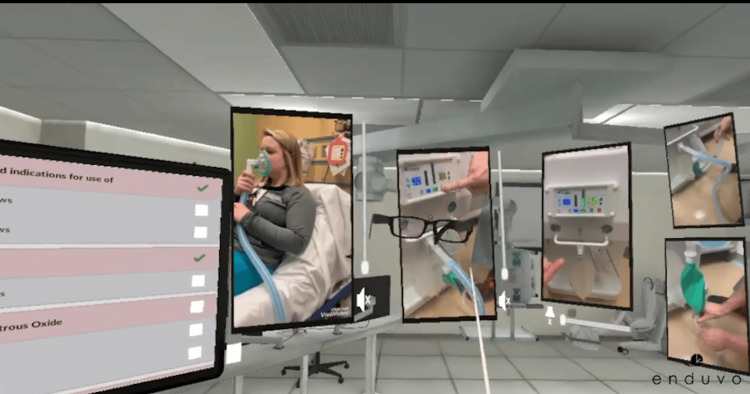 Figure 2
| Participant characteristics | N (%) |
| Years of clinical experience | |
| 0-5 years | 34 (97) |
| 6-10 years | 1 (3) |
| Formal sedation training received (Includes medical school rotation, SPS Course, computer-based course, sedation or anesthesia elective, didactic training on adverse events (Y) | 16 (45.7) |
| Adverse events experienced (Y) | 17 (48) |
| Total participants | 35 (100) |
| Category | |
| Medical students | 7 (20) |
| Emergency medicine residents | 7 (20) |
| Pediatric residents | 6 (17.1) |
| Internal medicine-pediatrics | 5 (14.3) |
| Other(s) residents | 4 (11.4) |
| Fellows | 4 (11.4) |
| Faculty | 2 (5.7) |
| Self-preparedness | VR prepared me better than prior training methods N (%) | VR gave me the same level of preparation as my prior training N (%) | VR did not prepare me as well N (%) | Not applicable N (%) |
| Nitrous oxide | 18 (75) | 5 (20) | 1 (4.16) | 11 (31.4) |
| Chest wall rigidity | 16 (84) | 3 (15) | 0 (0) | 16 (45.7) |
| Apnea | 17 (60) | 11 (39) | 0 (0) | 7 (20) |
| Laryngospasm | 20 (95) | 1 (5) | 0 (0) | 14 (40) |
| Confidence | 100% (completely) confident | 50% (somewhat) confident | Not confident | Not applicable |
| Nitrous oxide | 15 (45) | 13 (39) | 5 (15) | 2 (5.7) |
| Chest wall rigidity | 3 (17) | 13 (76) | 1 (5.8) | 18 (51.4) |
| Apnea | 9 (33) | 18 (66) | 0 (0) | 8 (22.9) |
| Laryngospasm | 5 (27) | 12 (66.6) | 1 (5.5) | 17 (48.6) |
| Participants’ feedback on relevance and difficulty of VR technology | N (%) | ||||
| Relevance of VR to current clinical role | Extremely relevant | Very relevant | Relevant | Neutral | Irrelevant |
| 12 (34) | 14 (40) | 7 (20) | 2 (5.7) | 0 (0) | |
| Level of difficulty with technology (head-mounted display, hand tools, software | Very simple | Somewhat simple | Neutral | Somewhat difficult | Very difficult |
| 19 (54) | 11 (31) | 3 (8.5) | 2 (5.7) | 0 (0) | |
Peer Reviews
No public reviews on file for this paper yet. If you reviewed it on a platform where reviews are public (OpenReview, ICLR, NeurIPS, ICML), you can paste yours below so the community can read it here.
Videos
No videos yet. Explain this paper in a talk, walkthrough, or lecture? Add one.
Taxonomy
TopicsSimulation-Based Education in Healthcare · Airway Management and Intubation Techniques · Pediatric Pain Management Techniques
Introduction
Mastering the skill of pediatric procedural sedation is a complex yet essential skill for pediatric trainees. Understanding how to manage sedated pediatric patients, grasping the nuances of indications and contraindications, recognizing complications, and being prepared for safe procedural sedation can be challenging [1,2]. Many outpatient procedures that were previously performed under anesthesia are now frequently done outside the operating room with varying levels of sedation by subspecialists, particularly intensivists and pediatric hospitalists. Thus, there is a growing need for this training despite a limited number of dedicated sedation programs.
Currently, the sedation training for non-anesthesiologists is variable and institution-dependent [3]. Despite a detailed description of clinical practice guidelines provided by the American Society of Anesthesiologists task force on sedation and analgesia, there is much room to improve sedation education for non-anesthesiologists [4]. In a commentary by Toney et al., the authors emphasized the need to incorporate robust sedation training in pediatric hospital medicine fellowship curricula [5]. Similarly, Sulton et al. identified notable delays in critical task performance during simulated pediatric airway events in emergency medicine training [6]. Given the need, we created a virtual reality (VR) pediatric sedation curriculum for students, residents, fellows, and attending physicians.
Our hospital offers a two-week pediatric sedation and analgesia elective rotation for trainees. The program entails the planning of sedation and analgesia, medication understanding, hands-on monitoring for adverse events, and proficiency in airway assessment and management. While adverse events during procedural sedation are relatively uncommon, infants and children are a vulnerable population due to their unique airway anatomy, cardiorespiratory physiology, and response to sedation-analgesia medications. Due to the rarity of these events and the perceived need and feedback to improve learners’ experience in adverse event training, we identified a gap in providing a comprehensive experience in this area and utilized simulation to improve our education.
Simulation has been recognized as a key teaching modality to learn high-stakes, low-frequency events [7-9]. In the realm of simulation, VR has expanded as a robust, immersive experience that helps learners have one-on-one, self-paced learning. Leveraging state-of-the-art VR education software from Enduvo Inc. (Peoria, USA), we developed training around adverse and low-frequency events within pediatric sedation that require stepwise learning for stabilization. Our VR curriculum consists of four competency-based training modules, including managing three adverse events, specifically apnea due to airway obstruction, laryngospasm, and chest wall rigidity, and a learning module on nitrous oxide use. The study aims to develop a simulation-based curriculum for all sedation learners, ensuring a comprehensive learning experience.
Materials and methods
Study design
This study was conducted at OSF Healthcare St. Francis Medical Center and OSF HealthCare Children's Hospital of Illinois in the Midwest region of the United States. The Peoria Institutional Review Board issued approval number 2130903-1. Our institution has been running a well-established sedation program for over 20 years. An elective rotation of two weeks is offered to interested students, residents, and fellows, and approximately 18-20 learners take part in the sedation elective each year. To the existing two-week sedation elective program, a two-hour VR course was added as part of their rotation. This cross-sectional study aims to evaluate the experience of trainees using VR for rare yet crucial aspects of pediatric sedation, specifically those related to the management of adverse events and the setup of the inhaled nitrous oxide machine.
The sedation training was created by subject matter experts, who utilized HTC Vive hardware with locally developed Enduvo software from Peoria, USA, for content creation. The course was divided into four modules, three of which focus on troubleshooting airway complications such as apnea, laryngospasm, and chest wall rigidity caused by the commonly used sedatives. The fourth module provided education on the setup and use of inhaled nitrous oxide. The training took place in a VR environment within a designated simulation space. The experts meticulously developed the curriculum to ensure it is effective and comprehensive.
Objectives
The learning objectives of the curricula were the following:
1. To identify uses, indications, and complications of the sedative agents used in pediatrics, including propofol, benzodiazepines, and opiates.
2. To recognize and troubleshoot life-threatening situations during procedural sedations, including apnea, laryngospasm, and chest wall rigidity.
3. To describe the use of inhaled nitrous oxide equipment and review its setup and troubleshooting mechanisms.
Each module was 20 minutes in length. After the initial instructional segment, each module was subdivided into three segments: an introduction to the concept, a detailed explanation of relevant physiology and anatomy, and techniques for managing these events. The segments included a variety of multimedia elements such as videos and three-dimensional images, which are also referred to as assets. Learners were expected to complete embedded quizzes after finishing each segment to reinforce their understanding. These modules were designed to be brief and engaging while allowing learners to take breaks if needed. On completion of the 15 minutes, a five-minute pre-recorded summary was provided for a quick review. Learners were able to complete the tutorial at their own pace and repeat it as many times as needed until they felt comfortable.
Study population
All learners who rotated through the sedation elective from 2019 to 2022 were expected to complete the VR modules as part of their elective. Residents experiencing motion sickness were exempt from completing the modules if they had any concerns. After finishing all the modules, participants were invited to complete a three-point Likert scale survey to assess their perceptions, knowledge acquisition, and confidence levels regarding the VR curriculum (Appendix). The survey results were anonymized to prevent expectation bias.
Results
Thirty-five participants were included in the study: seven medical students, 22 resident physicians, four pediatric hospital medicine fellows, and two attending physicians. Ninety-seven percent (34/35) of the learners had zero to five years of clinical experience. Overall, 16 (45.7%) participants had prior pediatric sedation/anesthesia training, which included any training as a medical school rotation, Society for Pediatric Sedation (SPS) course, computer-based course, sedation or anesthesia elective, or didactic training on adverse events. Of all the participants, 17 (48%) had experienced adverse events during sedation (Table 1).
For the apnea module, 17 (60%) individuals felt adequately prepared with VR training, while 11 (39%) reported an equivalent level of preparation compared to their previous methods. Confidence levels in apnea management were high, with nine (33%) reporting complete confidence, 18 (66%) expressing some confidence, and no respondents reporting a lack of confidence. In the laryngospasm module, 20 (95%) respondents expressed feeling significantly more well-prepared through VR training. Conversely, one (5%) reported an equivalent level of readiness compared to their previous training (Table 2).
Confidence levels in laryngospasm management were more varied, with five (27%) expressing complete confidence, 12 (66.6%) reporting some confidence, and one (5.5%) indicating a lack of confidence.
For the chest wall rigidity module, a substantial 16 (84%) participants reported a high level of self-preparedness through VR training, and five (15%) reported an equivalent preparation level as their prior training. Importantly, none of the respondents reported feeling unprepared with VR in this scenario. Within the same module, three (17%) reported complete confidence, 13 (76%) expressed some confidence, and one (5.8%) lacked confidence (Table 2).
For the nitrous oxide setup, a majority of respondents, totaling 18 (75%), conveyed a sense of readiness attributed to VR training, while an additional five (20%) indicated an equivalent level of preparation compared to their prior training methods. Notably, one (4.16%) expressed dissatisfaction, feeling that VR did not adequately prepare them, and 11 (31.4%) responders did not complete that module. Confidence levels in the context of nitrous oxide were more diverse, with 15 (45%) expressing complete confidence, 13 (39%) reporting some confidence, and five (15%) indicating a lack of confidence (Table 2).
Learners were also requested to complete a post-survey regarding the relevance and effectiveness of VR technology (Table 3).
A significant portion of learners find VR to be relevant to their clinical roles, with a majority rating it as either extremely or very relevant. Additionally, the majority of learners reported that the technology, including head-mounted displays, hand tools, and software, was perceived to be very simple to use. These findings suggest a positive outlook on the incorporation of VR technology in the clinical learning environment, with a notable emphasis on its relevance and user-friendly nature.
Discussion
Our findings indicate that the VR training was well received by the participants and improved their confidence and self-preparedness to handle adverse reactions as compared to prior educational training modalities. The participants showed a positive attitude toward integrating VR technology into sedation curricula. This pilot study highlights the potential benefits of incorporating such technology in the training of healthcare professionals.
VR has emerged as an innovative educational tool, demonstrating effectiveness in improving manual and immediate decision-making skills [10]. VR has been studied specifically in surgical and emergency medicine specialties, where clinical skills training is needed to improve clinical outcomes [11-13].
We applied the same concept in developing a pediatric sedation curriculum to lay the groundwork for understanding the physiological and anatomical factors crucial for mastering airway complications through 3D visualization. By creating a less stressful learning environment with an individualized and self-paced focus, learners are better prepared for real-life situations. The interactivity of the video and embedded quizzes helps learners assimilate the information better because they provide better visual guidance as compared to traditional learning.
The rapid growth of pediatric sedation services nationally merits more opportunities for residents and fellows in the future years. A study by Kamat et al. demonstrated a steep uptrend in the sedations being performed by non-anesthesiologists over the past decade [1]. As a result, there is a growing need for residents and fellows to receive additional training in this specialty, particularly with the emergence of a pediatric hospital medicine fellowship. While the SPS is a national consortium and provides simulation-based training for pediatric physicians in sedation, these courses are only offered at limited times throughout the year. Introducing VR training for sedation will provide young physicians and trainees with a more focused and intensive learning experience while prioritizing the safety of real patients (Figures 1-2).
Virtual reality image of apnea moduleCredit: This figure is a snapshot of one of the modules in the lecture series created by Enduvo, Inc. Each manikin was utilized from the Jump Trading Simulation Center at OSF Saint Francis Medical Center, and the photograph was taken by the content developers at Enduvo, Inc.Written informed consent has been provided by the patient to have the case details and any accompanying images published.
Virtual reality image of nitrous oxide moduleCredit: This figure is a snapshot of one of the modules in the lecture series created by Enduvo, Inc. Each manikin was utilized from the Jump Trading Simulation Center at OSF Saint Francis Medical Center, and the photograph was taken by the content developers at Enduvo, Inc.Written informed consent has been provided by the patient to have the case details and any accompanying images published.
The pediatrics sedation research consortium reported that the most common serious adverse events involve laryngospasm and airway obstruction [14]. While chest wall rigidity is exceedingly rare, managing it effectively can be challenging without receiving additional specialized training. Moreover, proficiency in handling nitrous oxide necessitates hands-on training for practitioners to feel at ease with the equipment. A lack of familiarity with the equipment could pose a barrier to its effective utilization. Competence to use the equipment is achieved after repeated practice, which is not feasible for learners with patients and families. These findings influenced our decision to select them for our training program and integrate VR training into our program to provide a solution to enhance familiarity and competence among practitioners. Management of these complications requires learning specific maneuvers. VR enhanced the learner’s experience by providing education on anatomic variances, adjustment techniques, and troubleshooting methods in a controlled environment, enabling them to evaluate each step and refine their skills before applying them in real patient scenarios. It also allows access to a 3D, immersive setting that contains the equipment and replicates the environment they are being asked to work in.
Our study had a few limitations. One limitation is that there was a heterogeneous sample of participants, meaning that learning objectives and outcomes may differ for each group. The purpose of this study was not to prove the effectiveness of VR technology in medical education. Future research can consider comparing traditional video recording or other educational modalities with VR experience to compare efficacy. While VR is an excellent educational tool to utilize, some participants experienced nausea and dizziness after using VR headsets, highlighting a barrier that can limit its use. All immersive pieces of training, such as augmented reality and mixed reality headsets, can cause the same symptoms, although the newest technologies are minimizing these effects by switching modes that are most stable.
Conclusions
Our study confirms heightened confidence levels and self-preparedness among participants after undergoing VR training for complex sedation events. Future projects should explore the potential impact of VR training on the clinical implications of these learned skills. This will pave the way for further advancements in medical education.
The reference list from the paper itself. Each links out to its DOI / PubMed record.
- 1Procedural sedation outside the operating room and potential neurotoxicity: analysis of an at-risk pediatric population Acad Pediatr Kamat PP Sulton C Kudchadkar SR 9789841920193085808110.1016/j.acap.2019.02.011 · doi ↗ · pubmed ↗
- 2Development of a pediatric hospitalist sedation service: training and implementation J Hosp Med Turmelle M Moscoso LM Hamlin KP Daud YN Carlson DW 335339720122204255010.1002/jhm.979 · doi ↗ · pubmed ↗
- 3Variation in pediatric procedural sedations across children's hospital emergency departments Hosp Pediatr Miller AF Monuteaux MC Bourgeois FT Fleegler EW 3643820182923385310.1542/hpeds.2017-0045 · doi ↗ · pubmed ↗
- 4Practice guidelines for sedation and analgesia by non-anesthesiologists Anesthesiology 100410179620021196461110.1097/00000542-200204000-00031 · doi ↗ · pubmed ↗
- 5The time Is now: standardized sedation training for pediatric hospitalists Pediatrics Toney M Pattishall S Garber M 0145202010.1542/peds.2020-044632332054 · doi ↗ · pubmed ↗
- 6Evaluation of pediatric procedural sedation education in pediatric emergency medicine fellowships Medicine (Baltimore) Sulton CD Burger RK Figueroa J Taylor TR 0100202110.1097/MD.0000000000024690 PMC 1054522633578603 · doi ↗ · pubmed ↗
- 7Pediatric sedation: can it be safely performed by non-anesthesiologists?Curr Opin Anaesthesiol Smallman B 4554591520021701923810.1097/00001503-200208000-00008 · doi ↗ · pubmed ↗
- 8Assessing pediatric residents' clinical performance in procedural sedation: a simulation-based needs assessment Pediatr Emerg Care Schinasi DA Nadel FM Hales R Boswinkel JP Donoghue AJ 4474522920132352851410.1097/PEC.0b 013e 31828 b 6552 · doi ↗ · pubmed ↗