Achieving Over 30% Body Weight Loss With Semaglutide in a Patient: A Case Report
Sidra Danish, Vallabh Dogra, Uzma Rauf, Maryam Saghir, Nadia Aslam

TL;DR
A 69-year-old woman with severe obesity lost over 30% of her body weight using semaglutide, improving her health significantly.
Contribution
This case report demonstrates exceptional weight loss and health improvements with semaglutide in a patient with morbid obesity.
Findings
The patient lost 90 lb (30% of her body weight) over 65 weeks with semaglutide.
Her hypertension resolved and glucose levels normalized during treatment.
The weight loss exceeded average results from previous studies.
Abstract
A 69-year-old female with morbid obesity (BMI: 47) and hypertension achieved significant weight loss following treatment with semaglutide. Starting at 241 lb, she lost 90 lb (over 30% of her body weight) over 65 weeks without side effects. This weight loss exceeded the average reduction reported in previous studies. Additionally, her hypertension resolved, and her glucose levels normalized, illustrating the multifaceted benefits of semaglutide in weight management.
Genes, proteins, chemicals, diseases, species, mutations and cell lines named across the full text — each resolved to its canonical identifier and authoritative record.
Click any figure to enlarge with its caption.
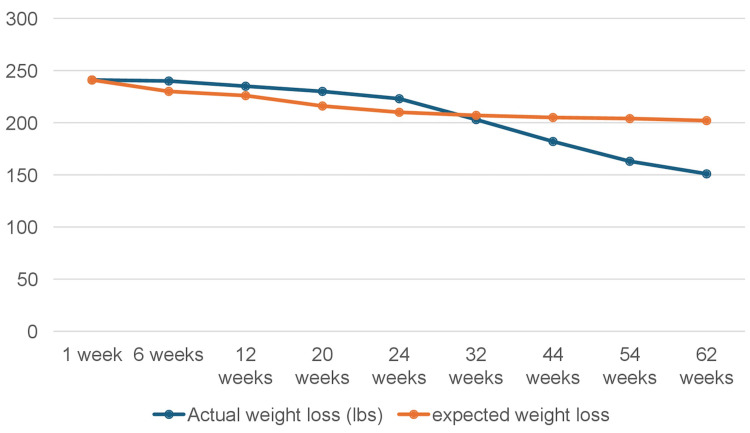 Figure 1
Peer Reviews
No public reviews on file for this paper yet. If you reviewed it on a platform where reviews are public (OpenReview, ICLR, NeurIPS, ICML), you can paste yours below so the community can read it here.
Videos
No videos yet. Explain this paper in a talk, walkthrough, or lecture? Add one.
Taxonomy
TopicsDiabetes Treatment and Management · Metabolism, Diabetes, and Cancer · Pharmacology and Obesity Treatment
Introduction
Semaglutide is well-recognized for its role in promoting weight loss via various mechanisms. It activates glucagon-like peptide-1 (GLP-1) receptors in the hypothalamus, which regulate both hunger and satiety, and patients often report reduced appetite and increased satiety, leading to lower caloric consumption. Semaglutide also delays gastric emptying, which helps with satiety and reduces postprandial blood glucose spikes. More importantly, semaglutide has a metabolic effect by increasing insulin secretion and reducing glucagon release, thereby enhancing insulin sensitivity [1]. However, the extent of weight reduction varies among individuals based on the duration of treatment, medication tolerance, the presence of other metabolic comorbidities, and the use of medications that could potentially lead to weight gain (e.g., steroids). Previous studies have shown an average weight loss of 15% over 68 weeks with 2.4 mg weekly doses [2]. This case demonstrates that semaglutide can lead to substantial weight loss exceeding 30% at a dosage of 2.0 mg/week, which is lower than the dose tested in clinical trials.
Case presentation
A 69-year-old female with a history of primary hypertension, prediabetes, and morbid obesity (BMI: 47) faced significant limitations in ambulation due to her weight. Despite lifestyle modifications, which mainly included dietary changes and, to some extent, physical therapy, which was limited by her morbid obesity, she failed to achieve meaningful weight loss, prompting consideration of semaglutide as an alternative to bariatric surgery. No other weight loss medications were tried before starting semaglutide.
The patient began semaglutide at 0.25 mg/week for four weeks, followed by 0.5 mg/week for another four weeks. The dose was then increased to 1 mg/week and subsequently to 2 mg/week, as reported in the medication guidelines [3]. The patient was assessed at regular intervals for medication tolerance and to rule out adverse effects such as gastrointestinal issues, fatigue, reduced appetite, and pancreatitis, which have been cited as reasons for discontinuation in other studies [4]. The patient reported no adverse effects throughout 65 weeks of treatment. She experienced a remarkable weight reduction of 90 lb, equating to 37.34% of her initial body weight, in contrast to the 15% reduction reported in previous studies (Figure 1) [2,5]. Concurrently, her hypertension improved to the point that all antihypertensive medications (lisinopril and hydrochlorothiazide) were discontinued, and she maintained normotension throughout treatment. Additionally, her prediabetes resolved, with hemoglobin A1c returning to the normal range.
Observed vs. expected weight loss with semaglutide in clinical trials
To exclude other causes of significant weight loss, an extensive evaluation was performed [6]. A thorough clinical history was taken again, and it was not suggestive of any underlying cause of unintentional weight loss. Her thyroid profile was unremarkable. The patient was up to date with cancer screenings, including mammography and colonoscopy. She had undergone a total hysterectomy with cervix removal, eliminating the need for cervical cancer screening. A CT scan of the chest, abdomen, and pelvis ruled out occult malignancy, further supporting that the weight loss was attributable to semaglutide therapy.
Discussion
This case underscores the significant weight loss potential of semaglutide and its associated health benefits. Weight loss is associated with remarkable beneficial outcomes, including improved insulin sensitivity, lower blood pressure, better glycemic control and dyslipidemia, decreased systemic inflammation and endothelial dysfunction, reduced progression of non-alcoholic fatty liver disease (NAFLD), and a lower risk of cardiovascular events and mortality [6]. All these beneficial effects are linearly related to the extent of weight loss. While clinical trials report an average weight loss of approximately 15% with 2.4 mg weekly doses of semaglutide over 68 weeks [2,5,7], this patient achieved a 37.34% weight reduction with a lower dose of 2.0 mg/week. This suggests that greater weight loss may be achievable in select individuals when the medication is well-tolerated and used for a longer duration.
The patient's case highlights semaglutide's role in addressing obesity-related comorbidities, including hypertension and prediabetes. Other potential benefits of weight loss, such as a reduction in cardiometabolic risk factors, further demonstrate the broad therapeutic impact of this treatment [8].
It is essential to rule out alternative causes of weight loss, such as malignancy, gastrointestinal, and endocrine pathologies, when observing significant reductions in body weight. This patient’s comprehensive evaluation confirmed that her weight loss was associated with semaglutide therapy.
Conclusions
This case shows that the response to semaglutide is dose-dependent and varies based on patient-specific factors. The patient was able to lose more than 30% of her body weight with semaglutide, far exceeding the clinical trial results of approximately 15%. This demonstrates that individual responses to semaglutide may vary, and further research is needed to evaluate the factors associated with significant weight loss. The patient's remarkable weight reduction and resolution of her comorbidities highlight the transformative potential of this medication, supporting its use as an effective intervention for significant weight loss and the management of obesity-related comorbidities.
The reference list from the paper itself. Each links out to its DOI / PubMed record.
- 1Clinical impact of semaglutide, a glucagon-like peptide-1 receptor agonist, on obesity management: a review Clin Pharmacol Alorfi NM Algarni AS 6167142022 https://pmc.ncbi.nlm.nih.gov/articles/PMC 9357557/3595804610.2147/CPAA.S 374741 PMC 9357557 · doi ↗ · pubmed ↗
- 2Drugs for treating obesity Handb Exp Pharmacol Ryan DH 3874142742022 https://pubmed.ncbi.nlm.nih.gov/34783910/3478391010.1007/164_2021_560 · doi ↗ · pubmed ↗
- 3Dosing for semaglutide injections 2024 https://www.ozempic.com/how-to-take/ozempic-dosing.html
- 4Clinical insight on semaglutide for chronic weight management in adults: patient selection and special considerations Drug Des Devel Ther Chao AM Tronieri JS Amaro A Wadden TA 44494461162022 https://pmc.ncbi.nlm.nih.gov/articles/PMC 9807016/10.2147/DDDT.S 365416 PMC 980701636601368 · doi ↗ · pubmed ↗
- 5Anti-diabetic drugs and weight loss in patients with type 2 diabetes Pharmacol Res Lazzaroni E Ben Nasr M Loretelli C 1057821712021 https://pubmed.ncbi.nlm.nih.gov/34302978/3430297810.1016/j.phrs.2021.105782 · doi ↗ · pubmed ↗
- 6Unintentional weight loss in older adults Am Fam Physician Gaddey HL Holder KK 34401042021 https://www.aafp.org/pubs/afp/issues/2021/0700/p 34.html 34264616 · pubmed ↗
- 7Once-weekly semaglutide in adults with overweight or obesity N Engl J Med Wilding JP Batterham RL Calanna S 98910023842021 https://www.nejm.org/doi/full/10.1056/NEJ Moa 20321833356718510.1056/NEJ Moa 2032183 · doi ↗ · pubmed ↗
- 8Weight loss outcomes associated with Semaglutide treatment for patients with overweight or obesity JAMA Netw Open Ghusn W De la Rosa A Sacoto D 052022 https://pmc.ncbi.nlm.nih.gov/articles/PMC 9486455/10.1001/jamanetworkopen.2022.31982 PMC 948645536121652 · doi ↗ · pubmed ↗