Gene model for the ortholog of Pdk1 in Drosophila grimshawi
Megan E. Lawson, Madison A. Sharp, Laura K Reed, Norma Velazquez-Ulloa, Amy T. Hark, John Stanga, Chinmay P. Rele

TL;DR
This paper describes the gene model for the Pdk1 ortholog in Drosophila grimshawi, part of a study on the evolution of a key signaling pathway in fruit flies.
Contribution
A new gene model for Pdk1 ortholog in Drosophila grimshawi is presented as part of an educational genomics dataset.
Findings
The Pdk1 ortholog was identified in the Drosophila grimshawi genome assembly.
The gene model contributes to a dataset for studying the evolution of the IIS pathway in Drosophila.
The work follows a standardized gene annotation protocol for undergraduate research.
Abstract
Gene model for the ortholog of Phosphoinositide-dependent kinase 1 ( Pdk1 ) in the May 2011 (Agencourt dgri_caf1/DgriCAF1) Genome Assembly (GenBank Accession: GCA_000005155.1 ) of Drosophila grimshawi . This ortholog was characterized as part of a developing dataset to study the evolution of the Insulin/insulin-like growth factor signaling pathway (IIS) across the genus Drosophila using the Genomics Education Partnership gene annotation protocol for Course-based Undergraduate Research Experiences.
Genes, proteins, chemicals, diseases, species, mutations and cell lines named across the full text — each resolved to its canonical identifier and authoritative record.
Click any figure to enlarge with its caption.
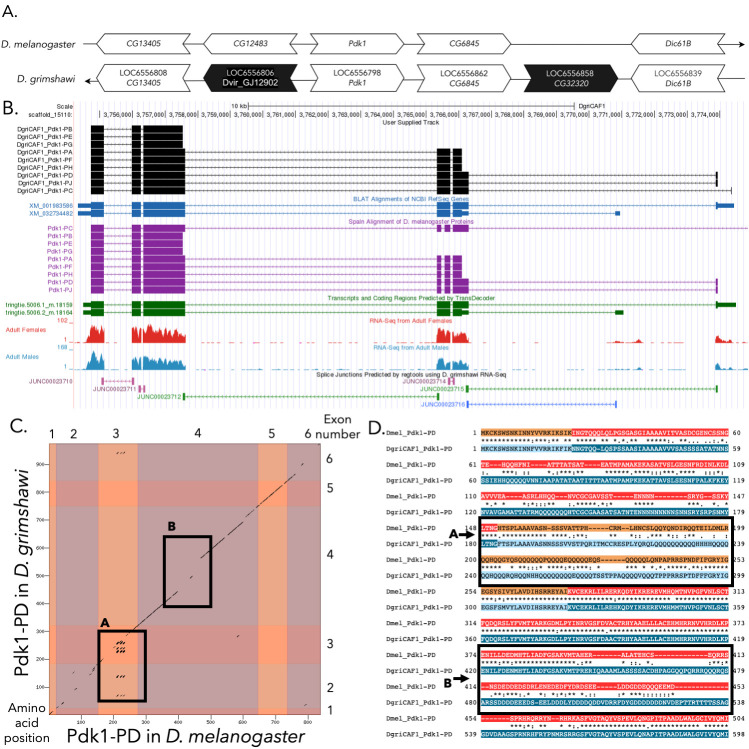 Figure 1
|
"In this GEP CURE protocol students use web-based tools to manually annotate genes in non-model
“The particular gene ortholog described here was characterized as part of a developing dataset to study the evolution of the Insulin/insulin-like growth factor signaling pathway (IIS) across the genus
|
- —National Institutes of Health (United States)https://ror.org/01cwqze88
- —National Science Foundation (United States)https://ror.org/021nxhr62
Peer Reviews
No public reviews on file for this paper yet. If you reviewed it on a platform where reviews are public (OpenReview, ICLR, NeurIPS, ICML), you can paste yours below so the community can read it here.
Videos
No videos yet. Explain this paper in a talk, walkthrough, or lecture? Add one.
Taxonomy
TopicsGene Regulatory Network Analysis
Description
**: **
The model presented here is the ortholog of * Pdk1 * in the May 2011 (Agencourt dgri_caf1/DgriCAF1) assembly of *D. grimshawi * ( GCA_000005155.1 ; Drosophila 12 Genomes Consortium et al . , 2007) and corresponds to the Gnomon Peptide ID ( XM_001983586 ) predicted model in
- D. grimshawi * ( LOC6556798 ) . This gene model is based on RNAseq data from D. grimshawi ( SRP073087 ; Yang et al., 2018 *) * and
Pdk1 * ( GCA_000001215.4 ; Drosophila 12 Genomes Consortium et al . , 2007) in *D. melanogaster * from FB2022_02 (Larkin et al *., * 2021; Gramates et al., 2022; Jenkins et al., 2022).
Pdk1 * ( Phosphoinositide-dependent kinase 1 , also known as DSPTK61; FBgn0020386) is a serine-threonine kinase that regulates insulin-mediated growth through Akt and S6K in D. melanogaster (Rintelen et al., 2001) . * Pdk1 * is widely conserved across eukaryotes, unlike many kinases (Dittrich and Devarenne 2012) . The rabbit Pdk1 protein, isolated from skeletal muscle, was used to identify orthologous genes from humans and *D. melanogaster * (Alessi et al., 1997a; Alessi et al., 1997b) . Pdk1 is characterized by a kinase domain and a pleckstrin-homology phosphatidylinositol-lipid-binding domain (Alessi et al., 1997a) . Some D. melanogaster * Pdk1 * isoforms are transcribed from different promoters (Clyde and Bownes 2000) .
** Synteny **
Pdk1 * occurs on chromosome 3L in *D. melanogaster * and is flanked downstream by * CG6845 * and *Dynein intermediate chain at 61B * ( * Dic61B * ) and upstream by * CG13405 * and * CG12483 . * We determined that the putative ortholog of * Pdk1 * is found on scaffold 15110 ( CH916366.1 ) in *D. grimshawi * with LOC6556798 ( XP_001983622.1 ) (via tblastn search with an e-value of 0.0 and percent identity of 84.57%), where it is surrounded downstream by LOC6556862 ( XP_043071420.1 ), LOC6556858 ( XP_032599000.2 ), and LOC6556839 ( XP_001983619.1 ), which correspond to * CG6845 , CG32320 , * and * Dic61B * in *D. melanogaster * with e-values of 0.0, 3e-98, and 0.0 respectively and percent identities of 55.90%, 35.69%, and 60.48% respectively, as determined by blastp ( Figure 1A, A ltschul et al., 1990). The ortholog of * CG32320 * is found in the downstream genomic neighborhood of * Pdk1 * in *D. grimshawi, * but it is on a separate chromosome from * Pdk1 * in D. melanogaster (see: “special characteristics”) *. * However, synteny on either side of * CG32320 * is still conserved between the two species. The *D. grimshawi * ortholog of * Pdk1 * ( LOC6556798 ) is flanked upstream by LOC6556808 ( XP_001983625.1 ), which corresponds to * CG13405 * in *D. melanogaster * with an e-value of 2e-28 and a percent identity of 44.00% *, * as well as LOC6556806 ( XP_001983624.2 ), which does not have an ortholog in D. melanogaster and is uncharacterized in *D. grimshawi. * In the synteny diagram (Figure A), this gene has been denoted by its locus tag (Dvir_ GJ12902) in a more closely related species, *Drosophila virilis * (see: “special characteristics”). While this gene is not syntenic to the gene at this location in *D. melanogaster * ( * CG12483 * ), the second closest upstream genes are conserved between both species. Because four of the five genes in the *D. melanogaster * neighborhood of * Pdk1 * have the same location and direction relative the genomic neighborhood for * Pdk1 * in both species, this is a good indicator that this is the correct ortholog assignment for * Pdk1 * in *D. grimshawi. * The high quality of the blast hits used to determine orthology are additional evidence for this assignment.
** Protein Model **
Pdk1 * in
- Drosophila grimshawi * has four unique protein coding isoforms ( Figure 1B ), one encoded by mRNA isoforms Pdk1-RB , Pdk1-RE , and Pdk1-RG which contain three CDSs. A second encoded by mRNA isoforms Pdk1-RA , Pdk1-RF , and Pdk1-RH which contain five CDSs. A third encoded by mRNA isoforms Pdk1-RD and Pdk1-RJ which contain six CDSs. And a fourth mRNA isoform Pdk1-RC containing six CDSs. There is the same number of isoforms in *D. melanogaster * as there is in D. grimshawi , and all isoforms have the same number of CDSs in both species. The sequence of
Pdk1 * in
- D. grimshawi* has 63.9% conservation with the
Pdk1 * in *D. melanogaster * as determined by the Gene Model Checker protein alignment algorithm (Figure C and D). Differences were found in the location of the first CDS of isoform Pdk1-PC between the two species (see: “special characteristics”). The coordinates of the curated gene models for Pdk1-PD, Pdk1-PJ, Pdk1-PA, Pdk1-PF, Pdk1-PH, Pdk1-PB, Pdk1-PG, Pdk1-PE and Pdk1-PC can be found in NCBI at GenBank using the accessions BK064442 , BK064443 , BK064444 , BK064445 , BK064446 , BK064447 , BK064448 , BK064449 , and BK064450 , respectively. These data are also available in Extended Data files below, which are archived in CaltechData.
** Special characteristics of the protein model **
** Presence of * CG32320 * in D. grimshawi **
In the * Pdk1 * neighborhood in *D. melanogaster, * the two closest downstream genes are * CG6845 * and *Dic61. * The orthologs of these genes are present and syntenic in the * D. grimshawi Pdk1 * neighborhood, but there is another gene located between them with LOC6556858 . The ortholog of this gene D. melanogaster is * CG32320 * , and in this species it is on a different chromosome than * Pdk1 * . This may be the result of a translocation event involving this gene in one of these lineages relative to the other.
** Presence of a gene in *D. grimshawi * with no ortholog in D. melanogaster **
The *D. grimshawi * ortholog of * Pdk1 * ( LOC6556798 ) is flanked upstream by LOC6556806 , which does not have an ortholog in D. melanogaster and is uncharacterized in *D. grimshawi. BLASTn * searches for the gene found at LOC6556806 indicated that though this gene is uncharacterized in D. grimshawi , it is a very good match (e-value of 6e-29, percent identity of 86.36%, and accession XM_002046413 .3) to the alanine and glycine-rich protein-coding gene in Drosophila virilis , which has the locus tag Dvir_GJ12902. All other BLASTn results point to a similar gene in other species that are more closely related to D. grimshawi than *D. melanogaster. * These include the glycine-rich protein 5 gene in *Drosophila novamexicana * (e-value 6e-29, percent identity of 86.36%, and accession XM_030705026 .1), the glycine-rich protein 1 gene in *Drosophila albomicans * (e-value of 1e-21, percent identity of 75.44%, and accession XM_034249794 .1), the glycine-rich protein 1 gene in Drosophila innubila (e-value of 3e-17, percent identity of 91.78%, and accession XM_034626231 .1), and the glycine-rich protein 1 gene in *D. ficusphila * (e-value of 1e-16, percent identity of 90.67%, and accession XM_017202231 .2). These species also have a similar genomic neighborhood surrounding the best matches to LOC6556806 consistent with conservation of the syntenic relationship between LOC6556806 and the * Pdk1 * ortholog within the Drosophila subgenus.
** Location of CDS one of isoform Pdk1-RC **
The most likely location of isoform Pdk1-RC in *D. grimshawi * was determined using student annotations and RNA-Seq data, but it should be noted that the unique first CDS that differentiates Pdk1-RC from isoforms Pdk1-RD and Pdk1-RJ is very small and could potentially exist at a different location than what the gene model indicates. In D. melanogaster , the first CDS of Pdk1-RC is located downstream of the first CDS of Pdk1-RD and Pdk1-RJ . However, the RNA-Seq data signal is strong at the annotated location and there is a viable start codon at the start of this region, so we believe this is the best estimate of where CDS one of Pdk1-RC is in D. grimshawi.
Tandem repeats and low sequence similarity in alignment of Pdk1-PD in both species
The boxed regions in the dot plot (C) and protein alignment (D) show regions with abnormalities in the alignment of Pdk1-PD in D. melanogaster and its orthologous protein in D. grimshawi. Box A shows a tandem repeat in CDS three and Box B shows a region in CDS four that contains an indel and low sequence similarity.
Methods
Detailed methods including algorithms, database versions, and citations for the complete annotation process can be found in Rele et al. (2023). Briefly, students use the GEP instance of the UCSC Genome Browser v.435 ( https://gander.wustl.edu ; Kent WJ et al., 2002; Navarro Gonzalez et al., 2021) to examine the genomic neighborhood of their reference IIS gene in the D. melanogaster genome assembly (Aug. 2014; BDGP Release 6 + ISO1 MT/dm6). Students then retrieve the protein sequence for the D. melanogaster reference gene for a given isoform and run it using tblastn against their target *Drosophila * species genome assembly on the NCBI BLAST server ( https://blast.ncbi.nlm.nih.gov/Blast.cgi ; Altschul et al., 1990) to identify potential orthologs. To validate the potential ortholog, students compare the local genomic neighborhood of their potential ortholog with the genomic neighborhood of their reference gene in D. melanogaster . This local synteny analysis includes at minimum the two upstream and downstream genes relative to their putative ortholog. They also explore other sets of genomic evidence using multiple alignment tracks in the Genome Browser, including BLAT alignments of RefSeq Genes, Spaln alignment of
- D. melanogaster* proteins, multiple gene prediction tracks (e.g., GeMoMa, Geneid, Augustus), and modENCODE RNA-Seq from the target species. Detailed explanation of how these lines of genomic evidenced are leveraged by students in gene model development are described in Rele et al. (2023). Genomic structure information (e.g., CDSs, intron-exon number and boundaries, number of isoforms) for the D. melanogaster reference gene is retrieved through the Gene Record Finder ( https://gander.wustl.edu/~wilson/dmelgenerecord/index.html ; Rele et al *., * 2023). Approximate splice sites within the target gene are determined using tblastn using the CDSs from the D. melanogaste r reference gene. Coordinates of CDSs are then refined by examining aligned modENCODE RNA-Seq data, and by applying paradigms of molecular biology such as identifying canonical splice site sequences and ensuring the maintenance of an open reading frame across hypothesized splice sites. Students then confirm the biological validity of their target gene model using the Gene Model Checker ( https://gander.wustl.edu/~wilson/dmelgenerecord/index.html ; Rele et al., 2023), which compares the structure and translated sequence from their hypothesized target gene model against the *D. melanogaster * reference gene model. At least two independent models for a gene are generated by students under mentorship of their faculty course instructors. Those models are then reconciled by a third independent researcher mentored by the project leaders to produce the final model. Note: comparison of 5' and 3' UTR sequence information is not included in this GEP CURE protocol.
The reference list from the paper itself. Each links out to its DOI / PubMed record.
- 1Alessi DR Deak M Casamayor A Caudwell FB Morrice N Norman DG Gaffney P Reese CB Mac Dougall CN Harbison D Ashworth A Bownes M 19971013-Phosphoinositide-dependent protein kinase-1 (PDK 1): structural and functional homology with the Drosophila DSTPK 61 kinase.Curr Biol 7100960-982277678910.1016/s 0960-9822(06)00336-89368760 · doi ↗ · pubmed ↗
- 2Alessi DR James SR Downes CP Holmes AB Gaffney PR Reese CB Cohen P 199741 Characterization of a 3-phosphoinositide-dependent protein kinase which phosphorylates and activates protein kinase Balpha.Curr Biol 740960-982226126910.1016/s 0960-9822(06)00122-99094314 · doi ↗ · pubmed ↗
- 3Altschul SF Gish W Miller W Myers EW Lipman DJ 1990105 Basic local alignment search tool.J Mol Biol 21530022-283640341010.1016/S 0022-2836(05)80360-22231712 · doi ↗ · pubmed ↗
- 4Baker RH De Salle R 1997121 Multiple sources of character information and the phylogeny of Hawaiian drosophilids.Syst Biol 4641063-515765467310.1093/sysbio/46.4.65411975337 · doi ↗ · pubmed ↗
- 5Carson HL 198331 Chromosomal sequences and interisland colonizations in hawaiian Drosophila.Genetics 10330016-673146548210.1093/genetics/103.3.46517246115 PMC 1202034 · doi ↗ · pubmed ↗
- 6Carson Hampton L. Hardy D. Elmo Spieth Herman T. Stone Wilson S. 1970 The Evolutionary Biology of the Hawaiian Drosophilidae Essays in Evolution and Genetics in Honor of Theodosius Dobzhansky 43754310.1007/978-1-4615-9585-4_15 · doi ↗
- 7Clyde D Bownes M 2000121 The Dstpk 61 locus of Drosophila produces multiple transcripts and protein isoforms, suggesting it is involved in multiple signalling pathways.J Endocrinol 16730022-079539140110.1677/joe.0.167039111115766 · doi ↗ · pubmed ↗
- 8Dittrich AC Devarenne TP 2012514 Perspectives in PDK 1 evolution: insights from photosynthetic and non-photosynthetic organisms.Plant Signal Behav 761559-231664264910.4161/psb.2003822580698 PMC 3442859 · doi ↗ · pubmed ↗