Transcription Regulatory Protein SIN3 (YOL004W) Influences Mutation Rates in Saccharomyces cerevisiae
Alexandra Eftimie, Damon Meyer

TL;DR
This study shows that the SIN3 protein in yeast affects mutation rates, indicating a role in genome stability.
Contribution
The paper reveals a new role for SIN3 in influencing mutation rates in the CAN1 gene.
Findings
SIN3 affects mutation rates in the CAN1 reporter gene.
This suggests SIN3 has an impact on genome stability in yeast.
Abstract
SIN3 (YOL004W) codes for a protein in Saccharomyces cerevisiae which is suggested to function as a broad cellular transcription regulator through the binding of histone deacetylases and other enzymes to form a large protein complex that modifies chromatin. In addition, SIN3 has also demonstrated potential roles in epigenetic silencing, DNA methylation, and centromere function. Here we report a new role of SIN3 in affecting mutation rates within the CAN1 reporter gene, suggesting an impact on genome stability.
Genes, proteins, chemicals, diseases, species, mutations and cell lines named across the full text — each resolved to its canonical identifier and authoritative record.
Click any figure to enlarge with its caption.
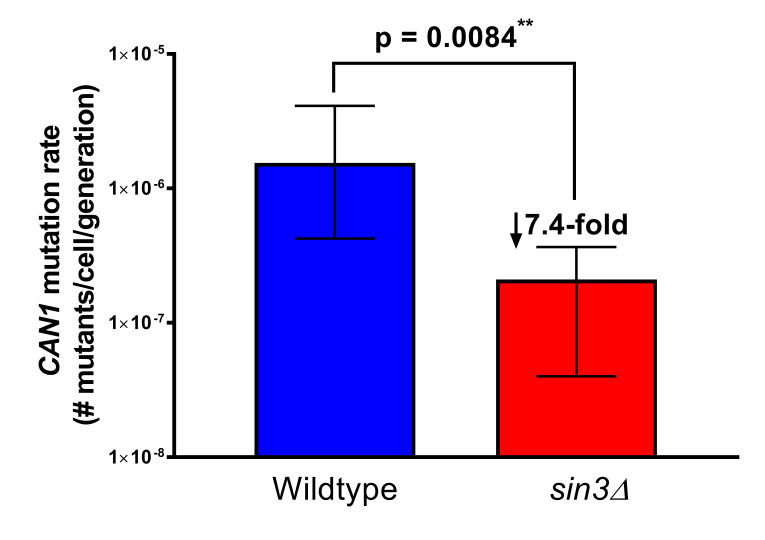 Figure 1
Peer Reviews
No public reviews on file for this paper yet. If you reviewed it on a platform where reviews are public (OpenReview, ICLR, NeurIPS, ICML), you can paste yours below so the community can read it here.
Videos
No videos yet. Explain this paper in a talk, walkthrough, or lecture? Add one.
Taxonomy
Topicsinterferon and immune responses · RNA Research and Splicing · Cancer-related gene regulation
Description
Exploring the various functions of genes and uncharacterized open reading frames in the budding yeast, S. cerevisia e, is an important step in unraveling the biological processes that govern not only yeast but more complex organisms (Vanderwaeren et al., 2022; Bowling et al. 2016). However, while the function of many proteins within S. cerevisiae have been verified, the examination of uncharacterized or understudied genes in the literature has been declining (Tantoso et al., 2023). Related to this, discovery of new activities for gene products (RNA or protein) is difficult if the activity is not closely related to any known function of the RNA or protein. Therefore, we attempted to uncover genes within S. cerevisiae which may have a role in genome stability by screening the Saccharomyces Genome Database (SGD) for genes that are involved in DNA replication, meiosis, or decreased resistance to genotoxins. One such gene identified was SIN3 , a conserved multifunctional regulator involved in chromatin modification and transcriptional regulation, exhibiting both corepressor and transcriptional stimulation capabilities through its association with a histone deacetylase complex (Silverstein & Ekwall, 2005; Adams et al., 2018). *SIN3 * encodes a 175-kDa polypeptide which functions to negatively regulate the yeast HO gene, thereby determining the mating type pattern of S. cerevisiae , facilitate telomere folding structure, affects sensitivity to genotoxic agents, influence tri-nucleotide expansion, and a moderate sensitivity to UV radiation (Sternberg et al., 1987; Wang et al., 1990; Wagner et al., 2020; Westmoreland et al., 2009; Debacker et al. 2012; Hanway et al., 2002). These phenotypes suggest that Sin3 influences several processes within the cell, some of which impact DNA stability.
To further establish the biological function of Sin3 in maintaining genome stability, the *CAN1 * forward mutation rate was evaluated in sin3 Δ knockout mutants compared to wildtype (WT). The *CAN1 * locus has been used as a proxy for genome mutation rates in S. cerevisiae since can1 mutations are easily detected by colony growth on medium containing canavanine which also lacks arginine (Whelan et al., 1979). This includes examination of individual genes required for mutation accumulation and large-scale genome wide screens to identify previously unknown genes that contribute to mutations (Huang, et al., 2003; Novarina et al., 2020). We observed a significantly reduced spontaneous *CAN1 * mutation rate of approximately 7.4-fold in sin3 Δ knockout mutants in comparison to WT colonies, with the median colony counts being 2.1 x 10 ^-7^ and 1.55 x 10 ^-6^ respectively (p < 0.05). This data indicates that Sin3 plays a role in overall genome stability by influencing spontaneous mutation rates. However, it is not clear what known function of Sin3 may facilitate the increase in mutations. Previous evidence has shown a link between chromosome organization and genome landscape with varying mutation rates (Makova & Hardison, 2015). Sin3 is known to interact with histone deacetylase complexes, which influence gene expression patterns through histone modification and are typically deregulated in human cancers (Ropero & Esteller, 2007). In addition, histone deacetylase complex activity in humans and yeast have been demonstrated to favor trinucleotide repeat expansion while also promoting homology-directed repair (Lahue & Frizzell, 2012). This suggests that Sin3 may indirectly influence mutation rates through its role in chromosome modification and regulation of gene expression. Alternatively, we cannot rule out the possibility that Sin3 possesses a yet unknown function which more directly impacts mutation rates and thereby genome stability.
Methods
*CAN1 * Forward Mutation Assay
The *CAN1 * mutation rate for wildtype and sin3 Δ deletion mutations were determined from a minimum of fifteen individual freshly grown colonies for each genotype. Each colony was dispersed in 1 mL of sterile water and 0.2 mL was plated onto synthetic medium lacking arginine containing 60 ug/mL of canavanine. In addition, a dilution of the dispersed colony was plated onto YPD medium to determine the total viable cells within the colony. All cells plated were grown for 3 days at 30 ^ο^ C. The median rate of *CAN1 * mutation was calculated by dividing the number of Can ^R^ colonies by the number of viable cells plated for each spore colony (Lea & Coulson, 1949). A 95% confidence interval was calculated for each genotype.
Reagents
Yeast strains used in this study:
Number Genotype Source
ORF1 MATa his3Δ1 leu2Δ0 met15Δ0 ura3Δ0 Horizon Discovery
ORF35 MATa his3Δ1 leu2Δ0 met15Δ0 ura3Δ0 sin3::KANMX Horizon Discovery
The reference list from the paper itself. Each links out to its DOI / PubMed record.
- 1Adams Grace E. Chandru Aditya Cowley Shaun M. 20181214 Co-repressor, co-activator and general transcription factor: the many faces of the Sin 3 histone deacetylase (HDAC) complex Biochemical Journal 475240264-60213921393210.1042/bcj 2017031430552170 PMC 6295471 · doi ↗ · pubmed ↗
- 2Bowling Bethany V. Schultheis Patrick J. Strome Erin D. 20151110 Implementation and assessment of a yeast orphan gene research project: involving undergraduates in authentic research experiences and progressing our understanding of uncharacterized open reading frames Yeast 3320749-503X 435310.1002/yea.313926460164 PMC 4738069 · doi ↗ · pubmed ↗
- 3Debacker Kim Frizzell Aisling Gleeson Olive Kirkham-Mc Carthy Lucy Mertz Tony Lahue Robert S. 2012221 Histone Deacetylase Complexes Promote Trinucleotide Repeat Expansions P Lo S Biology 1021545-7885 e 1001257 e 100125710.1371/journal.pbio.100125722363205 PMC 3283555 · doi ↗ · pubmed ↗
- 4Hanway Denise Chin Jodie K. Xia Gang Oshiro Guy Winzeler Elizabeth A. Romesberg Floyd E. 2002729 Previously uncharacterized genes in the UV- and MMS-induced DNA damage response in yeast Proceedings of the National Academy of Sciences 99160027-8424106051061010.1073/pnas.152264899 PMC 12498812149442 · doi ↗ · pubmed ↗
- 5Huang Meng-Er Rio Anne-Gaëlle Nicolas Alain Kolodner Richard D. 2003912 A genomewide screen in Saccharomyces cerevisiae for genes that suppress the accumulation of mutations Proceedings of the National Academy of Sciences 100200027-8424115291153410.1073/pnas.2035018100 PMC 20879212972632 · doi ↗ · pubmed ↗
- 6Lahue Robert S. Frizzell Aisling 2012818 Histone deacetylase complexes as caretakers of genome stability Epigenetics 781559-229480681010.4161/epi.2092222722985 PMC 3427275 · doi ↗ · pubmed ↗
- 7Lea D. E. Coulson C. A. 1949121 The distribution of the numbers of mutants in bacterial populations Journal of Genetics 4930022-133326428510.1007/bf 0298608024536673 · doi ↗ · pubmed ↗
- 8Makova Kateryna D. Hardison Ross C. 201533 The effects of chromatin organization on variation in mutation rates in the genome Nature Reviews Genetics 1641471-005621322310.1038/nrg 3890 PMC 450004925732611 · doi ↗ · pubmed ↗