Remote work and long-term sickness absence due to mental disorder trends among Japanese workers pre/post COVID-19
Yasuhiko Deguchi, Shinichi Iwasaki, Yuki Uesaka, Yutaro Okawa, Shohei Okura, Kunio Maekubo, Ayaka Matsunaga, Yuki Kageyama, Koki Inoue

TL;DR
This study examined if remote work during the pandemic affected long-term sickness absences due to mental disorders among Japanese workers.
Contribution
The study provides preliminary evidence suggesting remote work may have a protective effect against long-term sickness absences due to depressive disorders.
Findings
The number of workers with long-term sickness absence due to mental disorders did not significantly increase during the pandemic.
Offices with remote work models showed no significant difference in sickness absence rates compared to those without.
Depressive disorder was the most common condition among long-term sickness absence cases.
Abstract
The aim of this study was to ascertain whether there has been an increase in the number of workers with long-term sickness absence due to mental disorders (LTSA-MD) and determine the impact of remote work on new LTSA-MD cases. A web-based questionnaire was sent to 2,552 company offices with 150 or more workers in Osaka Prefecture. Data were obtained on the number of workers with LTSA-MD between April 1, 2019, and March 31, 2020 (fiscal year 2019) and between April 1, 2020, and March 31, 2021 (fiscal year 2020), along with their MD diagnoses (adjustment disorder [AD], depressive disorder [DEP], etc.). The difference in the number of new LTSA-MD, LTSA-AD, and LTSA-DEP cases between the fiscal years was evaluated, as well as the number of LTSA-MD cases per 100 employees. An independent t-test was used to compare the groups. DEP was the most prevalent condition, followed by AD. The number…
Genes, proteins, chemicals, diseases, species, mutations and cell lines named across the full text — each resolved to its canonical identifier and authoritative record.
Click any figure to enlarge with its caption.
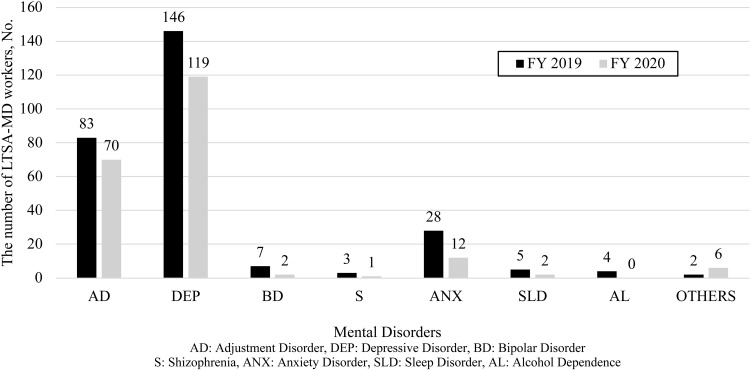 Figure 1
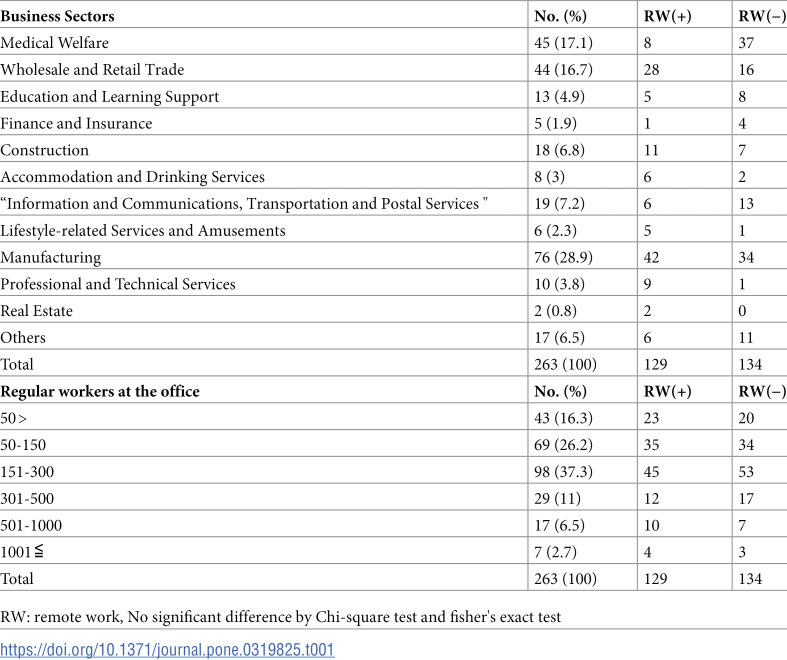 Figure 2
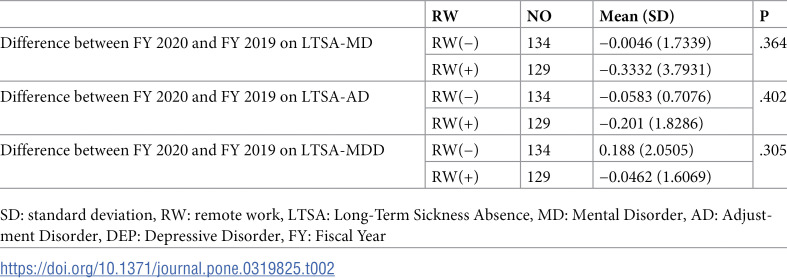 Figure 3
Peer Reviews
No public reviews on file for this paper yet. If you reviewed it on a platform where reviews are public (OpenReview, ICLR, NeurIPS, ICML), you can paste yours below so the community can read it here.
Videos
No videos yet. Explain this paper in a talk, walkthrough, or lecture? Add one.
Taxonomy
TopicsCOVID-19 and Mental Health · Employment and Welfare Studies · Workplace Health and Well-being