Complete genome sequences of Yersinia pestis 6/69 strain isolated from a bubonic plague patient in Madagascar and its isogenic strain cured of pPCP1
Emelyne Bougit, Guillem Mas Fiol, Pierre Lê-Bury, Charlotte Balière, Valérie Caro, Javier Pizarro-Cerdá, Olivier Dussurget

TL;DR
This paper presents the complete genome sequences of a bubonic plague-causing Yersinia pestis strain and a modified version without a specific virulence plasmid.
Contribution
The novel contribution is the sequencing of a clinical Y. pestis isolate and its isogenic derivative lacking the pPCP1 plasmid.
Findings
The genome of Yersinia pestis strain 6/69 was fully sequenced.
An isogenic strain of 6/69 cured of the pPCP1 plasmid was also sequenced.
The findings provide resources for studying plague pathogenesis.
Abstract
We report the complete genome sequences of two valuable strains to investigate plague pathogenesis: (i) Yersinia pestis strain 6/69, which was isolated from a bubonic plague patient in Madagascar and contains pCD1, pMT1, and pPCP1 virulence plasmids, and (ii) the 6/69 strain cured of pPCP1.
Genes, proteins, chemicals, diseases, species, mutations and cell lines named across the full text — each resolved to its canonical identifier and authoritative record.
Click any figure to enlarge with its caption.
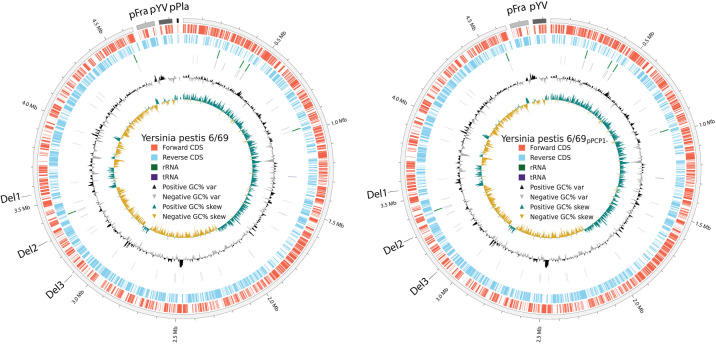 Fig 1
Fig 1| 6/69 | 6/69pPCP1- | ||||||||
|---|---|---|---|---|---|---|---|---|---|
|
|
|
|
|
|
|
|
|
|
|
| GenBank accession no. |
|
|
|
|
|
|
| ||
| No. of circular contigs | 1 | 1 | 1 | 1 | 4 | 1 | 1 | 1 | 3 |
| Size (bp) | 4,649,807 | 96,210 | 70,300 | 9,610 | 4,825,927 | 4,649,807 | 96,210 | 70,300 | 4,816,317 |
| G + C content (%) | 47.6 | 50.2 | 44.8 | 45.3 | 47.6 | 47.6 | 50.2 | 44.8 | 47.6 |
| No. of annotated protein-coding genes | 4,097 | 99 | 90 | 10 | 4,296 | 4,097 | 99 | 90 | 4,286 |
| No. of pseudogenes | 8 | 2 | 0 | 0 | 10 | 8 | 2 | 0 | 10 |
| No. of rRNAs | 19 | 0 | 0 | 0 | 19 | 19 | 0 | 0 | 19 |
| No. of tRNAs | 71 | 0 | 0 | 0 | 71 | 71 | 0 | 0 | 71 |
| No. of ncRNAs | 183 | 1 | 2 | 2 | 188 | 183 | 1 | 2 | 186 |
| CRISPR array | 4 | 0 | 0 | 0 | 4 | 4 | 0 | 0 | 4 |
| Total no. of reads | 80,656 (ONT) | 33,370 (ONT) | |||||||
| ONT | 14,027 | 14,960 | |||||||
| Total no. of bases | 624,569,231 (ONT) | 249,181,216 (ONT) | |||||||
| Sequencing depth (×) | 129 (ONT) | 51 (ONT) | |||||||
- —Institut Pasteur
- —Agence Nationale de la Recherche (ANR)
- —Agence Nationale de Recherches sur le Sida et les Hépatites Virales (ANRS)
- —Agence Nationale de Recherches sur le Sida et les Hépatites Virales (ANRS)
Peer Reviews
No public reviews on file for this paper yet. If you reviewed it on a platform where reviews are public (OpenReview, ICLR, NeurIPS, ICML), you can paste yours below so the community can read it here.
Videos
No videos yet. Explain this paper in a talk, walkthrough, or lecture? Add one.
Taxonomy
TopicsYersinia bacterium, plague, ectoparasites research · Vector-borne infectious diseases · Ethnobotanical and Medicinal Plants Studies
ANNOUNCEMENT
Yersinia pestis causes plague (1), a life-threatening zoonosis still prevalent in Africa, Asia, and America (2), whose pathogenesis remains to be fully characterized. Here, we report the genome sequences of Y. pestis 6/69 and 6/69_pPCP1-_ lacking pPCP1 virulence plasmid. The 6/69 strain was isolated in 1969 at the Institut Pasteur of Madagascar from a patient displaying a bubo in the Fandriana province of Madagascar (3). It belongs to Orientalis biovar, sublineage 1.ORI3 and harbors virulence plasmids pMT1, pCD1, and pPCP1, also known as pFra, pYV, and pPla, respectively (4, 5). Genomic characterization of the 6/69 strain is of interest as it has been used as a reference strain and, along with 6/69_pPCP1-_, is useful for studying virulence genes, in particular, plasminogen activator gene pla harbored by pPCP1 (5–11).
To eliminate pPCP1, the 6/69 strain was subcultured 11 times at 4°C on trypticase soy agar with 0.002% hemin. For sequencing, 6/69 and 6/69_pPCP1-_ strains were grown for 16 hours in lysogeny broth at 28°C. DNA was extracted using PureLink Genomic DNA kit (Invitrogen) and quantified using Qubit 2.0 (ThermoFisherScientific). Default parameters were used except where otherwise noted. DNA was sequenced on a MinION-Mk1b using Oxford Nanopore Technologies (ONT) Rapid Barcoding Kit 24 V14 (SQK-RBK14.24), a R10.4.1 flowcell (FLO-MIN114) and MinKNOW/23.04.3 software, generating 80,000 and 33,000-bp length reads for 6/69 and 6/69_pPCP1-, respectively. Dorado/0.3.0 (https://github.com/nanoporetech/dorado) in sup mode was used for basecalling. In parallel, a library was prepared using Illumina DNA Prep kit and sequenced on a MiSeq system (Illumina), generating 1,359 and 2,158 thousand 2 × 151 bp length reads for 6/69 and 6/69_pPCP1-, respectively. Hybrid genome assembly based on ONT and Illumina sequencing data was performed using the Easy pipeline (12). ONT reads were filtered with Filtlong/0.2.0 (https://github.com/rrwick/Filtlong) and assembled using Trycycler/0.5.0 (13), Flye/2.9 (14), Raven/1.6.0 (15), and NECAT/0.0.1 (16). Reads were polished using Medaka/1.11.3 (https://github.com/nanoporetech/medaka) and Polypolish/0.1.3 (17). Illumina reads were quality controlled using fastqc/0.12.1 and assembled using fq2dna/23.12 (gitlab.pasteur.fr/GIPhy/fq2dna), fqCleanER/23.12 (https://gitlab.pasteur.fr/GIPhy/fqCleanER), and SPAdes/3.15.5 (18). Annotation was performed with Bakta/1.5.0 (19). All reads were provided as FASTQ files.
The 6/69 strain possesses a 4.8 Mb circular chromosome and the three plasmids found in the CO92 reference strain (1) (Table 1; Fig. 1). The 6/69 and CO92 strains have an average nucleotide identity >99%. They differ by 52 chromosomal single nucleotide polymorphisms and 3 deletions of 1,510, 10,344, and 3,480 bp starting at positions 657344, 1310775, and 1534290 of CO92 chromosome (GCF_000009065.1). The absence of pPCP1 is the only difference between 6/69_pPCP1-_ and 6/69 strains, highlighting their relevance as tools to study the role of pPCP1 in pathogenesis.
Genome maps of Yersinia pestis 6/69 (left) and 6/69pPCP1- (right). Rings from the outside in: scale marks (1), protein-coding genes on the forward strand (2) or reverse strand (3), rRNA genes (4), tRNA genes (5), GC variation (6), and GC skew (7). Positions of the three identified deletions in 6/69 compared to CO92 are displayed (Del1, Del2, and Del3). Created using Circos.
The reference list from the paper itself. Each links out to its DOI / PubMed record.
- 1Perry RD, Fetherston JD. 1997. Yersinia pestis--etiologic agent of plague. Clin Microbiol Rev 10:35–66. doi:10.1128/CMR.10.1.358993858 PMC 172914 · doi ↗ · pubmed ↗
- 2Barbieri R, Signoli M, Chevé D, Costedoat C, Tzortzis S, Aboudharam G, Raoult D, Drancourt M. 2020. Yersinia pestis: the natural history of plague. Clin Microbiol Rev 34:e 00044-19. doi:10.1128/CMR.00044-1933298527 PMC 7920731 · doi ↗ · pubmed ↗
- 3Guiyoule A, Rasoamanana B, Buchrieser C, Michel P, Chanteau S, Carniel E. 1997. Recent emergence of new variants of Yersinia pestis in Madagascar. J Clin Microbiol 35:2826–2833. doi:10.1128/jcm.35.11.2826-2833.19979350742 PMC 230070 · doi ↗ · pubmed ↗
- 4Demeure CE, Dussurget O, Mas Fiol G, Le Guern A-S, Savin C, Pizarro-Cerdá J. 2019. Yersinia pestis and plague: an updated view on evolution, virulence determinants, immune subversion, vaccination, and diagnostics. Genes Immun 20:357–370. doi:10.1038/s 41435-019-0065-030940874 PMC 6760536 · doi ↗ · pubmed ↗
- 5Guiyoule A, Grimont F, Iteman I, Grimont PA, Lefèvre M, Carniel E. 1994. Plague pandemics investigated by ribotyping of Yersinia pestis strains. J Clin Microbiol 32:634–641. doi:10.1128/jcm.32.3.634-641.19948195371 PMC 263099 · doi ↗ · pubmed ↗
- 6Morelli G, Song Y, Mazzoni CJ, Eppinger M, Roumagnac P, Wagner DM, Feldkamp M, Kusecek B, Vogler AJ, Li Y, Cui Y, Thomson NR, Jombart T, Leblois R, Lichtner P, Rahalison L, Petersen JM, Balloux F, Keim P, Wirth T, Ravel J, Yang R, Carniel E, Achtman M. 2010. Yersinia pestis genome sequencing identifies patterns of global phylogenetic diversity. Nat Genet 42:1140–1143. doi:10.1038/ng.70521037571 PMC 2999892 · doi ↗ · pubmed ↗
- 7Kutyrev VV, Eroshenko GA, Motin VL, Nosov NY, Krasnov JM, Kukleva LM, Nikiforov KA, Al’khova ZV, Oglodin EG, Guseva NP. 2018. Phylogeny and classification of Yersinia pestis through the lens of strains from the plague foci of commonwealth of independent states. Front Microbiol 9:1106. doi:10.3389/fmicb.2018.0110629887859 PMC 5980970 · doi ↗ · pubmed ↗
- 8Ratovonjato J, Rajerison M, Rahelinirina S, Boyer S. 2014. Yersinia pestis in Pulex irritans fleas during plague outbreak, Madagascar. Emerg Infect Dis 20:1414–1415. doi:10.3201/eid 2008.13062925061697 PMC 4111190 · doi ↗ · pubmed ↗