Rad5 and Ubc4 directly ubiquitinate PCNA at Lys164 in vitro
Yixiong Hu, Kaiyang Liu, Xue Bai, Pu Chen, Kai Zhang, Song Xiang

TL;DR
This study shows that Rad5 and Ubc4 directly ubiquitinate PCNA at Lys164, contributing to replication stress responses in yeast.
Contribution
The study provides biochemical evidence that Rad5 and Ubc4 directly ubiquitinate PCNA at Lys164 in vitro.
Findings
Rad5 and Ubc4 directly ubiquitinate PCNA in vitro.
The reaction requires coordination of Rad5’s HIRAN and RING domains.
Lys164 is a major ubiquitination site on PCNA in this reaction.
Abstract
Ubiquitination of the proliferating cell nuclear antigen (PCNA) by the budding yeast protein Rad5 have important functions in replication stress responses. Rad5 together with the Ubc13–Mms2 complex attaches Lys63-linked ubiquitin chain to a highly conserved Lys164 residue in PCNA. The reaction requires prior PCNA monoubiquitination by the Rad6–Rad18 complex and signals for error-free DNA damage tolerance responses. Cellular studies suggested that Rad5 also cooperates with Ubc4 to catalyze PCNA ubiquitination in response to Okazaki fragment ligation defects, but biochemical evidence of this reaction is lacking. Here, we reconstituted this reaction and studied its biochemical properties. We found that Rad5 and Ubc4 directly ubiquitinate PCNA and the reaction requires a coordination of Rad5’s HIRAN and RING domains. Most interestingly, we found that the reaction ubiquitinates PCNA at…
Genes, proteins, chemicals, diseases, species, mutations and cell lines named across the full text — each resolved to its canonical identifier and authoritative record.
Click any figure to enlarge with its caption.
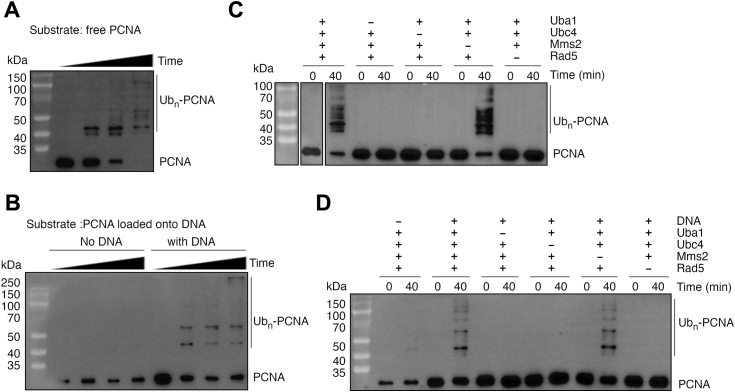 Figure 1
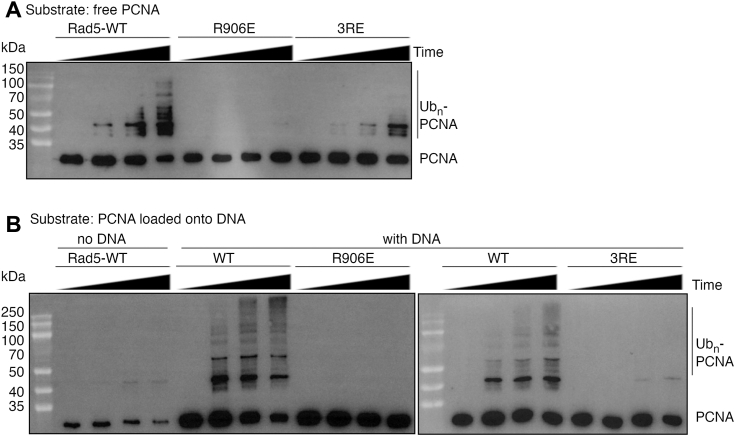 Figure 2
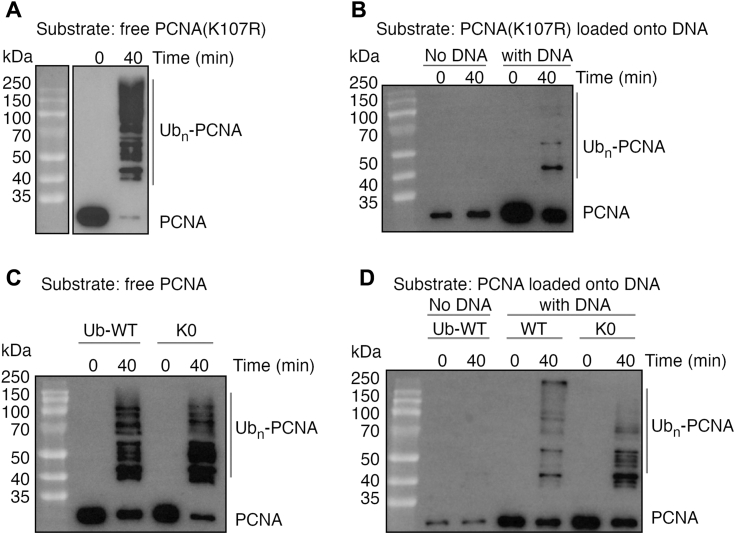 Figure 3
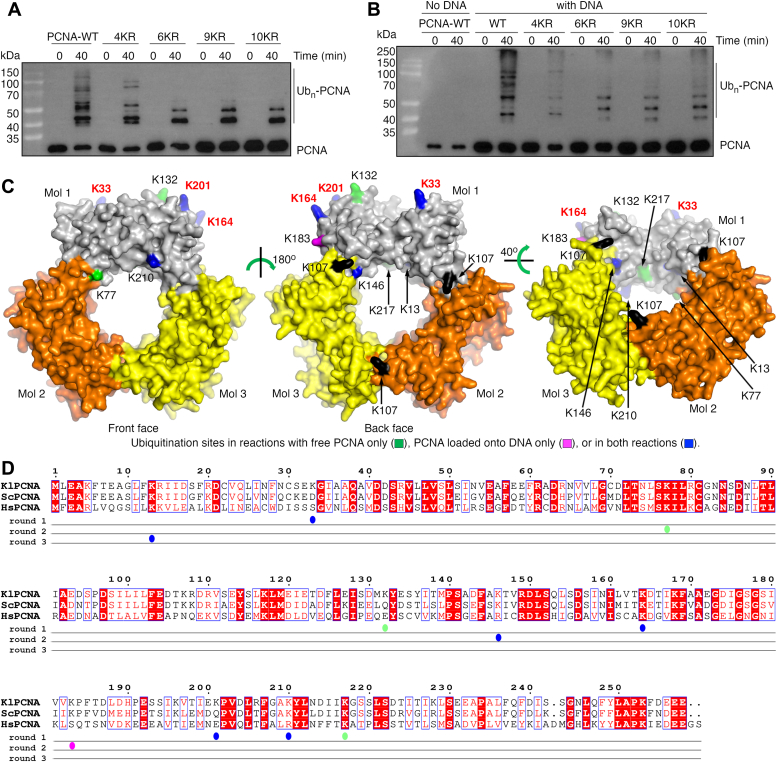 Figure 4
Peer Reviews
No public reviews on file for this paper yet. If you reviewed it on a platform where reviews are public (OpenReview, ICLR, NeurIPS, ICML), you can paste yours below so the community can read it here.
Videos
No videos yet. Explain this paper in a talk, walkthrough, or lecture? Add one.
Taxonomy
TopicsDNA Repair Mechanisms · Cancer-related Molecular Pathways · Polyomavirus and related diseases