The M.3.2 mutation in Drosophila melanogaster mapped as a novel allele of tout-velu
MacKenzie Patterson, Adriana R. Andrus, Conner Bell, Justin J. Bromell, Daniel Buchanan, Diana H. Chammout, Wisler X. Charles, Joseph E. Cummings, Anabelle Dabesh, Nixon Deleon Garcia, Kevin W. Dickerson, Toritsemose R. Emiko, Sara Fathi, Tavis J. Floyd, Hailee Gragg

TL;DR
A new mutation in fruit flies causes eye abnormalities and is linked to a known gene called tout-velu.
Contribution
The M.3.2 mutation is identified as a novel allele of the tout-velu gene in Drosophila.
Findings
M.3.2 causes cuticle expansion in the eye area and smaller eye size in Drosophila.
Genetic and molecular mapping confirmed the mutation is in the tout-velu (ttv) gene.
The mutation was identified through a screen for cell division and patterning defects.
Abstract
In Drosophila melanogaster genetic screens are often used to identify genes associated with different biological processes. Here, we have utilized the Flp/FRT system to generate mitotic clones within the developing eye. These clones were screened for mutations that disrupt cell division, organ patterning, and cell growth. One such mutation from this screen, mutant M.3.2, resulted in an expansion of the cuticle within the area normally covered by ommatidium as well as an overall smaller eye size. Genetic and molecular mapping revealed this mutation to be in the gene, t out-velu ( ttv ).
Genes, proteins, chemicals, diseases, species, mutations and cell lines named across the full text — each resolved to its canonical identifier and authoritative record.
Click any figure to enlarge with its caption.
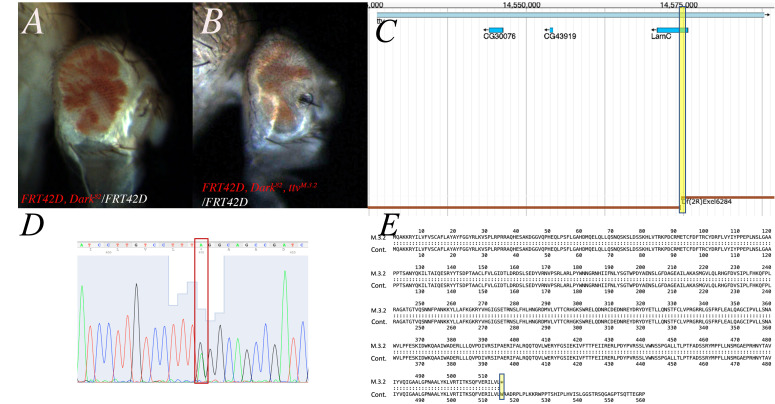 Figure 1
|
Starting stock for 2R EMS screen | |||
|
|
|
|
|
|
|
23285 |
FRT42D,Dark 82 /CyO |
Akdemir
|
|
Stocks from BDSC 2R Deficiency Kit | |||
|
|
|
|
|
|
|
8913 |
2R:14259045..14574557 |
Failure to complement |
|
|
7749 |
2R:1457750..14765770 |
Failure to complement |
|
Additional BDSC Deficiency stocks tests (not in 2R kit) | |||
|
|
24381 |
2R:14363886..14713687 |
Failure to complement |
|
|
7877 |
2R:14458207..14575583 |
Failure to complement |
|
Single genes tested for complementation | |||
|
|
|
|
|
|
|
10949 |
|
Failure to complement |
|
|
11050 |
|
Failure to complement |
- —U.S. National Science Foundation (United States)https://ror.org/021nxhr62
- —National Institutes of Health (United States)https://ror.org/01cwqze88
Peer Reviews
No public reviews on file for this paper yet. If you reviewed it on a platform where reviews are public (OpenReview, ICLR, NeurIPS, ICML), you can paste yours below so the community can read it here.
Videos
No videos yet. Explain this paper in a talk, walkthrough, or lecture? Add one.
Taxonomy
TopicsHippo pathway signaling and YAP/TAZ
Description
Drosophila melanogaster is a well-established genetic model system that has been an excellent source for gene discovery, in particular utilizing developing tissue(s) such as the eye (Morgan 1911) . All manners of genetic screening have been conducted in *Drosophila, * ranging from developmental screens to behavioral screens (St Johnston 2002) . A Flp/FRT EMS screen was conducted to identify developmental cell growth and cell division regulators on chromosome 2R. This screen identified mutations that disrupt cell growth, cell cycle, and organ development (Kagey
- et al.* 2012). Additionally, the screen was conducted in a genetic background in which cell death is homozygous blocked (via the
Dark ^82^ * allele present on the starting chromosome) (Akdemir
- et al.* 2006). Here, students from the Fly-CURE consortium worked within undergraduate laboratory courses to characterize and map one mutant from this screen, mutant M.3.2 (Merkle
- et al.* 2023).
Mosaic eyes were generated by mating the control (starting chromosome) * ;FRT42D, Dark ^82^ /CyO * and * ;FRT42D, Dark ^82^ , M.3.2/CyO * to virgin females of ;FRT42D, Ey-Flp (BDSC). The * Dark ^82^ * allele was generated with a mw+ containing transposon, so the * Dark ^82^ * containing mutant tissue is pigmented in both eyes. Straight-winged F1 progeny were scored for their mosaic eye phenotype. As previously reported, the * Dark ^82^ * mosaic eye results in a slight over representation of red tissue to white tissue (60-70% pigmented tissue, and Figure 1A ) (Akdemir
- et al.* 2006; Kagey
- et al.* 2012). Contrastingly, the
Dark ^82^ , M.3.2 * mosaic eye results in a deformed mosaic eye that has an expansion of cuticle, additional hair in the eye, and an overall smaller eye size than the control ( Figure 1A compared with 1B). The expansion of the cuticle coupled with the overall smaller adult eye size, suggests that there may be a non-autonomous aspect of the *M.3.2 * mutation.
The genetic mapping of the location of mutant M.3.2 was done by three independent groups of researchers within undergraduate genetics laboratory courses at Ohio Northern University, Morehouse College, and the University of Detroit Mercy as part of the Fly-CURE consortium (Merkle
- et al.* 2023). Genetic mapping was accomplished by setting up complementation tests between the
Dark ^82^ , M.3.2 * mutant stocks and the 2R deficiency kit (BDSC) (Cook
- et al.* 2012). Virgin females from the
;FRT42D, Dark ^82, ^ M.3.2 / CyO * stock were mated in series to male flies from the 87 deficiency stocks that comprise the Bloomington Stock Center 2R Deficiency kit (and are distal to the FRT42D location). Triplicate data from the three groups of mapping students confirmed that M.3.2 failed to complement Df(2R) Exel6284 and Df (2R) ED2354. Although these two deficiencies do not overlap ( overlap Chr2R:14,574,557 and14,574,750) there are two genes that span this gap, leaving a region that fails to complement of only two predicted genes ( Figure 1B, yellow box, and Table 1).
Further genetic mapping found that the M.3.2 mutation failed to complement two independent alleles of the gene * tout-velu (ttv ^00681b^ and ttv ^k11904^ ) * , suggesting that M.3.2 is a novel allele of * tout-velu, ttv ^M.3.2^ * . Once we had identified the causative locus for the M.3.2 mutation, we utilized WGS of heterozygous flies to look for the specific heterozygous mutations within the *ttv * locus that are unique to M.3.2 and not present in any other 2R mutant we have sequenced Bieser et al. (in preparation). From this we identified a point mutation in the ttv * locus that introduces a stop codon at the 515 amino acid (Trp515) ( Figure 1C ). TTV is a 772 amino acid protein and having a truncation at amino acid 515 suggests that the M.3.2 mutation in *ttv * is a truncation mutation and a novel null allele of * ttv * ( Figure 1C ). Given the extensive genetic and molecular data presented here we can reasonably conclude that M.3.2 is a lethal (and novel) allele of * ttv * and there are likely no additional lethal mutations (other than * Dark ^82^ * ) on the chromosome. However, a future rescue experiment would be necessary to demonstrate the phenotype observed is based solely on the *ttv * and * Dark * mutations.
Tout-velu is a homologue of the human gene, EXT1 , which is a tumor suppressor needed for the Hedgehog protein diffusion (Kim
- et al.* 2001). In flies, Hedgehog signaling is essential for proper development of many different tissues, including the processing of the morphogenetic furrow in the developing eye (Heberlein
- et al.* 1993). Given that previous studies have found a non-autonomous role for TTV in promoting Hh signaling, and the non-autonomous mosaic phenotypes we observed, we provide additional data supporting a non-autonomous role of TTV function (Bellaiche
- et al.* 1998). The Hedgehog protein is a morphogen essential for embryonic development, cell growth, cell specialization, and the patterning or shaping of the body, as TTV ensures receiving cells can interpret Hh signaling. Thus, it is likely that the
ttv ^M.3.2^ * mutant clones disrupted the MF progression in the developing eye both autonomously and non-autonomously. Additionally, loss of TTV results in cells that are unable to interpret Hh signaling from the MF, resulting in loss of Hh signaling for homozygous mutant cells, which would lead to arrested development of ommatidia (Ma and Moses 1995) .
Lastly, the inclusion of the * Dark ^82^ * allele allowed for the discovery of this *ttv * allele as a conditional regulator of cell growth and cell division in this Flp/FRT system. Previous studies disrupting Hh signaling in the developing eye through mutations in Ptc , Cos2 , or Smo have resulted in both autonomous and non-autonomous apoptosis (Christiansen
- et al.* 2012; Kagey
- et al.* 2012; Moore
- et al.* 2022). Given that *ttv * mutations disrupt Hh signaling, it is reasonable to suggest that
ttv ^-/-^ * clones would undergo apoptosis, and thus may have been missed in the initial round of Flp/FRT growth mutants (Moberg
- et al.* 2001; Tapon
- et al.* 2002; Harvey
- et al.* 2003). This would define
ttv ^M.3.2^ * as a conditional negative regulator of cell growth and development, only identified in a genetic background of blocked apoptosis (Gilbert
- et al.* 2011; Kagey
- et al.* 2012).
Reagents
**: **
The reference list from the paper itself. Each links out to its DOI / PubMed record.
- 1Akdemir F Farkas R Chen P Juhasz G Medved'ováL Sass M Wang L Wang X Chittaranjan S Gorski SM Rodriguez A Abrams JM 2006315 Autophagy occurs upstream or parallel to the apoptosome during histolytic cell death.Development 13380950-19911457146510.1242/dev.0233216540507 · doi ↗ · pubmed ↗
- 2Bellaiche Y The I Perrimon N 199872 Tout-velu is a Drosophila homologue of the putative tumour suppressor EXT-1 and is needed for Hh diffusion.Nature 39466880028-0836858810.1038/279329665133 · doi ↗ · pubmed ↗
- 3Christiansen AE Ding T Bergmann A 201265 Ligand-independent activation of the Hedgehog pathway displays non-cell autonomous proliferation during eye development in Drosophila.Mech Dev 1295-80925-47739810810.1016/j.mod.2012.05.00922677792 PMC 3917606 · doi ↗ · pubmed ↗
- 4Cook RK Christensen SJ Deal JA Coburn RA Deal ME Gresens JM Kaufman TC Cook KR 2012 The generation of chromosomal deletions to provide extensive coverage and subdivision of the Drosophila melanogaster genome.Genome Biol 1331474-7596 R 21R 2110.1186/gb-2012-13-3-r 2122445104 PMC 3439972 · doi ↗ · pubmed ↗
- 5Gilbert MM Tipping M Veraksa A Moberg KH 2011517 A screen for conditional growth suppressor genes identifies the Drosophila homolog of HD-PTP as a regulator of the oncoprotein Yorkie.Dev Cell 2051534-580770071210.1016/j.devcel.2011.04.01221571226 PMC 3386645 · doi ↗ · pubmed ↗
- 6Harvey KF Pfleger CM Hariharan IK 2003822 The Drosophila Mst ortholog, hippo, restricts growth and cell proliferation and promotes apoptosis.Cell 11440092-867445746710.1016/s 0092-8674(03)00557-912941274 · doi ↗ · pubmed ↗
- 7Heberlein U Wolff T Rubin GM 1993123 The TGF beta homolog dpp and the segment polarity gene hedgehog are required for propagation of a morphogenetic wave in the Drosophila retina.Cell 7550092-867491392610.1016/0092-8674(93)90535-x 8252627 · doi ↗ · pubmed ↗
- 8Kagey JD Brown JA Moberg KH 2012615 Regulation of Yorkie activity in Drosophila imaginal discs by the Hedgehog receptor gene patched.Mech Dev 1299-120925-477333934910.1016/j.mod.2012.05.00722705500 PMC 3668547 · doi ↗ · pubmed ↗