Time to First Analgesic Administration in the Emergency Department for Adolescents/Young Adults With Sickle Cell Disease: A Retrospective Cross-Sectional Study
Shreya Kolipaka, Michelle Axe, Brent A Passarello, David Brousseau, Charmaine Wright, Stephanie Guarino

TL;DR
This study examines how long it takes to give pain medicine to young sickle cell patients in the emergency department and finds that delays are common, which may lead to more hospital admissions.
Contribution
The study evaluates guideline adherence and TFAA impact on ED disposition for SCD patients, revealing potential for improved care through faster analgesic administration.
Findings
Most ED encounters were classified as ESI 3, with a mean TFAA of 108.9 minutes.
Only 4.1% of encounters followed both NHLBI ESI and TFAA guidelines.
Faster TFAA may reduce hospital admission rates for SCD patients.
Abstract
Many adolescent and young adult (AYA) patients with sickle cell disease (SCD) visit the emergency department (ED) for vaso-occlusive crisis (VOC) pain management. Clinical guidelines from the National Heart, Lung, and Blood Institute (NHLBI) suggest that patients should receive an Emergency Severity Index (ESI) of 2 and analgesics within 60 minutes of registration. Despite guidelines, SCD patients experience treatment delays. Our objectives are to describe a Mid-Atlantic healthcare system's guideline adherence and examine the effect of time to first analgesic administration (TFAA) on ED disposition. A retrospective cross-sectional study of the electronic health record data set of ED SCD patient encounters from July 2016 to June 2017 was conducted. Descriptive statistics were run for patient characteristics. ED encounters that followed NHLBI guidelines were included in the data set.…
Genes, proteins, chemicals, diseases, species, mutations and cell lines named across the full text — each resolved to its canonical identifier and authoritative record.
Click any figure to enlarge with its caption.
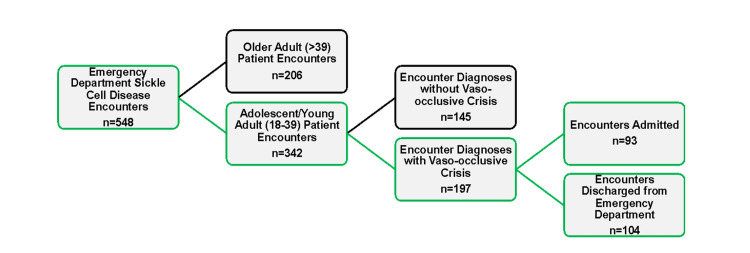 Figure 1
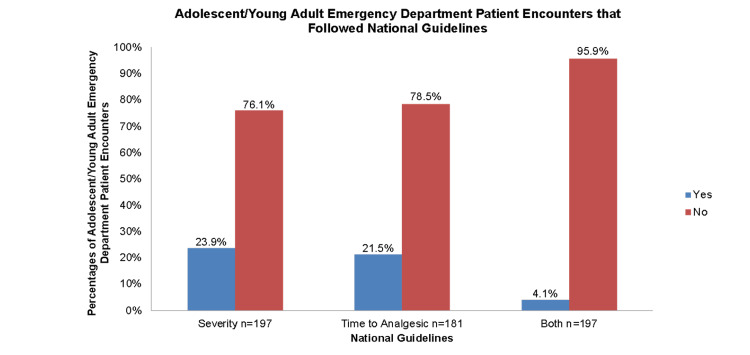 Figure 2
Peer Reviews
No public reviews on file for this paper yet. If you reviewed it on a platform where reviews are public (OpenReview, ICLR, NeurIPS, ICML), you can paste yours below so the community can read it here.
Videos
No videos yet. Explain this paper in a talk, walkthrough, or lecture? Add one.
Taxonomy
TopicsHemoglobinopathies and Related Disorders · Emergency and Acute Care Studies · Palliative Care and End-of-Life Issues