Populist attitudes and belief in conspiracy theories: anti-elitist attitudes and the preference for unrestricted popular sovereignty reduce the positive impact of an analytical thinking style on conspiracy beliefs
Stephanie Mehl, Winfried Rief, Daniel Soll, Nico Pytlik

TL;DR
The study explores how populist attitudes and belief in conspiracy theories are linked, finding that anti-elitism and preference for popular sovereignty reduce the protective effect of analytical thinking on conspiracy beliefs.
Contribution
The study reveals that populist attitudes moderate the relationship between analytical thinking and conspiracy beliefs, offering new insights into the psychological mechanisms behind conspiracy belief formation.
Findings
Populist attitudes moderately correlate with conspiracy beliefs.
Anti-elitism and preference for popular sovereignty reduce the impact of analytical thinking on conspiracy beliefs.
Populist attitudes may lower motivation to use effortful thinking to challenge conspiracy beliefs.
Abstract
Populist attitudes and the tendency to believe in specific conspiracy theories (conspiracy beliefs) are often exploited by extremist or populist parties. However, more scientific research is needed to scrutinize this association. Consequently, the present non-preregistered exploratory online study assessed whether and how conspiracy beliefs and populist attitudes are associated and whether populist attitudes moderate the association between the preference for an analytical or intuitive thinking style and conspiracy beliefs. We assessed 483 nonclinical individuals regarding their conspiracy beliefs, populist attitudes, and thinking styles and found a moderate correlation between populist attitudes and conspiracy beliefs. Conspiracy beliefs were significantly predicted by three facets of populist attitudes (anti-elitism, preference for unrestricted popular sovereignty, and belief in the…
Genes, proteins, chemicals, diseases, species, mutations and cell lines named across the full text — each resolved to its canonical identifier and authoritative record.
Click any figure to enlarge with its caption.
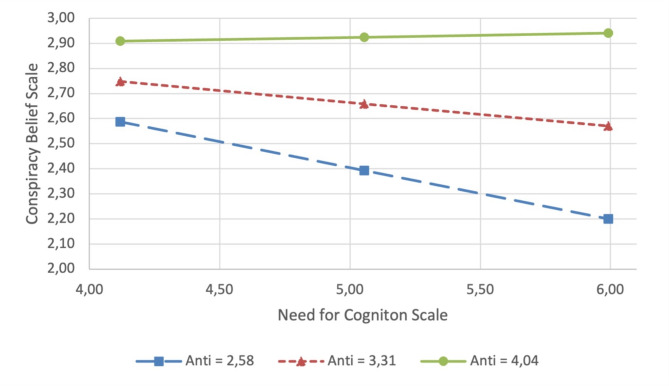 Figure 1
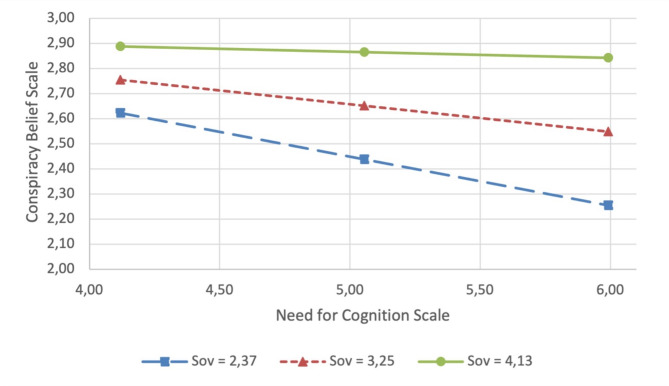 Figure 2
Peer Reviews
No public reviews on file for this paper yet. If you reviewed it on a platform where reviews are public (OpenReview, ICLR, NeurIPS, ICML), you can paste yours below so the community can read it here.
Videos
No videos yet. Explain this paper in a talk, walkthrough, or lecture? Add one.
Taxonomy
TopicsMisinformation and Its Impacts · Hate Speech and Cyberbullying Detection · Populism, Right-Wing Movements