Non-volatile photonic-electronic memory via 3D monolithic ferroelectric-silicon ring resonator
Hang Chen

TL;DR
This paper introduces a new type of memory that combines photonic and electronic components using a 3D structure with ferroelectric materials.
Contribution
The novel integration of ferroelectric thin films with silicon photonic platforms enables electrically and optically programmable non-volatile memory.
Findings
The memory supports electrically and optically programmable operations.
It allows non-destructive reading and multi-level data storage.
The fabrication process is compatible with both electronic and photonic systems.
Abstract
A novel non-volatile photonic-electronic memory, 3D integrating an Al-doped HfO2 ferroelectric thin film onto a silicon photonic platform using fully compatible electronic and photonic fabrication processes, enables electrically/optically programmable, non-destructively readable, and multi-level storage functions.
Genes, proteins, chemicals, diseases, species, mutations and cell lines named across the full text — each resolved to its canonical identifier and authoritative record.
Click any figure to enlarge with its caption.
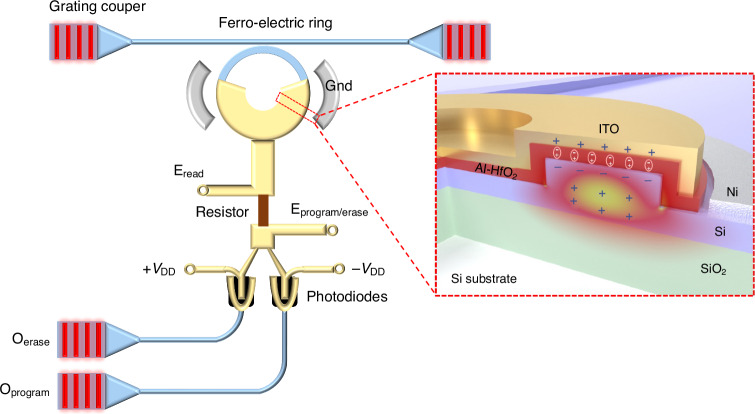 Figure 1
Peer Reviews
No public reviews on file for this paper yet. If you reviewed it on a platform where reviews are public (OpenReview, ICLR, NeurIPS, ICML), you can paste yours below so the community can read it here.
Videos
No videos yet. Explain this paper in a talk, walkthrough, or lecture? Add one.
Taxonomy
TopicsNeural Networks and Reservoir Computing · Photonic and Optical Devices · Advanced Memory and Neural Computing