
TL;DR
This paper explores how transcranial direct current stimulation improves the brain's protection against injury during isoflurane preconditioning.
Contribution
It identifies a new mechanism involving the nuclear protein Akirin2 in this protective process.
Findings
Transcranial direct current stimulation enhances isoflurane preconditioning effects.
The nuclear protein Akirin2 is associated with this protective mechanism.
This suggests a novel therapeutic approach for cerebral ischemia/reperfusion injury.
Abstract
The cover image is based on the article Transcranial direct current stimulation enhances the protective effect of isoflurane preconditioning on cerebral ischemia/reperfusion injury: A new mechanism associated with the nuclear protein Akirin2 by Xiangyi Kong et al., https://doi.org/10.1111/cns.70033.
Genes, proteins, chemicals, diseases, species, mutations and cell lines named across the full text — each resolved to its canonical identifier and authoritative record.
Click any figure to enlarge with its caption.
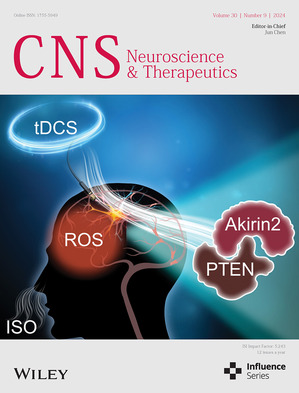 Figure 1
Peer Reviews
No public reviews on file for this paper yet. If you reviewed it on a platform where reviews are public (OpenReview, ICLR, NeurIPS, ICML), you can paste yours below so the community can read it here.
Videos
No videos yet. Explain this paper in a talk, walkthrough, or lecture? Add one.
Taxonomy
TopicsAnesthesia and Neurotoxicity Research · Cardiac Ischemia and Reperfusion · Vagus Nerve Stimulation Research