Impact of a structured teaching on the ill effects of tobacco chewing among Indian adults
Sivasubramanian N., Mahalakshmi B., Jadav Hetvi Dilipkumar, Padma P., Makwana Dhara Kamleshbhai, Jamunarani P., Jamiraben Aasifmasud Mansuri, Macwan Ellis Bharatbhai

TL;DR
A structured teaching program significantly improved knowledge about the harmful effects of tobacco chewing among Indian adults.
Contribution
The study demonstrates the effectiveness of educational interventions in increasing awareness about tobacco chewing.
Findings
Participants showed significant improvement in knowledge scores after the intervention (pretest mean 11.5, posttest mean 44.38).
Demographic factors like gender and education were associated with pre-test knowledge scores.
The program highlights the role of health education in reducing tobacco-related health risks.
Abstract
Tobacco chewing remains a prevalent health issue globally, particularly in India, where it is deeply ingrained in cultural practices. This study evaluates the impact of a structured teaching program on knowledge regarding the ill effects of tobacco chewing among adults enrolled in arts and commerce colleges in Patan, India. A quasi-experimental design was employed, with 100 participants recruited from arts and commerce colleges. The structured teaching program included educational sessions covering the harmful effects of tobacco chewing and cessation strategies. Pre and post-test knowledge assessments were conducted using a self-structured questionnaire. The majority of participants were aged 15-17 years (75%), male (75%), and from urban areas (58.33%). Significant improvements in knowledge scores were observed following the intervention (pretest mean score = 11.5, posttest mean score =…
Genes, proteins, chemicals, diseases, species, mutations and cell lines named across the full text — each resolved to its canonical identifier and authoritative record.
Click any figure to enlarge with its caption.
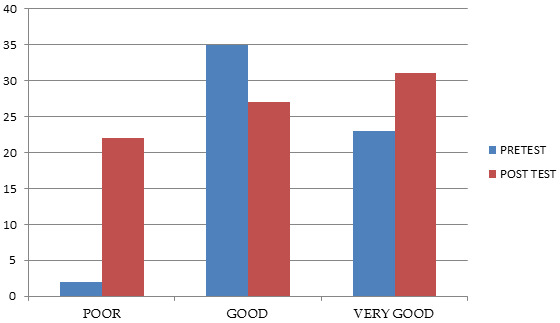 Figure 1
Peer Reviews
No public reviews on file for this paper yet. If you reviewed it on a platform where reviews are public (OpenReview, ICLR, NeurIPS, ICML), you can paste yours below so the community can read it here.
Videos
No videos yet. Explain this paper in a talk, walkthrough, or lecture? Add one.
Taxonomy
TopicsSmoking Behavior and Cessation · COVID-19 and Mental Health · Health and Lifestyle Studies
Background:
Tobacco use, including chewing, remains a significant public health challenge globally, contributing to a wide range of adverse health outcomes and placing a substantial burden on healthcare systems. According to the World Health Organization [WHO], tobacco kills more than 8 million people worldwide each year, with over 7 million of these deaths attributed to direct tobacco use and approximately 1.2 million to non-smokers exposed to secondhand smoke. Despite widespread awareness of the harmful effects of tobacco, its use continues to be prevalent, particularly in certain regions and population groups. [1] In India, where tobacco consumption is deeply ingrained in cultural and social practices, chewing tobacco is a common form of use, especially among adults. The Global Adult Tobacco Survey [GATS] conducted in India revealed that approximately 28.6% of adults [aged 15 and above] use tobacco in some form, with smokeless tobacco products, including chewing tobacco, being the most prevalent. This high prevalence underscores the urgent need for targeted interventions to address tobacco use and its associated health risks effectively. [2] Among the myriad health consequences of tobacco use, oral health is particularly impacted by chewing tobacco. Studies have linked tobacco chewing to various oral conditions, including oral cancer, periodontal diseases, tooth decay, and mucosal lesions. [3] The carcinogenic components present in tobacco, such as nitrosamines and polycyclic aromatic hydrocarbons, increase the risk of oral cancer significantly. Additionally, the abrasive nature of tobacco products can damage oral tissues and contribute to gum recession and tooth loss. [4] Educational interventions play a crucial role in raising awareness about the harmful effects of tobacco use and promoting behavior change among individuals. Arts and commerce colleges provide a unique opportunity to implement such interventions, given their diverse student populations and emphasis on holistic education. By integrating health education programs into the curriculum, colleges can empower students with knowledge and skills to make informed decisions about their health and well-being. [5] Therefore, it is of interest to evaluate the effectiveness of a structured teaching program on knowledge regarding the ill effects of tobacco chewing among adults enrolled in selected arts and commerce colleges at Patna. The objectives include assessing baseline knowledge levels, measuring changes in knowledge following the intervention, and exploring associations between pre-test knowledge scores and demographic variables. Through rigorous evaluation and analysis, this study seeks to contribute valuable insights into the design and implementation of effective health education initiatives targeting tobacco use and its consequences.
Methodology:
Design:
A quasi-experimental design [6] was utilized to assess the effectiveness of a structured teaching program on knowledge regarding the ill effects of tobacco chewing among adults in selected arts and commerce colleges at Patna.
Participants:
The study recruited 100 adults, including students and faculty members, from arts and commerce colleges in Patan.
Intervention:
The structured teaching program consisted of educational sessions covering the harmful effects of tobacco chewing and cessation strategies, delivered through various methods such as lectures, discussions, and multimedia presentations.
Data collection:
A pre-tested, self-structured questionnaire was used to collect demographic information and assess pre-test knowledge levels regarding tobacco chewing's ill effects. The same questionnaire was administered immediately after the intervention to assess post-test knowledge levels.
Analysis:
Descriptive statistics summarized demographic characteristics and knowledge scores. Paired t-tests compared pre and post-test scores, and chi-square tests explored associations between knowledge scores and demographic variables [7].
Results:
Table 1 summarizes the demographic characteristics of the sample. Majority of participants were aged 15-17 years [75%], male [75%], and from nuclear families [65%]. Most belonged to the Hindu religion [75%] and resided in urban areas [58.33%]. Additionally, a significant proportion had fathers employed as daily wage earners [55%] and mothers working as housewives [78%]. Comparison of pre and post scores among adults concerning the ill effects of tobacco chewing and its effects shows that the pretest means knowledge score was 11.5 with a standard deviation of 2.50; while the posttest means knowledge score was 44.38 with a standard deviation of 26.42. A paired t-test revealed a statistically significant difference between pre and post scores [t = 11.38, p < 0.001], indicating the effectiveness of the structured teaching program in enhancing knowledge regarding tobacco chewing and its effects. Associations between pre-test knowledge scores and demographic variables among adults shows there was Significant associations were found with gender (χ^2^ = 13.6), education (χ^2^ = 73.44), type of family (χ^2^ = 40.86), area of residence (χ^2^ = 47.55), father's education (χ^2^ = 59.58), father's occupation (χ^2^ = 84.81), monthly income (χ^2^ = 13.85), history of illness (χ^2^ = 13.6), and previous knowledge (χ^2^ = 47.55) (p < 0.05). No significant associations were observed for age, religion, mother's education, mother's occupation, and family history of tobacco chewing (p > 0.05)."
Discussion:
The findings of this study reveal significant improvements in knowledge regarding the ill effects of tobacco chewing among adults following the structured teaching program. These results align with previous research highlighting the effectiveness of educational interventions in enhancing awareness of tobacco-related health risks. Comparing our study's results with those of several other studies, including Maya Sahu et al. (2017) and Baskaran et al. (2019), similar trends were observed in the post-test knowledge scores among participants [8,9]. Anshuman et al. (2019) also reported a notable increase in knowledge levels following a structured educational intervention focused on tobacco chewing. [10] These consistent findings underscore the importance of targeted health education programs in addressing gaps in knowledge and promoting behaviour change. Furthermore, the associations between pre-test knowledge scores and demographic variables identified in our study resonate with previous research. For instance, similar to our findings, studies conducted Chatterjee et al. (2014) found significant associations between knowledge levels and factors such as gender, education, and socioeconomic status [11]. This suggests that certain demographic characteristics may influence individuals' baseline knowledge levels and their receptiveness to educational interventions. Despite the promising results, our study has several limitations that warrant consideration. The use of convenience sampling may limit the generalizability of findings, and potential biases in self-reported data could affect the accuracy of results. Future research could employ larger, more diverse samples and utilize randomized controlled trial designs to further validate the effectiveness of educational interventions. In conclusion, the findings of this study highlight the efficacy of a structured teaching program in enhancing knowledge regarding tobacco chewing's ill effects among adults. By addressing gaps in knowledge and raising awareness of tobacco-related health risks, such interventions play a crucial role in promoting public health and fostering behavior change.
The reference list from the paper itself. Each links out to its DOI / PubMed record.
- 1St Claire S Am J Physiol Lung Cell Mol Physiol . 2020318 L 1004.3223379110.1152/ajplung.00101.2020 PMC 7272734 · doi ↗ · pubmed ↗
- 2Rai B Bramhankar M Tob. Prev. Cessat. 20217193370904310.18332/tpc/132466 PMC 7942198 · doi ↗ · pubmed ↗
- 3Gajendra S Tob. Induc. Dis. 202321123674154210.18332/tid/157203 PMC 9875717 · doi ↗ · pubmed ↗
- 4Tomar S.L Adv. Dent. Res. 20193043153880710.1177/0022034519872481 · doi ↗ · pubmed ↗
- 5Nazir M.A Almas K.Eur. J. Dent. 201711292843536210.4103/ejd.ejd_300_16PMC 5379831 · doi ↗ · pubmed ↗
- 6Mahalakshmi B Bioinformation 2022186403731305410.6026/97320630018640 PMC 10259226 · doi ↗ · pubmed ↗
- 7Mahalakshmi B Bioinformation 20231910863804651310.6026/973206300191086 PMC 10692985 · doi ↗ · pubmed ↗
- 8Sahu M Asian J. Psychiatry 201729732906143210.1016/j.ajp.2017.04.021 · doi ↗ · pubmed ↗