Whole-genome sequencing of Helicobacter pylori isolates from Native American gastric biopsy specimens
Kimberly Celona, Charles H. D. Williamson, Rishi Dholakia, Jason W. Sahl, Fernando P. Monroy, Erik W. Settles

TL;DR
This study uses whole-genome sequencing to analyze Helicobacter pylori isolates from Native American patients with gastric disease.
Contribution
The study provides new genomic data on H. pylori isolates from a specific indigenous population in the U.S.
Findings
Three H. pylori isolates from Native American patients were sequenced.
The isolates originated from individuals with gastric disease.
The data may help understand H. pylori's role in gastric cancer in indigenous populations.
Abstract
Helicobacter pylori infection has been linked to gastrointestinal diseases including gastric cancer. High rates of H. pylori infection and gastric cancer have been reported in indigenous populations within the United States. We report whole-genome sequencing of three H. pylori isolates originating from Native American patients presenting with gastric disease.
Genes, proteins, chemicals, diseases, species, mutations and cell lines named across the full text — each resolved to its canonical identifier and authoritative record.
Click any figure to enlarge with its caption.
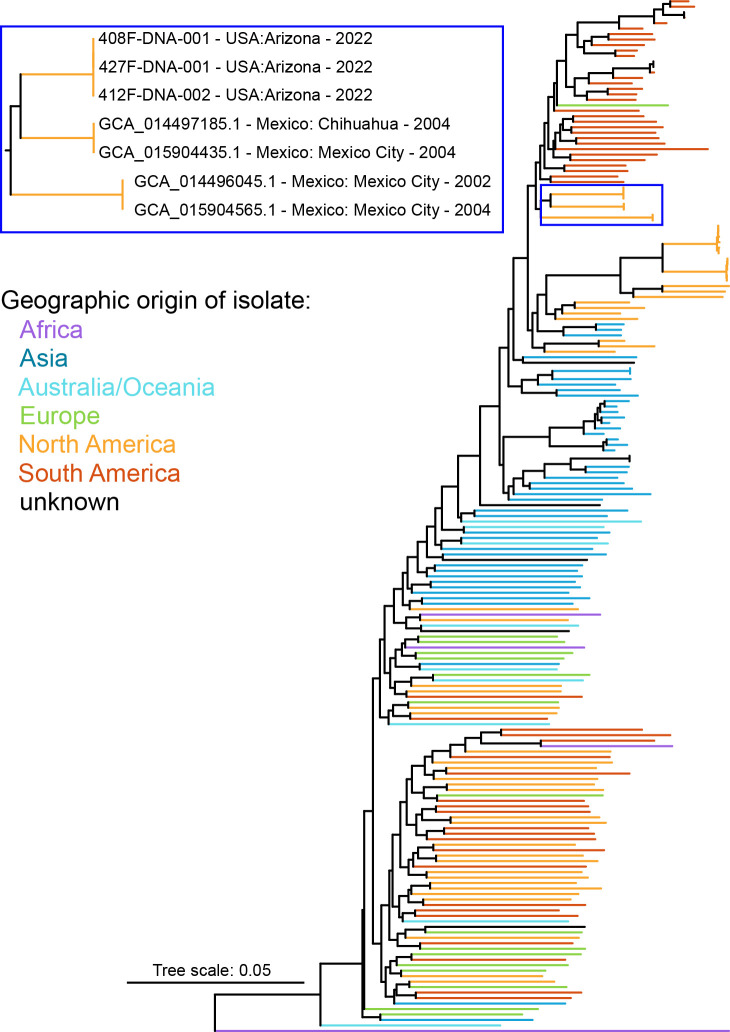 Fig 1
Fig 1| Isolate | 408F-DNA-001 | 412F-DNA-002 | 427F-DNA-001 |
|---|---|---|---|
| Assembly accession |
|
|
|
| SRA accession |
|
|
|
| Sequencing kit | 500-cycle Nano v2 | 500-cycle Nano v2 | 600-cycle v3 |
| Sequencing format | 2 × 251 bp | 2 × 251 bp | 2 × 301 bp |
| Total number of paired reads | 373,565 | 441,603 | 1,201,328 |
| Average depth of coverage | 113× | 124× | 436× |
| Number of contigs | 28 | 19 | 18 |
| Genome size (bp) | 1,570,731 | 1,570,272 | 1,570,218 |
| L50 | 4 | 3 | 3 |
| N50 (bp) | 176,074 | 236,910 | 236,904 |
| Length of longest contig (bp) | 266,682 | 411,760 | 411,746 |
| Average GC content | 0.39 | 0.39 | 0.39 |
| Total CDSs (PGAP) | 1,502 | 1,487 | 1,490 |
| Minimum inhibitory concentration for clarithromycin ( | 0.125 | 1.5 | 0.5 |
| Minimum inhibitory concentration for metronidazole | 8 | 16 | 1 |
| Mutations potentially associated with clarithromycin | Mutations within 23S rRNA (ARO:3004134) - T510C, G722A, G760del, T896C, T976G, T1024C, C1516del, T1568C, C1648T, T2199C | ||
| Genes/mutations potentially associated with metronidazole resistance | Presence of major facilitator superfamily antibiotic efflux pump (ARO:3003964); mutations within frxA (ARO:3007059) - | ||
- —HHS | NIH | National Cancer Institute (NCI)
- —HHS | NIH | National Cancer Institute (NCI)
Peer Reviews
No public reviews on file for this paper yet. If you reviewed it on a platform where reviews are public (OpenReview, ICLR, NeurIPS, ICML), you can paste yours below so the community can read it here.
Videos
No videos yet. Explain this paper in a talk, walkthrough, or lecture? Add one.
Taxonomy
TopicsHelicobacter pylori-related gastroenterology studies · Galectins and Cancer Biology · Veterinary medicine and infectious diseases
ANNOUNCEMENT
Helicobacter pylori, a Gram-negative bacterium, is the causative agent of most human gastric infections and is linked to gastric cancer (1–3). Indigenous communities in the United States have elevated rates of infection and gastric cancer. Members of the Navajo Nation have rates of infection ranging between 56% and 70% (4, 5) and gastric cancer rates three to four times higher than non-Hispanic white populations (6). Navajo patients with gastric symptoms had a gastric biopsy during endoscopy and H. pylori culturing or PCR was performed. H. pylori was present in ~23% of these biopsy samples (7). We describe whole-genome sequencing of three H. pylori isolates from these patients.
Patients were enrolled by informed consent (Navajo Nation IRB #NNR16.263). Gastric pinch biopsy samples were collected during a routine scheduled patient endoscopy. Samples were ground in sterile phosphate-buffered saline, inoculated onto Columbia Agar plates containing 5% defibrinated sheep blood and H. pylori selective supplement (Dent), and incubated for 72 h at 37°C under microaerophilic conditions (5% O_2_, 10% CO_2_, and 85% N_2_). Minimum inhibitory concentrations (MICs) for clarithromycin and metronidazole were determined with ETESTs (bioMérieux) by inoculating 100 µL of a 3 McFarland equivalent isolate suspension onto Mueller-Hinton II plates with 5% defibrinated sheep blood and incubating at 37°C for 4 days under microaerophilic conditions.
Isolate genomic DNA was extracted using a Blood and Tissue Kit (Qiagen) following the manufacturer’s protocol with the additional pretreatment for Gram-negative bacteria. Whole-genome sequencing libraries were generated as previously described (8, 9) except quality was assessed with a Fragment Analyzer using the High Sensitivity NGS fragment kit. Samples were sequenced on the MiSeq platform. Contaminating sequencing reads were identified and removed with the BBsplit tool (BBMap v38.93—sourceforge.net/projects/bbmap/) using phiX (J02482.1) and human (GCF_000001405.39) genomes as references, followed by assignment of taxonomic classifications to reads with kraken2 v2.1.2 (10) and removal of contaminating reads. H. pylori genomes were assembled using SPAdes v3.15.3 (--careful, --cov-cutoff auto) (11). Depth of coverage was calculated from minimap2 v2.24 (-ax sr) (12) alignments using Samtools v1.16.1 (13). Contigs with anomalously low depth of coverage were removed. Assembly metrics were calculated with the statswrapper.sh tool (sourceforge.net/projects/bbmap/ v39.01). Assemblies were annotated with the NCBI Prokaryotic Genome Annotation Pipeline (PGAP) v6.6 (14). Core genome single nucleotide polymorphisms (SNPs) were called from nucmer v3.1 (15) alignments (reference = GCA_017821535.1) within NASP v1.2.1 (16), and a phylogeny was inferred with IQ-TREE v2.2.2.3 (17, 18) from proximity filtered SNPs (distance of 5). The vacA and cagA genotypes were determined with in silico PCR (usearch v11.0.667_i86linux32 – search_pcr, -maxdiffs 2) (19) using previously described primers (20–23). Genomes were screened for antibiotic-resistance markers listed in the Comprehensive Antimicrobial Resistance Database (24).
Genome assembly information is presented in Table 1. The three isolates are putatively genotyped as cagA^−^ and vacA type s2i2m2. A SNP phylogeny (Fig. 1) indicates that the isolates are closely related to isolates originating from Indigenous or Mestizo individuals presenting with gastritis in Mexico (25, 26). ETESTS indicate some isolates are resistant to clarithromycin and metronidazole (Table 1).
Core genome SNP phylogeny (midpoint rooted) of 186 publicly available H. pylori genomes and three newly sequenced H. pylori genomes. Colors indicate the continent of origin for the H. pylori isolates included in the tree. The blue box highlights the three newly sequenced isolates (408F, 412F, and 427F) and closely related isolates. The three newly sequenced isolates are closely related to isolates collected from Indigenous or Mestizo individuals presenting with gastritis in Mexico.
The reference list from the paper itself. Each links out to its DOI / PubMed record.
- 1Makola D, Peura DA, Crowe SE. 2007. Helicobacter pylori infection and related gastrointestinal diseases. J Clin Gastroenterol 41:548–558. doi:10.1097/MCG.0b 013e 318030 e 3c 317577110 · doi ↗ · pubmed ↗
- 2de Martel C, Ferlay J, Franceschi S, Vignat J, Bray F, Forman D, Plummer M. 2012. Global burden of cancers attributable to infections in 2008: a review and synthetic analysis. Lancet Oncol 13:607–615. doi:10.1016/S 1470-2045(12)70137-722575588 · doi ↗ · pubmed ↗
- 3Eusebi LH, Zagari RM, Bazzoli F. 2014. Epidemiology of Helicobacter pylori infection. Helicobacter 19 Suppl 1:1–5. doi:10.1111/hel.1216525167938 · doi ↗ · pubmed ↗
- 4Stancioiu F. 2005. Helicobacter pylori: findings in a native American population. IHS Prim Care Provid 30:60–63.
- 5Harris RB, Brown HE, Begay RL, Sanderson PR, Chief C, Monroy FP, Oren E. 2022. Helicobacter pylori prevalence and risk factors in three rural indigenous communities of northern Arizona. Int J Environ Res Public Health 19:797. doi:10.3390/ijerph 1902079735055622 PMC 8775467 · doi ↗ · pubmed ↗
- 6Anonymous. 2013 Cancer among the Navajo 2005-2013
- 7Monroy FP, Brown HE, Sanderson PR, Jarrin G, Mbegbu M, Kyman S, Harris RB. 2022. Helicobacter pylori in native Americans in northern Arizona. Diseases 10:19. doi:10.3390/diseases 1002001935466189 PMC 9036257 · doi ↗ · pubmed ↗
- 8Stone NE, Hall CM, Ortiz M, Hutton SM, Santana-Propper E, Celona KR, Williamson CHD, Bratsch N, Fernandes LGV, Busch JD, Pearson T, Rivera-Garcia S, Soltero F, Galloway R, Sahl JW, Nally JE, Wagner DM. 2022. Diverse lineages of pathogenic leptospira species are widespread in the environment in Puerto Rico. P Lo S Negl Trop Dis 16:e 0009959. doi:10.1371/journal.pntd.000995935584143 PMC 9154103 · doi ↗ · pubmed ↗