Complete coding sequence of Rift Valley fever virus identified by metagenomic sequencing in patient with undifferentiated febrile illness at Marigat sub-district hospital, Kenya
Allan Lemtudo, Gathii Kimita, George Awinda, Beth Mutai, John Waitumbi

TL;DR
Scientists identified the full genetic code of Rift Valley fever virus in a child's blood sample using metagenomic sequencing in Kenya.
Contribution
The study reports the complete coding sequence of Rift Valley fever virus identified through metagenomic sequencing in a clinical setting.
Findings
The virus's genome clustered phylogenetically with sequences from the 2017 Uganda and 2021 Kiambu outbreaks.
Metagenomic sequencing successfully identified the virus in a patient with undifferentiated fever.
Abstract
We report on the complete coding sequence of Rift Valley Fever Virus inadvertently identified through metagenomics in a child with undifferentiated fever at Marigat sub-county hospital, Kenya. On phylogeny, the genome clustered with sequences obtained during the 2017 human outbreak in Uganda and the 2021 cattle outbreak in Kiambu, Kenya.
Genes, proteins, chemicals, diseases, species, mutations and cell lines named across the full text — each resolved to its canonical identifier and authoritative record.
Click any figure to enlarge with its caption.
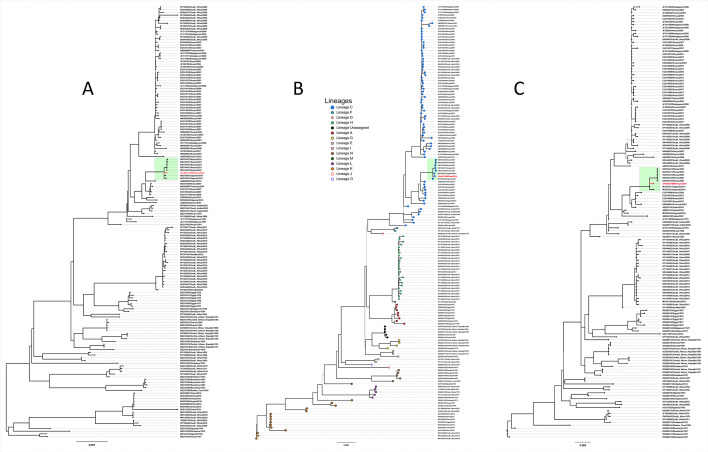 Fig 1
Fig 1| Variable | Category | Frequency | (%) |
|---|---|---|---|
| Demographic distribution | |||
| Sex | Male | 20 | 44.4 |
| Female* | 25 | 55.6 | |
| Age (years) | ≤5 | 10 | 22.2 |
| 06-Dec* | 19 | 42.2 | |
| 13–19 | 11 | 24.4 | |
| 20–35 | 4 | 8.9 | |
| ≥35 | 1 | 2.2 | |
| Risk exposure | |||
| Contact with cows | 26* | 57.8 | |
| Contact with goats | 32 | 71.1 | |
| Contact with sheep | 23* | 51.1 | |
| Symptoms | |||
| Fever (≥38⁰) | 44* | 100 | |
| Headache | 44* | 100 | |
| Joint aches | 37* | 82.2 | |
| Chills | 34* | 75.6 | |
| Muscle aches | 33* | 73.3 | |
| Vomiting | 17 | 37.8 | |
- —DOD | MHS | Armed Forces Health Surveillance Branch (AFHSB)
Peer Reviews
No public reviews on file for this paper yet. If you reviewed it on a platform where reviews are public (OpenReview, ICLR, NeurIPS, ICML), you can paste yours below so the community can read it here.
Videos
No videos yet. Explain this paper in a talk, walkthrough, or lecture? Add one.
Taxonomy
TopicsViral Infections and Vectors · Viral Infections and Outbreaks Research · Fire effects on ecosystems
ANNOUNCEMENT
Rift Valley fever virus (RVFV) is a Phlebovirus in the Bunyaviridae family that is transmitted by mosquitoes that largely affect livestock, but can also infect humans (1, 2). Outbreaks occur after heavy rains that create mosquito breeding grounds (2, 3). In 2018, conditions in Wajir and Marsabit counties, Kenya, led to RVF cases (4). In December 2019, a blood sample that had been obtained in August 2018 from a febrile child at Marigat sub-county hospital (648 km from the nearest county) had short genomic sequences that mapped to RVFV. Presence of RVFV in the sample was confirmed by RT-qPCR (Altona Diagnostics GmbH, Hamburg Germany) in 7500 fast machine (Applied Biosystem, CA, USA). Extended screening comprising 44 other samples collected from febrile patients around the same time as the index case (Table 1), revealed two more RVFV-positive samples (Cts 19.3 and 34.3).
RNA was isolated from serum of positive samples using the MagMAX Pathogen RNA/DNA Kit (Applied Biosystems), then depleted of host genomic DNA with TURBO DNase Kit (Invitrogen, CA, USA), followed by first-strand cDNA synthesis with Superscript IV RT kit (Invitrogen) using SISPA primers (5). The second strand was synthesized by a Klenow reaction (New England Biolabs, MA, USA), followed by random fragment amplification with MyTaq Red master mix (Meridian Bioscience Inc, OH, USA). Amplicons were used to prepare sequence libraries using Collibri ES DNA library prep kit (Invitrogen, CA, USA) and paired ends were sequenced using v3 chemistry on a Miseq (Illumina, CA, USA). The ngs_mapper pipeline v1.4.2 (https://github.com/VDBWRAIR/ngs_mapper) was used to quality filter, map, and generate consensus sequences, which were curated and annotated in Geneious Prime v2023.2.1 using a customized database of RVFV genomes derived from NCBI Genbank. Lineage assignment was conducted using rvfvtyping v1.0 (6). Only the study sample with a Ct value of 19.3 yielded useable sequences and was analyzed for phylogenetic assignment in MAFFT v7 (7) together with sequences obtained from the BV-BRC database. Nucleotide substitution models were tested in JModelTest v2 (8), and the GTR + GI substitution model was used to infer a maximum likelihood phylogeny with PhyML v3 (9).
The study genome yielded 1,611,904 reads that mapped to a 12-kilobase RVFV reference genome: NC_014397 corresponding to the L segment (6,397 bp, 43.4% GC, mean coverage 34,331×); NC_014396 to M segment (3,875 bp, 46.3% GC, mean coverage 33,671×), and NC_014395 to S (1,684 bp, 51.1% GC, mean coverage 22,465×). The study genome was classified as lineage C (Fig. 1, red fonts), and clustered in a clade comprising sequences from the 2017 human RVFV outbreak in Uganda (10) and the 2021 cattle outbreak in Kenya (6) (Fig. 1, highlighted in green).
Phylogenetic tree drawn from 477 RVFV L (Panel A), M (Panel B), and S (Panel C) genomes from BV-BRC (Bacterial and Viral Bioinformatics Resource Center). The study genome (indicated with red fonts) branched with lineage C genomes and clustered with the 2017 human RVFV outbreak in Uganda and the 2021 cattle outbreak in Kenya (highlighted in green).
We detected RVFV in febrile patients without travel history to outbreak-affected counties, suggesting exposure through transported animals, meat, or milk. Enzootic RVFV circulation in Baringo County is also possible due to its high-risk status (11). The C lineage, previously linked to major RVF outbreaks in East Africa (including the 2006–2007 outbreak in Kenya, Tanzania, and Somalia), may have reservoirs in the country (12).
The reference list from the paper itself. Each links out to its DOI / PubMed record.
- 1Hartman A. 2017. Rift Valley fever. Clin Lab Med 37:285–301. doi:10.1016/j.cll.2017.01.00428457351 PMC 5458783 · doi ↗ · pubmed ↗
- 2Wright D, Kortekaas J, Bowden TA, Warimwe GM. 2019. Rift Valley fever: biology and epidemiology. J Gen Virol 100:1187–1199. doi:10.1099/jgv.0.00129631310198 PMC 7613496 · doi ↗ · pubmed ↗
- 3Okaka FO, Odhiambo BDO. 2018. Relationship between flooding and out break of infectious diseasesin Kenya: a review of the literature. J Environ Public Health 2018:5452938. doi:10.1155/2018/545293830416526 PMC 6207902 · doi ↗ · pubmed ↗
- 4WHO. 2018. Disease outbreak news. World health organization. Available from: https://www.who.int/emergencies/disease-outbreak-news/item/18-june-2018-rift-valley-fever-kenya-en
- 5Djikeng A, Halpin R, Kuzmickas R, Depasse J, Feldblyum J, Sengamalay N, Afonso C, Zhang X, Anderson NG, Ghedin E, Spiro DJ. 2008. Viral genome sequencing by random priming methods. BMC Genomics 9:1–9. doi:10.1186/1471-2164-9-518179705 PMC 2254600 · doi ↗ · pubmed ↗
- 6Juma J, Fonseca V, Konongoi SL, van Heusden P, Roesel K, Sang R, Bett B, Christoffels A, de Oliveira T, Oyola SO. 2022. Genomic surveillance of Rift Valley fever virus: from sequencing to lineage assignment. BMC Genomics 23:520. doi:10.1186/s 12864-022-08764-635850574 PMC 9295512 · doi ↗ · pubmed ↗
- 7Katoh K, Standley DM. 2013. MAFFT multiple sequence alignment software version 7: improvements in performance and usability. Mol Biol Evol 30:772–780. doi:10.1093/molbev/mst 01023329690 PMC 3603318 · doi ↗ · pubmed ↗
- 8Darriba D, Taboada GL, Doallo R, Posada D. 2012. J Model Test 2: more models, new heuristics and parallel computing. Nat Methods 9:772–772. doi:10.1038/nmeth.2109 PMC 459475622847109 · doi ↗ · pubmed ↗