Isolated Adrenocorticotropic Hormone Deficiency Diagnosed After the Cessation of Glucocorticoid Therapy for Eosinophilic Esophagitis: A Case Report
Shogo Iwamura, Shiori Watts, Kazuma Sakuraba, Yohei Yamamoto, Daisuke Matsuda

TL;DR
A 71-year-old woman developed adrenal insufficiency after stopping glucocorticoid therapy, and doctors diagnosed her with a rare pituitary disorder instead of a reversible condition.
Contribution
This case highlights the importance of distinguishing isolated adrenocorticotropic hormone deficiency from glucocorticoid-induced adrenal insufficiency.
Findings
The patient's adrenal insufficiency was caused by isolated adrenocorticotropic hormone deficiency, not by GC-induced secondary adrenal insufficiency.
The case emphasizes the need for endocrinological evaluation when adrenal symptoms arise after GC therapy reduction.
The patient required lifelong hydrocortisone replacement therapy.
Abstract
Isolated adrenocorticotropic hormone deficiency (IAD) is a rare pituitary disorder that can cause adrenal insufficiency. However, due to its nonspecific symptoms, its diagnosis is often difficult and may be delayed. Patients with IAD require lifelong glucocorticoid (GC) replacement therapy. Contrastingly, GC-induced secondary adrenal insufficiency is a reversible condition that arises when patients receiving GC therapy reduce their GC dosage or discontinue therapy. Differentiating between IAD and GC-induced secondary adrenal insufficiency is clinically crucial. We report a unique case that required differentiation between these two conditions. A 71-year-old Japanese woman presented with symptoms of adrenal insufficiency after discontinuation of GC therapy for eosinophilic esophagitis. We conducted detailed interviews and repeated the endocrinological examinations. We concluded that her…
Genes, proteins, chemicals, diseases, species, mutations and cell lines named across the full text — each resolved to its canonical identifier and authoritative record.
Click any figure to enlarge with its caption.
 Figure 1
 Figure 2
 Figure 3
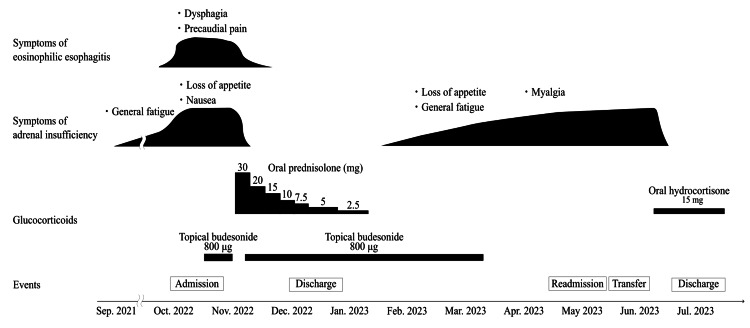 Figure 4
Peer Reviews
No public reviews on file for this paper yet. If you reviewed it on a platform where reviews are public (OpenReview, ICLR, NeurIPS, ICML), you can paste yours below so the community can read it here.
Videos
No videos yet. Explain this paper in a talk, walkthrough, or lecture? Add one.
Taxonomy
TopicsEosinophilic Esophagitis · Eosinophilic Disorders and Syndromes · Urticaria and Related Conditions