Genomic evidence that Ornithinicoccus soli Jiang et al. 2020 is a later heterotypic synonym of Segeticoccus rhizosphaerae Lee and Whang 2020
Qing Liu, Yu-Hua Xin

TL;DR
This study shows that two soil bacteria species, Ornithinicoccus soli and Segeticoccus rhizosphaerae, are actually the same species based on genomic and phylogenetic evidence.
Contribution
The paper provides genomic evidence to reclassify Ornithinicoccus soli as a later synonym of Segeticoccus rhizosphaerae.
Findings
Both strains share identical 16S rRNA gene sequences and similar genomic features.
Average nucleotide identity and digital DNA–DNA hybridization values confirm they are the same species.
Phylogenetic analysis shows they form a distinct cluster separate from other genera.
Abstract
The genus Segeticoccus includes only one species with validly published name, Segeticoccus rhizosphaerae. The type strain Segeticoccus rhizosphaerae YJ01T was isolated from soil in Korea, while Ornithinicoccus soli XNB-1T was isolated from soil in China. Both strains share similar phenotypic and chemotaxonomic characteristics, including predominant menaquinone MK-8(H4) and major polar lipids diphosphatidylglycerol and phosphatidylglycerol. Whole genome sequences revealed a DNA G+C content of 70.1 mol% for both strains and 100% similarity in their 16S rRNA gene sequences. Phylogenetic analysis showed they form a distinct cluster separate from other genera. Genomic comparisons showed average nucleotide identity and digital DNA–DNA hybridization values of 99.16 and 94.2%, respectively, indicating they represent a single species. Based on this genomic evidence, Ornithinicoccus soli Jiang et…
Genes, proteins, chemicals, diseases, species, mutations and cell lines named across the full text — each resolved to its canonical identifier and authoritative record.
Click any figure to enlarge with its caption.
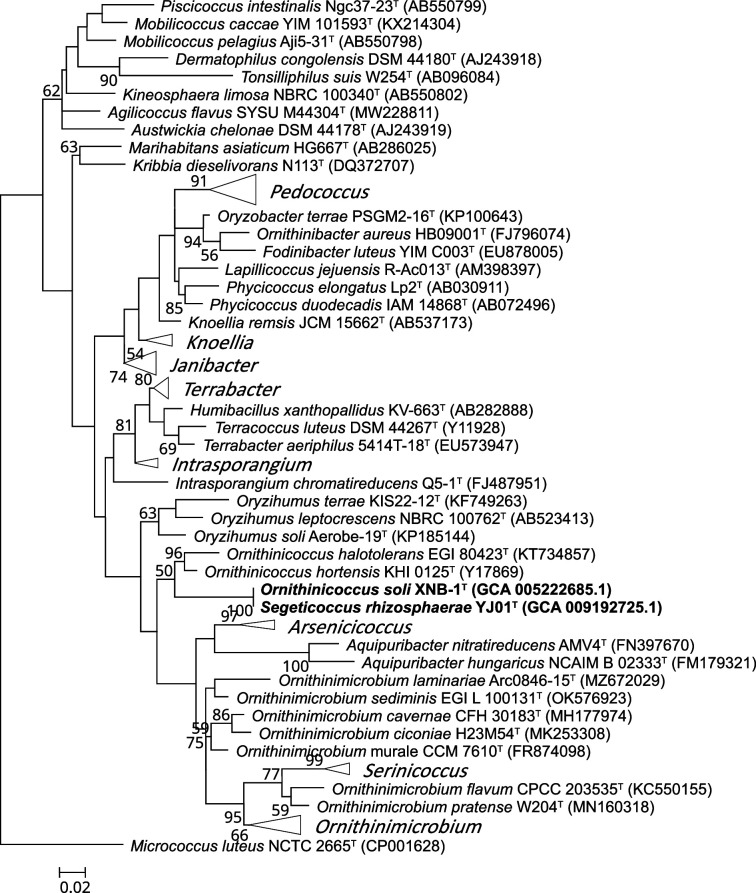 Figure 1
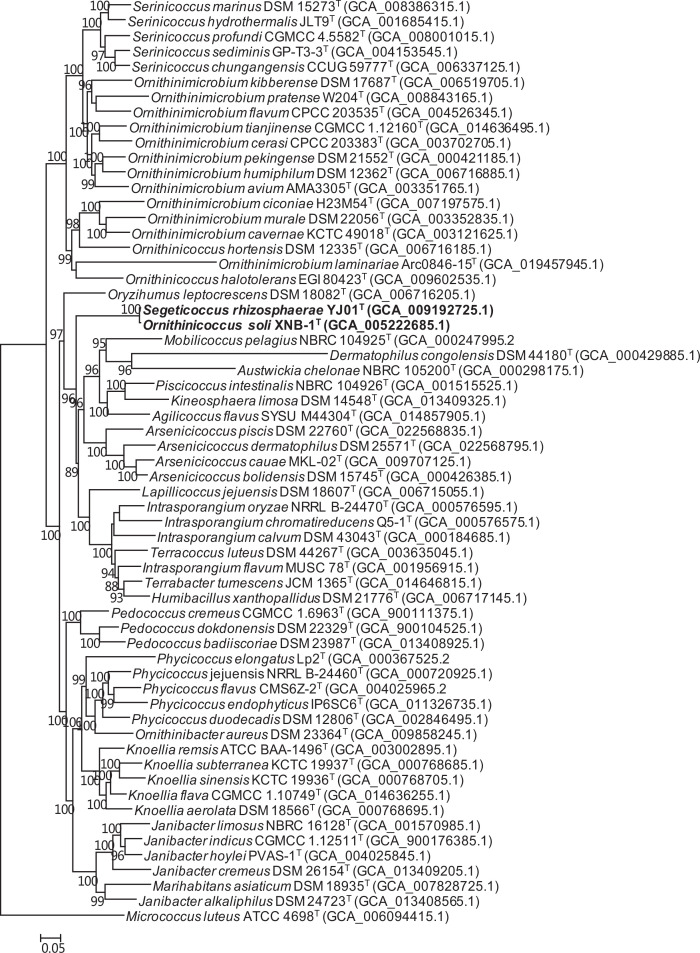 Figure 2
- —http://dx.doi.org/10.13039/501100001809 National Natural Science Foundation of China
Peer Reviews
No public reviews on file for this paper yet. If you reviewed it on a platform where reviews are public (OpenReview, ICLR, NeurIPS, ICML), you can paste yours below so the community can read it here.
Videos
No videos yet. Explain this paper in a talk, walkthrough, or lecture? Add one.
Taxonomy
TopicsGenomics and Phylogenetic Studies · Microbial Community Ecology and Physiology · Protist diversity and phylogeny
The genus Segeticoccus, was first described by Lee and Whang [1]. Currently, only one species within Segeticoccus is validly published, namely, Segeticoccus rhizosphaerae [2]. The type strain Segeticoccus rhizosphaerae YJ01^T^ (=KACC 19547^T^=NBRC 113173^T^), was isolated from a spinach farming field soil at Shinan in Korea. It was a Gram-stain-positive, aerobic, non-motile, non-spore-forming cocci, capable of growing at 10–37 °C (optimum, 28–30 °C) and 0–7.5 % (w/v) NaCl (optimum, 1.0% NaCl) [1]. Ornithinicoccus soli XNB-1^T^ (=CCTCC AB 2019099^T^=KCTC 49259^T^) was isolated from farmland soil in Taian, Shandong province, PR China [3]. It is a Gram-stain-positive, aerobic, non-motile, coccoid-shaped bacterium, capable of growing at 16–30 °C (optimum, 30 °C) and 0–7% (w/v) NaCl (optimum, 1.0%). Both strains contained MK-8(H_4_) as the predominant menaquinone, and diphosphatidylglycerol and phosphatidylglycerol as the major polar lipids. Both the names Segeticoccus rhizosphaerae Lee and Whang 2020 [1] and Ornithinicoccus soli Jiang et al. 2020 [3] were published in issue 3 of volume 70 in 2020. However, their relationship and taxonomic status need to further clarified.
Whole genome sequences of type strains in the genera Segeticoccus, Ornithinicoccus, Ornithinimicrobium, and related genera within family Intrasporangiaceae were obtained from the publicly available NCBI GenBank. Genome quality, genome completeness and contamination were evaluated using the CheckM program version 1.1.3 [4]. The genome sequences were annotated using Prokka v1.13 software [5]. The 16S rRNA gene phylogenetic trees were reconstructed by the neighbour-joining (NJ) [6] and maximum-likelihood (ML) [7] methods using the mega software version 5.2 [8]. The alignment was generated using mafft version 7.520 software [9]. The genetic distances for the NJ analysis were calculated by Kimura’s two parameter model [10]. The ML phylogenetic tree was generated with the best nucleotide substitution model of GTR+G+I [11]. The tree topologies were evaluated by bootstrap values based on 1000 resamplings [12]. The phylogenomic tree was reconstructed usingiq-tree version 2.0.7 [13] with model GTR+F+R5 based on 92 core genes extracted by UBCG program [14]. The digital DNA–DNA hybridization (dDDH) values were calculated using the TYGS as implemented on the DSMZ website [15]. The average nucleotide identity (ANI) values were determined using FastANI version 1.33 [16]. The average amino acid identity (AAI) values were calculated using the CompareM program (https://github.com/dparks1134/CompareM).
The genome information showed that the DNA G+C content of both strains was 70.1 mol% (Table 1). The complete 16S rRNA gene sequences of Segeticoccus rhizosphaerae YJ01^T^ (1519 bp) and Ornithinicoccus soli XNB-1^T^ (1519 bp) were retrieved from their genomic sequences, revealing 100% similarity, indicating a very close relationship. The 16S rRNA gene phylogenetic tree showed that Segeticoccus rhizosphaerae and Ornithinicoccus soli formed a distinct cluster, separated from Ornithinicoccus halotolerans and Ornithinicoccus hortensis (Figs 1 and S1, available in the online Supplementary Material).
A robust phylogenomic tree showed the very close relationship between Segeticoccus rhizosphaerae YJ01^T^ and Ornithinicoccus soli XNB-1^T^, indicating they may belong to the same species (Fig. 2). They formed an independent branch, separated from other genera such as Ornithinicoccus, Oryzihumus and Ornithinimicrobium. Therefore, strain XNB-1^T^ should be classified as belonging to the genus Segeticoccus rather than Ornithinicoccus. The ANI and dDDH values between the two strains were 99.1 and 94.2%, respectively, confirming that they represent a single species. The ANI values between Segeticoccus rhizosphaerae YJ01^T^, Ornithinicoccus soli XNB-1^T^ and other type strains of genus Ornithinicoccus were lower than 78% (Table 2). The AAI values between Segeticoccus rhizosphaerae YJ01^T^, Ornithinicoccus soli XNB-1^T^ and other members of Ornithinicoccus were lower than 63.7%, which were below the AAI threshold for bacterial genus delineation of 65–72% suggested by Konstantinidis and Tiedje [17]. Therefore, combined with the evidence provided by Lee and Whang [1], they should be classified into the genus Segeticoccus. Additionally, both strains shared similar phenotypic and chemotaxonomic characteristics, as shown in Table 3.
Collectively, based on the genomic evidence, including ANI, dDDH and AAI values, and phylogenetic characteristics, Ornithinicoccus soli is proposed to be a later heterotypic synonym of Segeticoccus rhizosphaerae.
supplementary material
10.1099/ijsem.0.006503Uncited Fig. S1.
The reference list from the paper itself. Each links out to its DOI / PubMed record.
- 1Lee JC Whang KS Segeticoccus rhizosphaerae gen. nov., sp. nov., an actinobacterium isolated from soil of a farming field Int J Syst Evol Microbiol 2020701785179210.1099/ijsem.0.00397331951190 · doi ↗ · pubmed ↗
- 2Oren A Garrity GM Notification that new names of prokaryotes, new combinations, and new taxonomic opinions have appeared in volume 70, part 3 of the IJSEM Int J Syst Evol Microbiol 2020703583358710.1099/ijsem.0.00419632600513 · doi ↗ · pubmed ↗
- 3Jiang W-K Gao Q-Q Zhang L Sun G-J Zhang M-L et al Ornithinicoccus soli sp. nov., isolated from farmland soil Int J Syst Evol Microbiol 2020701793179910.1099/ijsem.0.00397231958054 · doi ↗ · pubmed ↗
- 4Parks DH Imelfort M Skennerton CT Hugenholtz P Tyson GW Check M: assessing the quality of microbial genomes recovered from isolates, single cells, and metagenomes Genome Res 2015251043105510.1101/gr.186072.11425977477 PMC 4484387 · doi ↗ · pubmed ↗
- 5Seemann T Prokka: rapid prokaryotic genome annotation Bioinformatics 2014302068206910.1093/bioinformatics/btu 15324642063 · doi ↗ · pubmed ↗
- 6Saitou N Nei M The neighbor-joining method: a new method for reconstructing phylogenetic trees Mol Biol Evol 1987440642510.1093/oxfordjournals.molbev.a 0404543447015 · doi ↗ · pubmed ↗
- 7Felsenstein J Evolutionary trees from DNA sequences: a maximum likelihood approach J Mol Evol 19811736837610.1007/BF 017343597288891 · doi ↗ · pubmed ↗
- 8Tamura K Peterson D Peterson N Stecher G Nei M et al MEGA 5: molecular evolutionary genetics analysis using maximum likelihood, evolutionary distance, and maximum parsimony methods Mol Biol Evol 2011282731273910.1093/molbev/msr 12121546353 PMC 3203626 · doi ↗ · pubmed ↗