Role of TGFβ-producing regulatory T cells in scleroderma and end-stage organ failure
Kuo-Cheng Lu, Kuo-Wang Tsai, Wan-Chung Hu

TL;DR
This paper reviews how TGFβ-producing regulatory T cells contribute to tissue fibrosis in scleroderma and end-stage organ failure, highlighting their role in disease progression.
Contribution
The paper provides a review connecting TGFβ-producing regulatory T cells to the pathogenesis of systemic sclerosis and organ fibrosis.
Findings
TGFβ-producing regulatory T cells are linked to systemic sclerosis and organ fibrosis.
Tregs and TGFβ play a key role in the pathogenesis of heart, liver, and lung fibrosis.
Understanding TGFβ mechanisms could improve treatments for end-stage organ failures.
Abstract
Regulatory T cells (Tregs) are crucial immune cells that initiate a tolerable immune response. Transforming growth factor-beta (TGFβ) is a key cytokine produced by Tregs and plays a significant role in stimulating tissue fibrosis. Systemic sclerosis, an autoimmune disease characterized by organ fibrosis, is associated with an overrepresentation of regulatory T cells. This review aims to identify Treg-dominant tolerable host immune reactions and discuss their association with scleroderma and end-stage organ failure. End-stage organ failures, including heart failure, liver cirrhosis, uremia, and pulmonary fibrosis, are frequently linked to tissue fibrosis. This suggests that TGFβ-producing Tregs are involved in the pathogenesis of these conditions. However, the exact significance of TGFβ and the mechanisms through which it induces tolerable immune reactions during end-stage organ failure…
Genes, proteins, chemicals, diseases, species, mutations and cell lines named across the full text — each resolved to its canonical identifier and authoritative record.
Click any figure to enlarge with its caption.
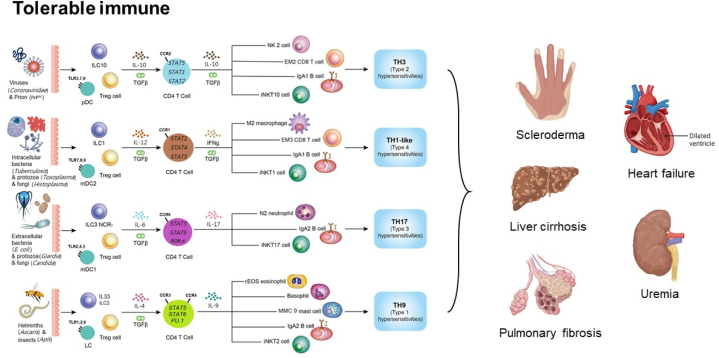 Figure 1
Peer Reviews
No public reviews on file for this paper yet. If you reviewed it on a platform where reviews are public (OpenReview, ICLR, NeurIPS, ICML), you can paste yours below so the community can read it here.
Videos
No videos yet. Explain this paper in a talk, walkthrough, or lecture? Add one.
Taxonomy
TopicsScientific Research and Philosophical Inquiry