Mobile-CRISPRi protocol optimization for Vibrionaceae
Logan J. Geyman, Madeline P. Tanner, Natalia Rosario-Meléndez, Jason M. Peters, Mark J. Mandel, Julia C. van Kessel

TL;DR
This paper describes optimized methods for using the Mobile-CRISPRi system to knock down gene expression in various Vibrio bacteria.
Contribution
The study provides optimized protocols for applying Mobile-CRISPRi in multiple Vibrio species.
Findings
Mobile-CRISPRi components were successfully integrated into the chromosome of Vibrio species via Tn7 transposition.
The optimized protocol enables inducible gene expression knockdown in multiple Vibrio species.
The system uses isopropyl β-D-1-thiogalactopyranoside to induce deactivating Cas9 and guide RNA expression.
Abstract
Mobile clustered regularly interspaced palindromic repeats interference (Mobile-CRISPRi) is an established method for bacterial gene expression knockdown. The deactivated Cas9 protein and guide RNA are isopropyl β-D-1-thiogalactopyranoside inducible, and all components are integrated into the chromosome via Tn7 transposition. Here, we optimized methods specific for applying Mobile-CRISPRi in multiple Vibrio species.
Genes, proteins, chemicals, diseases, species, mutations and cell lines named across the full text — each resolved to its canonical identifier and authoritative record.
Click any figure to enlarge with its caption.
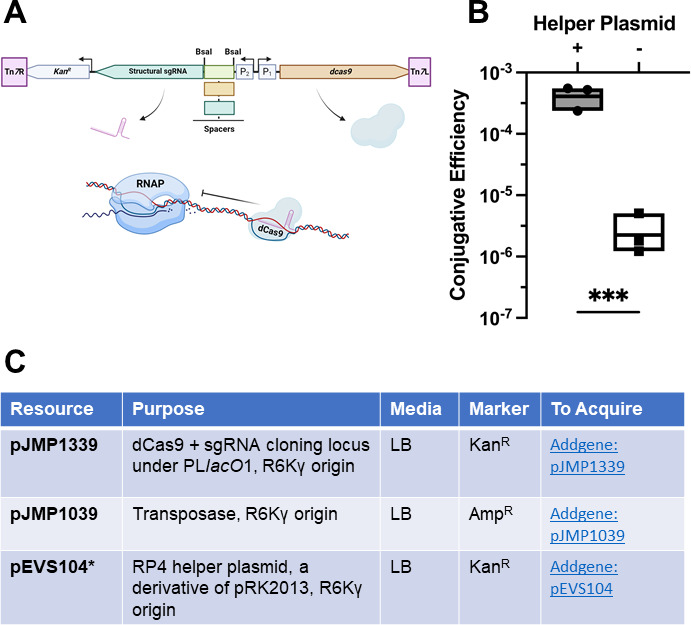 Fig 1
Fig 1- —HHS | National Institutes of Health (NIH)
- —HHS | National Institutes of Health (NIH)https://doi.org/10.13039/100000002
- —HHS | National Institutes of Health (NIH)https://doi.org/10.13039/100000002
- —HHS | National Institutes of Health (NIH)https://doi.org/10.13039/100000002
- —NSF | National Science Foundation Graduate Research Fellowship Program (GRFP)
Peer Reviews
No public reviews on file for this paper yet. If you reviewed it on a platform where reviews are public (OpenReview, ICLR, NeurIPS, ICML), you can paste yours below so the community can read it here.
Videos
No videos yet. Explain this paper in a talk, walkthrough, or lecture? Add one.
Taxonomy
TopicsCRISPR and Genetic Engineering · Vibrio bacteria research studies · Aquaculture disease management and microbiota
ANNOUNCEMENT
Vibrio bacteria are important model organisms for diverse fields of research. Their use in research has predicated the demand for increasingly creative genetic tools. While many Vibrio species are naturally competent (1), other models remain more genetically recalcitrant. Mobile clustered regularly interspaced palindromic repeats interference (Mobile-CRISPRi) was initially demonstrated in non-model Vibrio caseii, and its potential made it a target for further optimization in model Vibrio species (2, 3). Herein, we specify the optimized workflow for Mobile-CRISPRi in Vibrio.
Mobile-CRISPRi utilizes inducible expression of deactivated Cas9 and a single-guide RNA (sgRNA), both expressed through isopropyl β-D-1-thiogalactopyranoside-dependent induction, to facilitate conditional knockdown of target genes. This system is stably incorporated endogenously into the target organism via Tn7 transposition (Fig. 1A). This is typically done using a tri-parental conjugation, with diaminopimelic acid (DAP) counter-selection of the plasmid donors and antibiotic selection for successful target organism integration. When optimizing this system for use in Vibrio, we observed a limiting deficiency in successful conjugates, typically yielding exconjugants in Vibrio fischeri but not the other species tested. To address this issue, we deployed an Escherichia coli strain containing an RP4 helper plasmid, pRK600, a pRK2013 derivative (4, 5). We found that quadraparental mating improved conjugative efficiency by ~100-fold in Vibrio campbellii (Fig. 1B). As a result, we have optimized this protocol for non-fischeri Vibrio as follows:
Acquire the necessary vectors from Addgene (see Fig. 1C).Clone desired sgRNA into pJMP1339 following the protocol from Banta et al. (6).
- Note that the R6Kγ origins require the use of cloning strains that possess pir (e.g., λ pir). Grow up overnight cultures of E. coli strains containing the following plasmids in appropriate antibiotic-containing Lysogeny Broth (LB) media:
- pJMP1039 (transposase).
- Modified pJMP1339 with the cloned sgRNA.
- Target bacterial strain.
- pEVS104 helper plasmid.
- Note: While plasmid pRK600 is not available in public repositories, pEVS104 is an alternate RP4 helper plasmid modified for use in Vibrio that is publicly available through Addgene (Fig. 1C) (5). Spin down 1 mL of each culture in a tabletop centrifuge for 5 minutes at 8,000 × g and resuspend in antibiotic-free LB medium.Following this, co-spot 10 µL of each culture onto an LB plate. Repeat this three times to create four co-spots on the same LB plate. Incubate overnight at 30°C with the lid up.The next day, resuspend all four of the co-spots in the same 1 mL of LB-Marine (LM): LB supplemented with 10 g of NaCl per liter. Streak the co-spot mix for single colonies on LM plates supplemented with polymyxin B to counter-select against E. coli (see note below) and 100-µg/mL kanamycin to select for successful Mobile-CRISPRi plasmid integration. Incubate plates at 30°C overnight.
- For Vibrio strains that are not naturally polymyxin B resistant, DAP auxotrophic E. coli should be used and the co-spots streaked on LM without DAP to counter-select against. E. coli.
- We recommend plating for viability on both the plates listed above and a plate group without kanamycin to calculate conjugative efficiency out of the total viable cells. In Fig. 1B, these values were calculated by dividing the CFUs on the polymyxin B + kanamycin plates by those present on plates with polymyxin alone. Upon the growth of colonies, test a small subset of exconjugants (two to three) for integration via colony PCR using a primer that sits in the glmS locus and one that sits within the Mobile-CRISPRi near the Tn7-R site.
*(A) Schematic for Mobile-CRISPRi. P1 and P2 are both PLlacO1 (6). (B) Conjugative efficiency of plasmid pLG2 targeting luxR in V. campbellii with and without RP4 helper plasmid pRK600 (3). The line in each box represents the group mean. Each point is a biological replicate that is the average of two technical replicates. Statistical analysis performed using GraphPad Prism: unpaired t-test on log-transformed data. ***P = 0.0005. (C) Table outlining the conjugation resources available for this method. pEVS104 was not the helper used in panel B.
The same concept can be applied in V. fischeri using conjugation and media conditions described by Stabb and Ruby (5). Use of the DAP counter-selection against the E. coli donor is especially useful in V. fischeri.
Further details of how this toolkit functions experimentally in Vibrio are available here (3). The use of the RP4 helper plasmid greatly expanded the efficiency of this system (Fig. 1B). This modification has made the use of Mobile-CRISPRi a reliable, robust toolkit for exploring Vibrio genetics (3).
The reference list from the paper itself. Each links out to its DOI / PubMed record.
- 1Simpson CA , Podicheti R , Rusch DB , Dalia AB , van Kessel JC . 2019. Diversity in natural transformation frequencies and regulation across Vibrio species. m Bio 10:e 02788-19. doi:10.1128/m Bio.02788-19 31848285 PMC 6918086 · doi ↗ · pubmed ↗
- 2Peters JM , Koo B-M , Patino R , Heussler GE , Hearne CC , Qu J , Inclan YF , Hawkins JS , Lu CHS , Silvis MR , Harden MM , Osadnik H , Peters JE , Engel JN , Dutton RJ , Grossman AD , Gross CA , Rosenberg OS . 2019. Enabling genetic analysis of diverse bacteria with Mobile-CRISP Ri. Nat Microbiol 4:244–250. doi:10.1038/s 41564-018-0327-z 30617347 PMC 6424567 · doi ↗ · pubmed ↗
- 3Geyman LJ , Tanner MP , Rosario-Meléndez N , Peters JM , Mandel MJ , van Kessel JC . 2024. Mobile-CRISP Ri as a powerful tool for modulating Vibrio gene expression. Appl Environ Microbiol 90:e 0006524. doi:10.1128/aem.00065-24 38775491 PMC 11218623 · doi ↗ · pubmed ↗
- 4Kessler B , de Lorenzo V , Timmis KN . 1992. A general system to integrate lac Z fusions into the chromosomes of gram-negative eubacteria: regulation of the Pm promoter of the TOL plasmid studied with all controlling elements in monocopy. Mol Gen Genet 233:293–301. doi:10.1007/BF 00587591 1318499 · doi ↗ · pubmed ↗
- 5Stabb E , Ruby E . 2002. RP 4-based plasmids for conjugation between Escherichia coli and members of the vibrionaceae. Meth Enzymol 358. doi:10.1016/S 0076-6879(02)58106-4 12474404 · doi ↗ · pubmed ↗
- 6Banta AB , Ward RD , Tran JS , Bacon EE , Peters JM . 2020. Programmable gene knockdown in diverse bacteria using Mobile-CRISP Ri. Curr Protoc Microbiol 59:e 130. doi:10.1002/cpmc.130 33332762 PMC 7809906 · doi ↗ · pubmed ↗