osm-5p- driven fluorophores are differentially expressed in ccpp-1Δ and nekl-4Δ mutant ciliated neurons
Kaiden M Power, Maureen M Barr

TL;DR
This study shows that the expression of a key ciliary protein, OSM-5, is affected in specific mutant worms, suggesting new regulatory mechanisms.
Contribution
The study reveals that OSM-5 expression levels may be regulated by ccpp-1 and nekl-4, introducing new regulatory pathways in ciliary biology.
Findings
OSM-5-driven fluorophores show altered brightness in ccpp-1Δ and nekl-4Δ mutants.
This suggests that ccpp-1 and nekl-4 may regulate osm-5 expression in ciliated neurons.
The osm-5 promoter is commonly used for expressing constructs in ciliated neurons.
Abstract
Intraflagellar transport (IFT) involves the coordinated transport of molecular motors and other proteins and is required for ciliogenesis and ciliary maintenance. The C. elegans IFT protein OSM-5 /IFT88 is expressed in a majority of the ciliated neurons in the animal, and osm-5 mutants exhibit structurally defective cilia. The osm-5 promoter is commonly used to express genetic constructs in the ciliated neurons. In this study, we show that brightness of osm-5p- driven constructs is altered in mutants of the tubulin deglutamylase ccpp-1 and the NIMA-related kinase nekl-4 . This raises the possibility that osm-5 expression levels may be regulated by ccpp-1 and nekl-4 .
Genes, proteins, chemicals, diseases, species, mutations and cell lines named across the full text — each resolved to its canonical identifier and authoritative record.
Click any figure to enlarge with its caption.
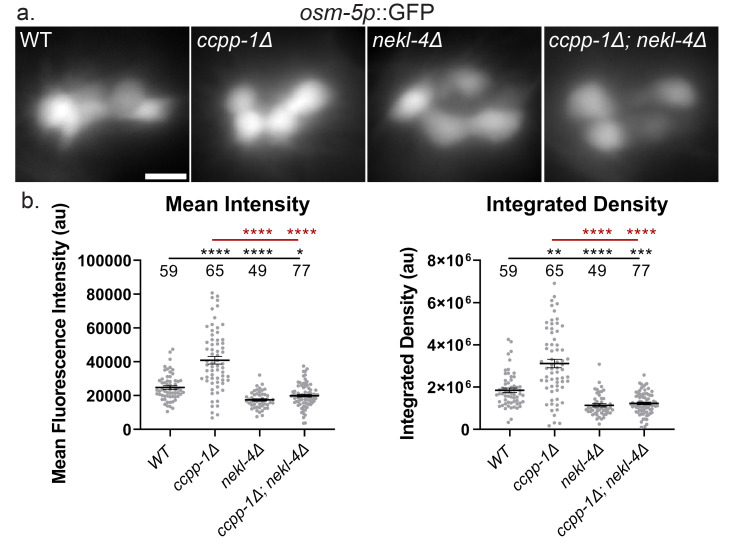 Figure 1
Peer Reviews
No public reviews on file for this paper yet. If you reviewed it on a platform where reviews are public (OpenReview, ICLR, NeurIPS, ICML), you can paste yours below so the community can read it here.
Videos
No videos yet. Explain this paper in a talk, walkthrough, or lecture? Add one.
Taxonomy
TopicsDNA and Nucleic Acid Chemistry · Molecular Sensors and Ion Detection