Caudiquinol: A Meroterpenoid with an Intact C20 Geranylgeranyl Chain Isolated from Garcinia caudiculata
Maya Valmiki, Stephen Ping Teo, Pedro Ernesto de Resende, Simon Gibbons, A. Ganesan

TL;DR
Researchers discovered a new natural compound, caudiquinol, from Garcinia caudiculata, which contains an intact geranylgeranyl chain, a rare feature in plant compounds.
Contribution
The study reports the isolation and characterization of a new meroterpenoid, caudiquinol, from Garcinia caudiculata.
Findings
A new hydroquinone methyl ester, caudiquinol, was isolated and identified from Garcinia caudiculata.
Caudiquinol and another known compound were found to have an intact C20 geranylgeranyl chain.
This is the first phytochemical investigation of Garcinia caudiculata from Borneo.
Abstract
The tropical Garcinia genus of flowering plants is a prolific producer of aromatic natural products including polyphenols, flavonoids, and xanthones. In this study, we report the first phytochemical investigation of Garcinia caudiculata Ridl. from the island of Borneo. Fractionation, purification, and structure elucidation by MS and NMR resulted in the discovery of two meroterpenoids. One was a benzofuranone lactone previously isolated from Iryanthera grandis and Rhus chinensis, and the second was a new hydroquinone methyl ester that we named caudiquinol. Both natural products are rare examples of plant meroterpenoids with an intact geranylgeranyl chain.
Genes, proteins, chemicals, diseases, species, mutations and cell lines named across the full text — each resolved to its canonical identifier and authoritative record.
Click any figure to enlarge with its caption.
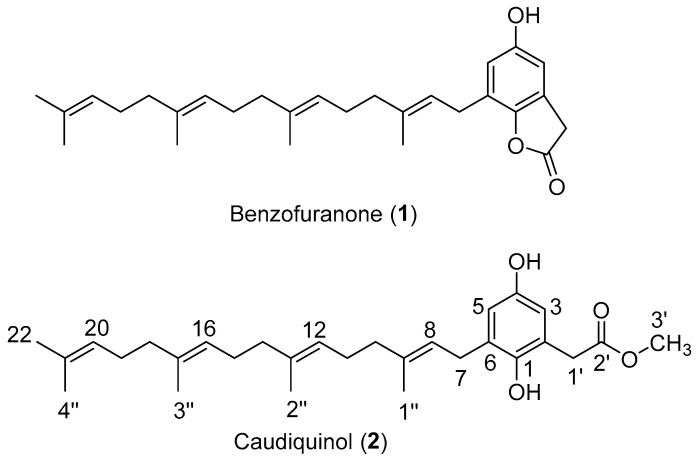 Figure 1
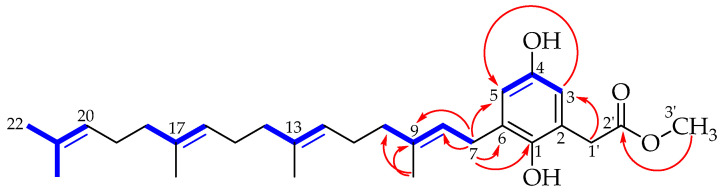 Figure 2
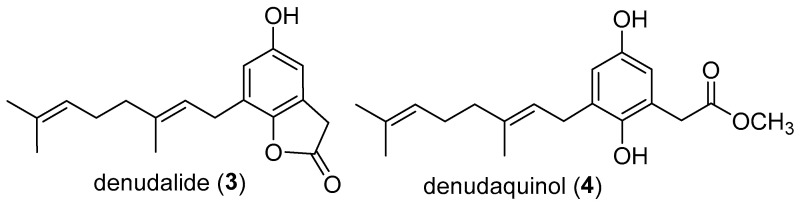 Figure 3
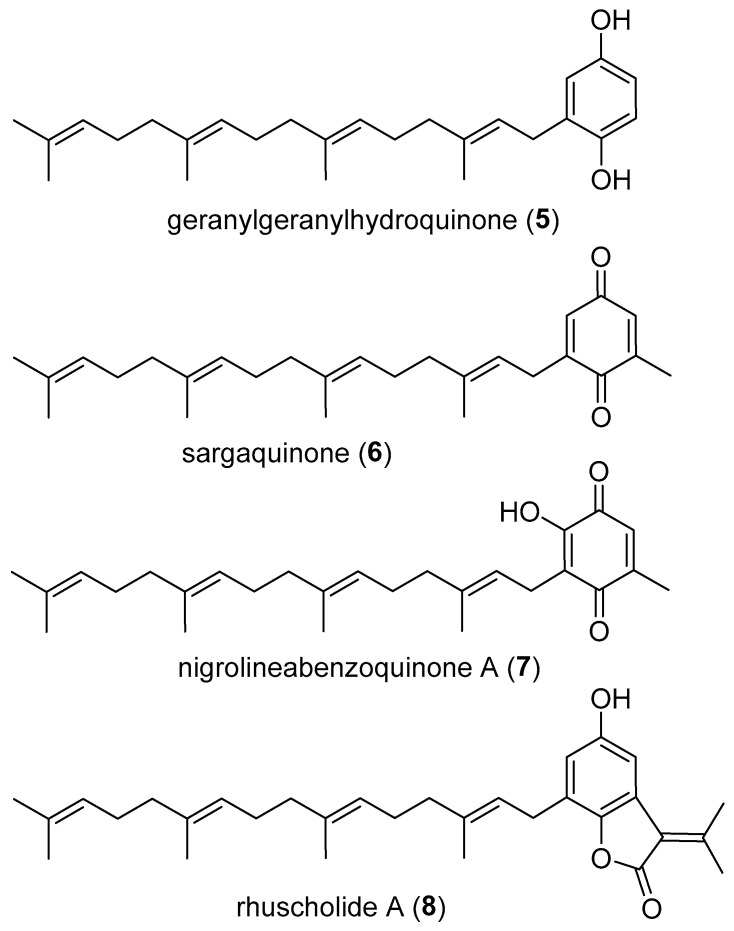 Figure 4
Peer Reviews
No public reviews on file for this paper yet. If you reviewed it on a platform where reviews are public (OpenReview, ICLR, NeurIPS, ICML), you can paste yours below so the community can read it here.
Videos
No videos yet. Explain this paper in a talk, walkthrough, or lecture? Add one.
Taxonomy
TopicsNatural Compound Pharmacology Studies · Synthesis of Organic Compounds · Natural product bioactivities and synthesis
1. Introduction
The Garcinia genus of saptrees within the Clusiaceae family comprises several hundred species of flowering shrubs and trees that are widely distributed in tropical regions around the world [1]. In addition to producing edible fruit, such as the mangosteen from Garcinia mangostana, Garcinia species are a prolific source of biologically active secondary metabolites, including polyphenols, flavonoids, and xanthones [2,3,4]. Within this genus, Ridley classified the bunau tree found on the island of Borneo as a new species, G. caudiculata, nearly a century ago [5]. However, no phytochemical investigations have appeared until the present work, where we report two meroterpenoids with a geranylgeranyl sidechain: the benzofuranone lactone 1 (Figure 1), previously isolated from two other plant genera, and a new quinol 2 that was given the name caudiquinol.
2. Results
Leaves of G. caudiculata Ridl. were collected from Lundu, Sarawak, Malaysia, and air-dried before being ground into a powder and extracted with dichloromethane. In a minimum inhibitory concentration (MIC) antibacterial assay, the crude extract was active against methicillin-susceptible Staphylococcus aureus (MSSA) 25923 at a level of 128 μg/mL. A portion of this extract of 5 g was subjected to vacuum liquid chromatography (VLC), eluting with a gradient of hexane/ethyl acetate (100:0 to 0:100) to provide 16 fractions. Upon evaporation, the most abundant yellow fractions 10 and 11, each containing ~0.5 g of residue, were selected for further purification. By recycling preparative HPLC, we ultimately obtained 7 mg of 1 from fraction 10 and 6 mg of 2 from fraction 11. Based on the spectroscopic and mass spectrometric data (Supporting Information), we assigned 1 as a benzofuranone lactone (Figure 1) with a C20 geranylgeranyl sidechain. This lactone was first identified in Iryanthera grandis of the Myristicaceae family [6] and later, in Rhus chinensis of the Anacardiaceae family [7]. It was the subject of a recent total synthesis due to its anti-HIV activity [8].
Compound 2 was isolated as a yellow oil with IR absorptions at 3387 and 1714 cm^−1^ suggesting the presence of OH and C=O functional groups. The ^1^H and ^13^C NMR chemical shifts of 2 (Table 1) indicated a carbonyl group at δ_C_ 173.9, a tetrasubstituted aromatic benzene ring with two proton signals in a meta relationship at δ_H_ 6.50 and 6.41 (J = 3 Hz), and an unsaturated terpenoid chain with four double bonds and five methyl groups at δ_C_ 16.2, 16.2, 16.3, 17.8, and 25.6. All these features were common to both 1 and 2. However, 2 uniquely contained a singlet at δ_H_ 3.66 (3H) that correlated with a signal at δ_C_ 52.5. Furthermore, the pseudo-molecular ion of m/z 455.316 observed in the positive-mode ESI MS of 2 was higher than that of 1 by 32 Da. We concluded that the two natural products differed by the addition of a methoxy group. Since the geranylgeranyl moiety and the two aromatic protons within 1 were preserved in 2, we deduced that the methoxy group was attached as either a phenolic ether or as an ester of the ring-opened lactone. In the HMBC spectrum (Supporting Information), an absence of correlations between the methoxy group and the aromatic ring ruled out the ether structures. Meanwhile, a ^3^J coupling observed between the methyl group and the carbonyl (Figure 2) enabled us to conclusively elucidate 2 as the methyl ester that we named caudiquinol.
3. Discussion
The lactone versus methyl ester relationship between meroterpenoids 1 and 2 was precedented by a shorter C10 geranyl sidechain by the pair of natural products denudalide (3) and denudaquinol (4) (Figure 3) isolated from fruits of Magnolia denudata of the Magnoliaceae family [9]. Although denudalide could give rise to denudaquinol, in principle, by methanolic hydrolysis, the authors could not demonstrate this conversion in the laboratory. Similarly, given our mild HPLC conditions (aq MeOH; pH 7; rt), we believe that caudiquinol is an authentic natural product.
Meroterpenoids that contain units larger than the simple C5 prenyl (dimethylallyl) group typically undergo further transformations, such as oxidation or cyclization, whereas 1–4 feature unmodified C10 or C20 sidechains. The discovery of 1–4 from four different tree families suggests a common biosynthetic pathway to such meroterpenoids within the plant kingdom, and that congeners with an intermediate C15 sidechain are also likely to be found in nature. Furthermore, in addition to 1 and 2, we are aware of only four other meroterpenoids (5–8 (Figure 4)) of plant origin with an intact C20 geranylgeranyl unit [7,10,11,12].
Purified 1 and 2 were inactive against seven Gram-positive bacterial strains assayed (MSSA 25923, methicillin-resistant S. aureus (MRSA) 13373, SA XU212, SA 1199B, SA RN4220, Enterococcus faecalis 12967, and E. faecalis 51299) with MIC values of >250 µM or against the A549 lung cancer cell line at 100 µM. We did not have access to the HIV virus or the SFME cell line against which 1, 3, and 4 were reported to be active. We conclude the original antibiotic activity of the crude extract arises from other components within the mixture.
4. Materials and Methods
General experimental procedures: Vacuum liquid chromatography (VLC) was performed using dry silica gel 60 PF_254+366_ (Merck, London, UK). LC-QToF-MS/MS data were acquired using an Agilent (Santa Clara, CA, USA) 6546 Quadrupole/Time-of-Flight (Q-ToF) mass spectrometer with 1290 UHPLC, equipped with a Phenomenex Kintex C_18_ column (100 × 2.1 mm, 2.6 μm, 100 Å) using deionized H_2_O/MeCN (95:5 to 5:95 gradient with 0.1% HCO_2_H over 5 min 50 s) eluent mixture. Preparative HPLC was performed using a recycling LaboACE LC-5060 series HPLC instrument fitted with a C18 column (20 × 500 mm, 10 μm, 120 Å) (JAI, Tokyo, Japan) and a flow rate of 10 mL/min. One- and two-dimensional (1D and 2D) NMR spectra were recorded with a 500 MHz spectrometer (Bruker, Billerica, MA, USA) using a chloroform-d solvent. The spectra were processed using the MestReNova 14.1 software. UV–visible absorption spectra were recorded with a Perkin Elmer (Shelton, CT, USA) UV/Vis Lambda 365 spectrophotometer. IR absorbance spectra were recorded with a Perkin Elmer FT-IR System Spectrum BX.
Plant material: Leaves of Garcinia caudiculata Ridl. were collected at Lundu, Sarawak, Malaysia (1°37′15″ N, 109°45′57″ E). The samples were taxonomically identified by one of the authors, Stephen Ping Teo, and deposited as a voucher specimen STP86 at the Forest Herbarium (SAR), the Forest Department Sarawak. The leaves were air-dried and ground into a fine powder before storage.
Extraction and isolation: The dry, powdered leaves (100 g) were extracted by macerating them with CH_2_Cl_2_ at room temperature (1 L × 3 times for 24 h each). The extracts were filtered, and the supernatant was concentrated under reduced pressure at 40 °C to obtain the combined crude extract (10 g). Half of the crude extract (5 g) was separated using VLC via silica gel into 16 fractions using a mixture of two solvents (hexane and ethyl acetate) of increasing polarity. Of these, fractions 10 (554 mg) and 11 (459 mg), eluted with 50% and 30% hexane, respectively, were purified by preparative HPLC, using 1 mL volume injections. Fraction 10 was injected at 10 mg/mL and was eluted using 100% MeOH to yield compound 1 (7.4 mg). Fraction 11 was injected at 12 mg/mL and eluted using a gradient of deionized H_2_O/MeOH of 20%:80% for 10 min followed by a linear gradient reaching 100% MeOH at 15 min to yield caudiquinol 2 (6.0 mg).
Methyl 3-[(2E, 6E, 10E, 14E)-3,7,11,15-tetramethyl-2,6,10,14-hexadecatetraen-1-yl]-2,5-dihydroxybenzeneacetate (caudiquinol 2*)*. 6.0 mg; yellow oil; UV λ_max_ (MeOH): 220, 232, and 294 nm; IR: 3387, 2914, 1714, and 1435 cm^−1^; m/z 455.316 [M + H]^+^ (calcd. for C_29_H_43_O_4_; 455.316; Δ = 0 ppm); ^1^H NMR (500 MHz): δ 6.50 (d, J = 3.1 Hz, 1H), 6.41 (d, J = 3.1 Hz, 1H), 5.20–5.25 (m, 1H), 5.00–5.09 (m, 3H), 3.66 (s, 3H), 3.53 (s, 2H), 3.27 (d, J = 7.0 Hz, 2H), 1.90–2.02 (m, 12H), 1.66 (s, 3H), 1.61 (s, 3H), and 1.53 (s, 9H). ^13^C NMR (126 MHz): δ 173.9, 149.0, 147.0, 138.0, 135.3, 135.0, 131.3, 130.6, 124.4, 124.2, 123.9, 121.5, 121.6, 115.9, 115.0, 52.5, 39.75, 39.73, 39.69, 37.2, 29.2, 26.7, 26.6, 26.5, 25.6, 17.8, 16.3, 16.20, and 16.15.
The reference list from the paper itself. Each links out to its DOI / PubMed record.
- 1Garcinia L. Plants of the World Online Available online: https://powo.science.kew.org/taxon/urn:lsid:ipni.org:names:19345-1(accessed on 24 May 2024)
- 2Espirito Santo B.L.S.D. Santana L.F. Kato Junior W.H. de Araújo F.O. Bogo D. Freitas K.C. Guimarães R.C.A. Hiane P.A. Pott A. FiliúW.F.O. Medicinal Potential of Garcinia Species and Their Compounds Molecules 202025451310.3390/molecules 2519451333019745 PMC 7582350 · doi ↗ · pubmed ↗
- 3Brito L.C. Marques A.M. da Camillo F.C. Figueiredo M.R. Garcinia Spp: Products and by-products with potential pharmacological application in cancer Food Biosci.20225010211010.1016/j.fbio.2022.102110 · doi ↗
- 4Nchiozem-Ngnitedem V.-A. Mukavi J. Omosa L.K. Kuete V. Phytochemistry and antibacterial potential of the genus Garcinia Advances in Botanical Research Kuete V. Academic Press London, UK 2023 Volume 107105175
- 5Ridley H.N. Additions to the Flora of Borneo and Other Malay Islands: VI Bull. Misc. Inf. (Royal Gardens Kew)1938193811012310.2307/4107627 · doi ↗
- 6Vieira P.C. Gottlieb O.R. Gottlieb H.E. Tocotrienols from Iryanthera grandis Phytochemistry 1983222281228610.1016/S 0031-9422(00)80162-4 · doi ↗
- 7Gu Q. Wang R.R. Zhang X.M. Wang Y.H. Zheng Y.T. Zhou J. Chen J.J. A New Benzofuranone and Anti-HIV Constituents from the Stems of Rhus chinensis Planta Med.20077327928210.1055/s-2007-96711317290322 · doi ↗ · pubmed ↗
- 8Li T.Z. Geng C.A. Chen J.J. First total synthesis of rhuscholide A, glabralide B and denudalide Tetrahedron Lett.20196015105910.1016/j.tetlet.2019.151059 · doi ↗