A hitchhiker’s guide to autophagy
Susanna Tulli, Sascha Martens

TL;DR
The paper discovers a new mechanism that helps attach cytoplasmic components to proteins during autophagy, a process cells use to break down materials.
Contribution
The paper introduces a previously unknown mechanism for attaching cytoplasmic components to lipidated ATG8 proteins during autophagy.
Findings
A new mechanism was identified for attaching cytoplasmic components to lipidated ATG8 proteins.
This mechanism is specific to starvation-induced autophagy.
The mechanism may be widely used in autophagic pathways.
Abstract
Macroautophagy (autophagy) mediates the degradation of cytoplasmic materials within lysosomes. In this issue, Takeda et al, identify an as-yet unknown mechanism that specifically attaches cytoplasmic components to lipidated ATG8 proteins during starvation-induced autophagy. This mechanism may be widely employed in autophagic pathways. A study identifies a new mechanism to specifically attach cytoplasmic components to lipidated ATG8 proteins during starvation-induced autophagy.
Genes, proteins, chemicals, diseases, species, mutations and cell lines named across the full text — each resolved to its canonical identifier and authoritative record.
Click any figure to enlarge with its caption.
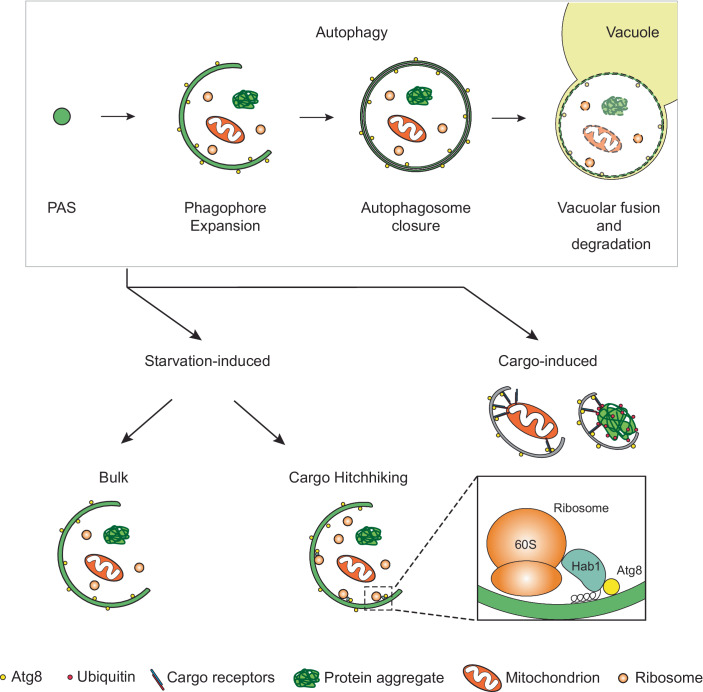 Figure 1
 Figure 2
Peer Reviews
No public reviews on file for this paper yet. If you reviewed it on a platform where reviews are public (OpenReview, ICLR, NeurIPS, ICML), you can paste yours below so the community can read it here.
Videos
No videos yet. Explain this paper in a talk, walkthrough, or lecture? Add one.
Taxonomy
TopicsAutophagy in Disease and Therapy · Endoplasmic Reticulum Stress and Disease · Mosquito-borne diseases and control