Efficient Knock-in by CRISPR/Cas9-mediated homology-directed repair in Caenorhabditis briggsae
Jiaonv Ma, Wangyan Zhou, Wenhua Shao, Yongbin Li

TL;DR
This study shows that using high concentrations of donor vectors improves CRISPR/Cas9 knock-in efficiency in the nematode Caenorhabditis briggsae.
Contribution
The novel finding is that high donor vector concentration enhances homology-directed repair in C. briggsae.
Findings
High concentration HDR donor vectors significantly improve knock-in efficiency in C. briggsae.
CRISPR/Cas9 knock-in in C. briggsae faces challenges, but this study provides a solution to enhance it.
Abstract
The CRISPR/Cas9 technology opens new avenues for detailed genetic exploration and comparative genomics. However, the current application of CRISPR/Cas9 in C. briggsae especially for homology-directed repair (HDR) knock-in (KI) still encounter significant challenges. In this study, we demonstrate that employing high concentration HDR donor vectors significantly improves KI efficiency in C. briggsae .
Genes, proteins, chemicals, diseases, species, mutations and cell lines named across the full text — each resolved to its canonical identifier and authoritative record.
Click any figure to enlarge with its caption.
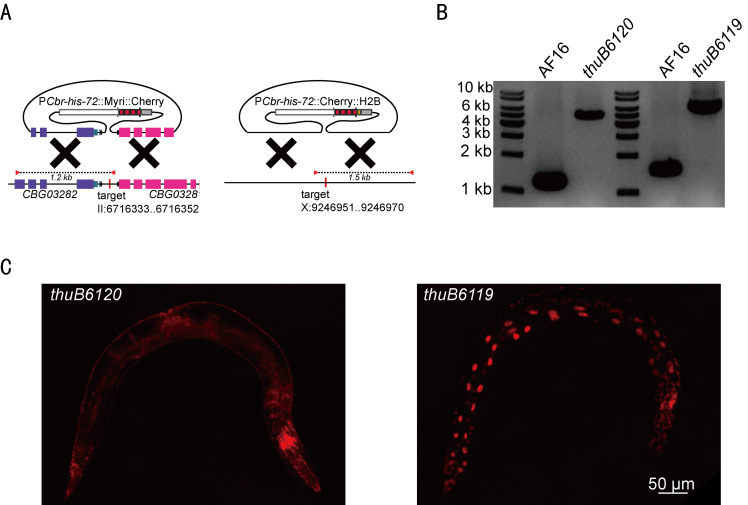 Figure 1
Peer Reviews
No public reviews on file for this paper yet. If you reviewed it on a platform where reviews are public (OpenReview, ICLR, NeurIPS, ICML), you can paste yours below so the community can read it here.
Videos
No videos yet. Explain this paper in a talk, walkthrough, or lecture? Add one.
Taxonomy
TopicsCRISPR and Genetic Engineering · Genetics and Neurodevelopmental Disorders · Pluripotent Stem Cells Research