U-Shaped Relationship Between Fibrinogen Level and 10-year Mortality in Patients With Acute Coronary Syndrome: Prospective Cohort Study
Yi ming Li, Yuheng Jia, Lin Bai, Bosen Yang, Mao Chen, Yong Peng

TL;DR
High or low fibrinogen levels are linked to higher death risk in heart patients over 10 years.
Contribution
A U-shaped relationship between fibrinogen levels and mortality in ACS patients is identified.
Findings
Fibrinogen is an independent risk factor for 10-year mortality in ACS patients.
A U-shaped nonlinear relationship exists between fibrinogen levels and mortality.
Long-term anti-inflammatory treatment may be beneficial for ACS patients.
Abstract
This study demonstrated that fibrinogen is an independent risk factor for 10-year mortality in patients with acute coronary syndrome (ACS), with a U-shaped nonlinear relationship observed between the two. These findings underscore the importance of monitoring fibrinogen levels and the consideration of long-term anti-inflammatory treatment in the clinical management of patients with ACS.
Genes, proteins, chemicals, diseases, species, mutations and cell lines named across the full text — each resolved to its canonical identifier and authoritative record.
Click any figure to enlarge with its caption.
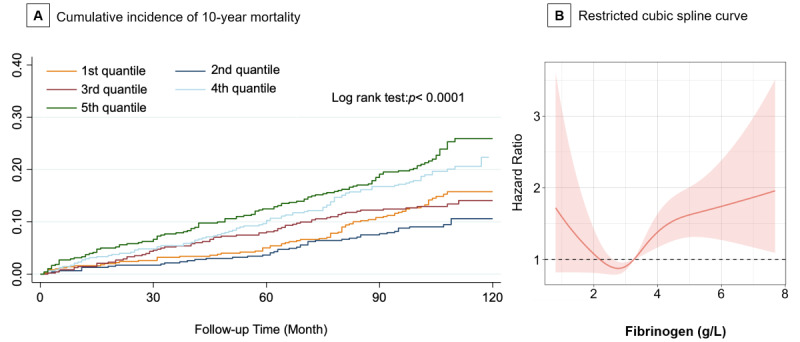 Figure 1
Peer Reviews
No public reviews on file for this paper yet. If you reviewed it on a platform where reviews are public (OpenReview, ICLR, NeurIPS, ICML), you can paste yours below so the community can read it here.
Videos
No videos yet. Explain this paper in a talk, walkthrough, or lecture? Add one.
Taxonomy
TopicsBlood properties and coagulation · Acute Myocardial Infarction Research · Adipokines, Inflammation, and Metabolic Diseases