An insulin-like signalling pathway model for Fasciola gigantica
Dongqi Wu, Yuqing Yang, Yankun Yang, Liang Li, Shishi Fu, Lei Wang, Li Tan, Xiuhong Lu, Weiyu Zhang, Wenda Di

TL;DR
This study identifies and analyzes the insulin-like signaling pathway in the liver fluke Fasciola gigantica, revealing key components and their roles in development and host interaction.
Contribution
The study reconstructs the IIS pathway in F. gigantica and identifies a novel receptor, FgIR-3, and excretory roles of several pathway components.
Findings
The core components of the insulin-like signaling pathway were identified in Fasciola gigantica.
Three insulin receptors (FgIR-1, FgIR-2, FgIR-3) were detected, including a novel receptor FgIR-3.
Several pathway genes showed increased transcription in specific developmental stages and were predicted to be present in excretory-secretory products.
Abstract
The insulin/insulin-like signalling (IIS) pathway is common in mammals and invertebrates, and the IIS pathway is unknown in Fasciola gigantica. In the present study, the IIS pathway was reconstructed in F. gigantica. We defined the components involved in the IIS pathway and investigated the transcription profiles of these genes for all developmental stages of F. gigantica. In addition, the presence of these components in excretory and secretory products (ESPs) was predicted via signal peptide annotation. The core components of the IIS pathway were detected in F. gigantica. Among these proteins, one ligand (FgILP) and one insulin-like molecule binding protein (FgIGFBP) were analysed. Interestingly, three receptors (FgIR-1/FgIR-2/FgIR-3) were detected, and a novel receptor, FgIR-3, was screened, suggesting novel functions. Fg14-3-3ζ, Fgirs, and Fgpp2a exhibited increased transcription in…
Genes, proteins, chemicals, diseases, species, mutations and cell lines named across the full text — each resolved to its canonical identifier and authoritative record.
Click any figure to enlarge with its caption.
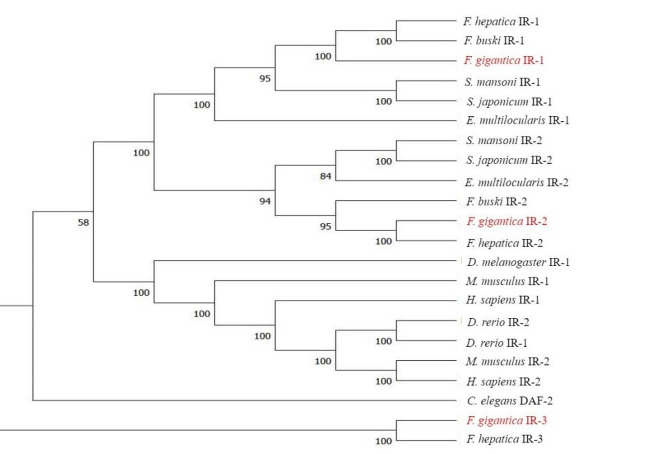 Figure 1
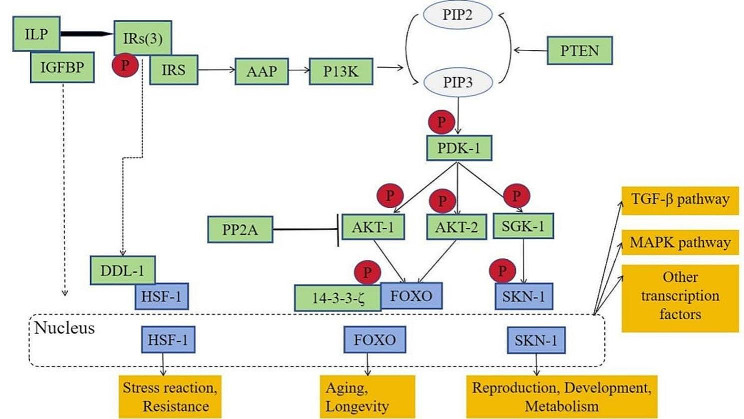 Figure 2
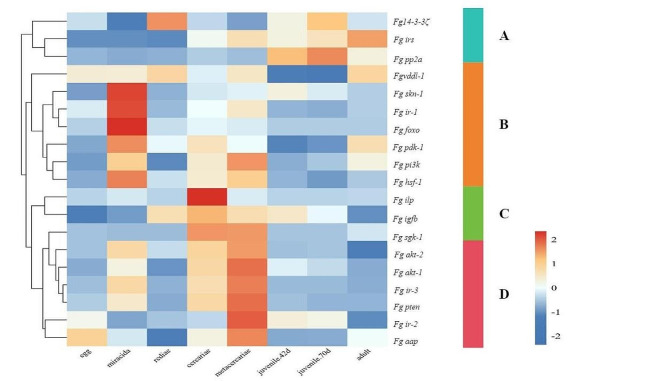 Figure 3
Peer Reviews
No public reviews on file for this paper yet. If you reviewed it on a platform where reviews are public (OpenReview, ICLR, NeurIPS, ICML), you can paste yours below so the community can read it here.
Videos
No videos yet. Explain this paper in a talk, walkthrough, or lecture? Add one.
Taxonomy
TopicsGenetics, Aging, and Longevity in Model Organisms · Helminth infection and control · Parasites and Host Interactions