Secondary analysis of Staphylococcus aureus whole genomes reveals diverse antimicrobial resistance profiles
Alyssa A Nitz, Daniel L Johnson, Pungki Lupiyaningdyah, Mckay A Meinzer, Joshua S Ramsey, Colin M Robinson, C Sebastian Valencia Amores, Brett E Pickett

TL;DR
This study analyzed Staphylococcus aureus genomes to identify diverse antimicrobial resistance genes across six strains.
Contribution
The novel contribution is the identification of 75 unique resistance genes against 22 antimicrobial compounds in S. aureus strains.
Findings
75 unique antimicrobial resistance genes were predicted in six S. aureus strains.
These genes confer resistance to 22 different antimicrobial compounds.
The study used de novo genome assembly and annotation for resistance gene prediction.
Abstract
Antimicrobial resistance (AMR) in microorganisms is an ongoing threat to human health across the globe. To better characterize the AMR profiles of six strains of Staphylococcus aureus , we performed a secondary analysis that consisted of the following steps: 1) download fastq files from the Sequence Read Archive, 2) perform a de novo genome assembly from the sequencing reads, 3) annotate the assembled contigs, 4) predict the presence of antimicrobial resistance genes. We predicted the presence of 75 unique genes that conferred resistance against 22 unique antimicrobial compounds.
Genes, proteins, chemicals, diseases, species, mutations and cell lines named across the full text — each resolved to its canonical identifier and authoritative record.
Click any figure to enlarge with its caption.
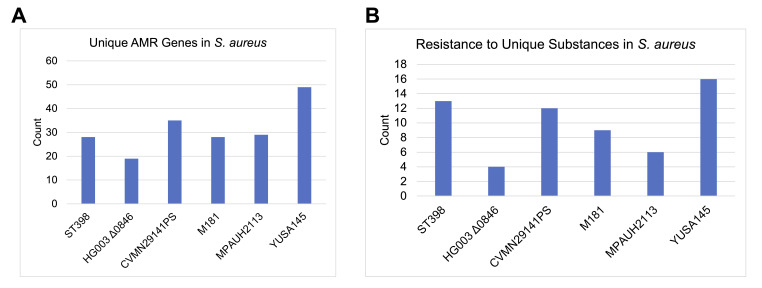 Figure 1
Peer Reviews
No public reviews on file for this paper yet. If you reviewed it on a platform where reviews are public (OpenReview, ICLR, NeurIPS, ICML), you can paste yours below so the community can read it here.
Videos
No videos yet. Explain this paper in a talk, walkthrough, or lecture? Add one.
Taxonomy
TopicsData Analysis and Archiving