The relevance of outcome expectations in group hypnosis for stress reduction: a secondary analysis of a multicenter randomized controlled trial
Julia Siewert, Michael Teut, Benno Brinkhaus, Silvia Fisch, Sonja Kummer

TL;DR
This study found that people's expectations about hypnosis did not affect how much their stress decreased after a group hypnosis program.
Contribution
The study is one of the few to investigate the role of outcome expectations in hypnosis for stress reduction.
Findings
Outcome expectations to hypnosis were not associated with reduced perceived stress after 5 weeks.
Both unadjusted and adjusted analyses showed no significant relationship between expectations and stress change.
The beneficial effects of hypnosis may be driven by mechanisms other than outcome expectations.
Abstract
There is evidence that patients’ positive outcome expectations prior to study interventions are associated with better treatment outcomes. Nevertheless, to date, only few studies have investigated whether individual outcome expectations affect treatment outcomes in hypnosis. To examine whether outcome expectations to hypnosis prior to starting treatment were able to predict perceived stress, as measured on a visual analog scale (VAS), after 5 weeks. We performed a secondary data analysis of a multicenter randomized controlled trial of intervention group participants only. Study participants with stress symptoms were randomized to 5 weekly sessions of a group hypnosis program for stress reduction and improved stress coping, plus 5 hypnosis audio recordings for further individual practice at home, as well as an educational booklet on coping with stress. Perceived stress for the…
Genes, proteins, chemicals, diseases, species, mutations and cell lines named across the full text — each resolved to its canonical identifier and authoritative record.
Click any figure to enlarge with its caption.
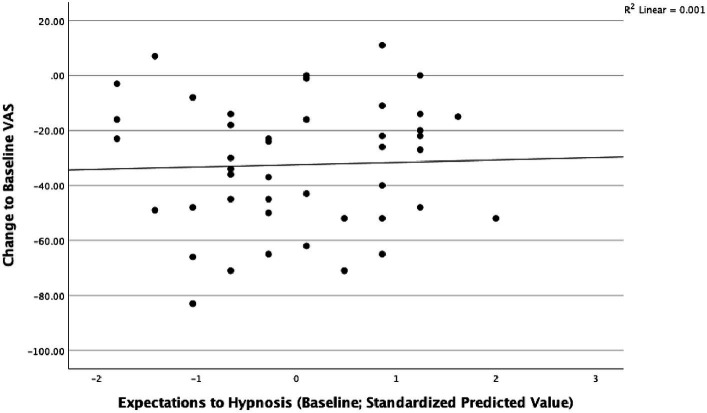 Figure 1
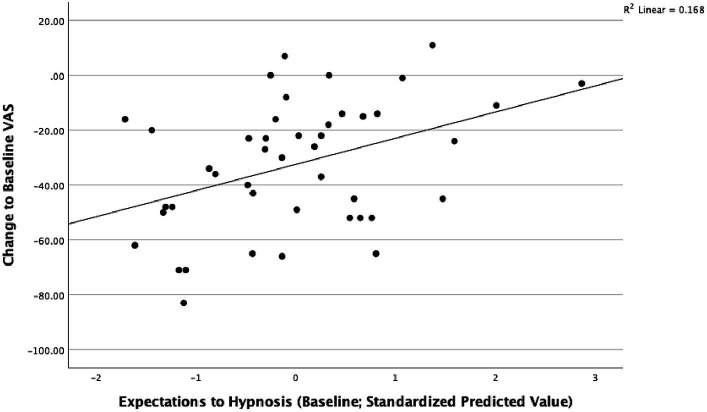 Figure 2
| Intervention group | ||
|---|---|---|
| Low expectations | High expectations | |
| Mean ± SD / | Mean ± SD / | |
| VAS Baseline Stress | 72.78 (11.14) | 74.71 (9.18) |
| Age [years] | 43.26 (13.57) | 46.71 (13.30) |
| Sex [Female] | 21 (91.3) | 19 (79.2) |
| Education | ||
| Abitur (German university entrance qualification) | 17 (73.9) | 19 (79.2) |
| Employment | ||
| Employed [yes] | 20 (87.0) | 21 (87.5) |
| Household | ||
| Single person household | 5 (21.7) | 6 (25.0) |
| Two-person household | 6 (26.1) | 10 (41.7) |
| Multiple person household | 12 (52.2) | 8 (33.3) |
| Health parameters | ||
| Smoking [yes] | 4 (17.4) | 3 (12.5) |
| Alcohol [yes] | 19 (82.6) | 18 (75.0) |
| Physical activity [yes] | 22 (95.7) | 22 (91.7) |
| Physical activity frequency [1–2 times per week] | 11 (50.0) | 12 (54.5) |
|
| ||
| Professional factors | ||
| Job/School/University | 16 (69.6) | 17 (70.8) |
| Exam preparation | 6 (26.1) | 4 (16.7) |
| High demands on oneself | 17 (73.9) | 18 (75.0) |
| Conflicts with colleagues /superiors | 5 (21.7) | 1 (4.2) |
| Time pressures, high density of appointments | 17 (73.9) | 15 (62.5) |
| Private factors | ||
| Private conflicts | 6 (26.1) | 12 (50.0) |
| Parenting | 4 (17.4) | 5 (20.8) |
| Disease (loved one) | 9 (39.1) | 4 (16.7) |
| Caring for a relative | 3 (13.0) | 2 (8.3) |
| Money worries | 3 (13.0) | 2 (8.3) |
| Household | 5 (21.7) | 4 (16.7) |
| Preparation of special events/festivities | 4 (17.4) | 1 (4.2) |
| Adversities of everday life/daily hassles | ||
| Organizing everyday activities | 4 (17.4) | 9 (37.5) |
| Public transport | 4 (17.4) | 3 (12.5) |
| Doctor visits | 3 (13.0) | 3 (12.5) |
| Waiting | 1 (4.3) | 0 (0.0) |
| Being disturbed/interrupted | 6 (26.1) | 10 (41.7) |
| Other | 5 (21.7) | 5 (20.8) |
Peer Reviews
No public reviews on file for this paper yet. If you reviewed it on a platform where reviews are public (OpenReview, ICLR, NeurIPS, ICML), you can paste yours below so the community can read it here.
Videos
No videos yet. Explain this paper in a talk, walkthrough, or lecture? Add one.
Taxonomy
TopicsPain Management and Placebo Effect · Psychosomatic Disorders and Their Treatments · Psychological Treatments and Assessments
Background
The European Agreement on Work-Related Stress defines stress as a state characterized by physical, psychological, or social complaints or dysfunctions resulting from individuals feeling unable to meet the demands or expectations placed upon them (Broughton, 2004). This definition underscores the global recognition of health-related problems associated with stress (Fisch et al., 2020a; Gnall et al., 2023; Mazure et al., 2023; Popescu et al., 2023; Sara et al., 2023; Walther and Wirtz, 2023). In Germany, a survey of 1,200 adults found that 61% reported experiencing stress either frequently or occasionally (Wohlers and Hombrecher, 2016).
Hypnosis is a state of focused attention and heightened suggestibility that can be induced by a trained professional. It has been used as a therapeutic tool for a variety of clinical purposes, including stress reduction. A 2017 systematic review examined the effects of hypnosis in patients with perceived stress. While six of the nine included studies reported significant positive effects of hypnosis on stress reduction, all of the included studies had a high risk of bias and used exploratory designs (Fisch et al., 2017). Since the publication of the aforementioned review, our research group has conducted a multicenter randomized controlled trial offering group hypnosis for stress reduction and improved stress coping, which showed a reduction in perceived stress in the hypnosis group compared to the control group at both 5 and 12 weeks (Fisch et al., 2020a). Other studies have also shown that hypnosis leads to a lower perception of stress (Payrau et al., 2017; Olendzki et al., 2020; Slonena and Elkins, 2021; Vahdat et al., 2022).
Although scientific evidence from other fields suggests that expectations are able to positively influence treatment outcomes for a range of medical conditions and procedures (Mondloch et al., 2001; Constantino et al., 2011; Auer et al., 2016), little research has examined whether expectations to hypnosis might be able to predict treatment outcomes.
Patients’ expectations may encompass their beliefs about the efficacy of hypnosis and their anticipated outcomes from the treatment in question. To date, few studies have attempted to discern whether individuals with high expectations of positive outcomes to hypnosis will experience more significant benefits compared to those with low expectations (Sliwinski and Elkins, 2017; De Pascalis et al., 2021; Egli et al., 2022). This debate is imperative because it raises questions about the role of psychological factors in the therapeutic process and the validity of hypnosis as a treatment modality in its own right. A perspective that has not been very well researched suggests that patients with different expectations to hypnosis may experience a different therapeutic effect, whereby their belief in the efficacy of the treatment may influence their response to it (Frisaldi et al., 2015; Koban et al., 2017). In this respect, participants’ expectations may confound the interpretation of study results, making it challenging to isolate the specific effects of hypnosis itself. As indicated by other studies, expectations also contribute to placebo and nocebo effects (Petrovic et al., 2005; Wager et al., 2007; Tracey, 2010). Consequently, they could also influence the effectiveness of hypnotic interventions (Kirsch, 1985). Moreover, it is assumed that hypnosis in clinical practice can induce altered states of consciousness independently of initial expectations and produce therapeutic benefits through suggestion and relaxation techniques.
We performed a secondary data analysis to examine whether treatment expectations to a group hypnosis program for stress reduction and improved stress coping would be able to predict perceived stress in the previous week, as measured on a visual analog scale, after 5 weeks.
Methods
Study design
This study comprised a secondary analysis of the two-armed randomized, controlled, open, multicenter HypnoStress trial (Trial Registration No. NCT03525093; Ethical Approval No. EA1/067/18). Details of the original study have been published elsewhere (Fisch et al., 2020a). This paper reports findings from a secondary data analysis only and required no additional ethical approval.
Participants and recruitment
Individuals were considered eligible for participation in the original trial if they were aged between 18 to 70 years, reported a subjective stress level of 40 mm or higher on a visual analog scale (VAS) for the preceding week (measured on a scale of 0 to 100 mm), reported a perceived increase in stress lasting for at least 3 months, maintained overall good health, and provided written informed consent. Conversely, individuals were excluded if they were currently participating or planning to participate in another psychological stress reduction program within the next 12 weeks, were currently undergoing psychotherapy, had a moderate or severe acute or chronic medical condition, or had an acute or chronic mental health problem. Recruitment for the study was conducted via newspaper ads in Berlin and Coesfeld, the Charité Outpatient Department for Integrative Medicine’s website and newsletter, the psychotherapeutic clinic in Coesfeld, the Studienhospital Münster’s Newsletter, and flyers at the MEDIAN Zentrum Bad Pyrmont. Potential participants underwent a preliminary consultation with a psychologist or study physician, where they were informed about the study.
Randomization
A detailed summary of the randomization and intervention content is provided in the original article (Fisch et al., 2020a). Briefly, patient enrollment was conducted under the supervision of study physicians and study psychologists. Following informed consent, enrollment and baseline assessments, participants were randomized to either the intervention or control group, using a 1:1 allocation ratio via a central telephone randomization line by an independent study nurse. The randomization was stratified by study center and in blocks of 20 participants (to take into account the group size of 10 people). SAS (Version 9.4) was used to generate the random allocation sequence.
Study intervention
Both the intervention and control group received a written educational booklet on behavioral stress management provided by a German health insurance company (Wagner-Link, 2017). The booklet contained sections on “recognizing stress,” “managing stress,” and “preventing stress.” The “recognizing stress” section outlined the physiological underpinnings of a natural stress response, detailing various facets of stress reactions, including cognitive, emotional, vegetative, and muscular aspects. It also aimed to sensitize readers to identify individual stressors. In the “managing stress” section, common stress management strategies such as problem-solving, time management, various relaxation techniques, sports, and recognizing and modifying unfavorable attitudes were introduced and briefly discussed. The third section, “preventing stress,” introduced the salutogenesis model and provided insights into the structure and promotion of resilience factors, with a particular emphasis on maintaining social connections. Additionally, this section outlined short-term stress management strategies and offers a suggested training protocol (Wagner-Link, 2017; Fisch et al., 2020b).
In addition to this, the intervention group received a hypnosis group program, which was previously designed, refined and tested in a feasibility study (Fisch et al., 2020b). The primary objectives of the hypnosis group program were to induce relaxation, assist participants in recognizing, activating, and experiencing resources for coping with stressful situations, foster the development and refinement of stress-coping skills, and impart mental training and anchoring techniques. The program was delivered by certified hypnotherapists (two psychotherapists and one family physician) and consisted of five standardized sessions of health education, hypnotic inductions, and therapeutic discussions. Hypnosis sessions were conducted weekly with groups of 8 to 12 participants and lasted 120 min. Additionally, at the end of each session, participants were provided with pre-recorded audio recordings (available as either CDs or downloadable MP3 files) of the hypnosis exercises so that they could self-practice at their convenience and discretion. Control group participants were offered free participation in the hypnosis group program following study completion.
Outcome measures
Relevant outcomes for this secondary data analysis were:
Stress: perceived stress level in the previous week was measured on a visual analog scale (VAS; 0–100 mm: 0 = no stress, 100 = maximum stress) after 5 weeks.Outcome expectations: expectations to hypnosis treatment were measured using a modified version of the Expectations for Treatment scale (ETS) (Barth et al., 2019). Participants were asked to indicate their expectations to hypnosis on a Likert scale ranging from 1 (low expectations) to 4 (high expectations): “I expect that hypnosis will help me deal with stress better,” “I expect stress levels to disappear as a result of hypnosis,” “I expect my energy to improve as a result of hypnosis,” “I expect my physical performance to improve as a result of hypnosis,” “I expect that after the hypnosis stress levels will improve significantly.” Items were summed to create a total score, with a minimum score of 4 indicating low expectations and a maximum score of 20 indicating high expectations.Demographic variables: self-reported data on age, gender, education, employment status, health parameters and stress factors were obtained at baseline.
Statistical analysis
The ETS was collapsed into a dichotomous variable using the median value (MD = 13.00) as the cut-off to group individuals into high (if the median score was above MD = 14.00) and low (if the median score was below MD = 13.00) expectations in order to determine and display baseline group differences regarding expectations to hypnosis only. Baseline group differences for sociodemographic, health and stress-related characteristics were analyzed using t-tests for continuous data and chi-square tests or Fisher’s exact test for small cell counts for categorical data, and summarized using means, SDs, or percentages.
Unadjusted linear regressions were then calculated to examine whether expectations to hypnosis (for this the ETS sum score was used) in the intervention group would be able to predict change in perceived stress between baseline and after 5 weeks as measured on a VAS. Linear regressions were subsequently adjusted for any potential confounders (baseline stress, study center, age, and sex). To determine whether expectations to hypnosis (for this the ETS sum score was used) in the intervention group would be able to predict change in perceived stress between baseline and after 5 weeks, we performed a sensitivity analysis using Spearman’s rho correlation to examine whether this non-parametric alternative would yield similar results as the linear regression. All results were considered exploratory. Analyses were conducted using the IBM Statistical Package for Social Sciences (SPSS), Version 28.
Sensitivity analysis
Two sensitivity analyses were conducted to test the robustness of our results. For the first we performed a non-parametric correlation analysis using Spearman’s rank-order correlation to determine expectations to hypnosis and change in perceived stress between baseline and after 5 weeks. For the second we performed unadjusted and adjusted regression analyses using the change in Cohen’s Perceived Stress Scale (CPSS) (Cohen et al., 1983) score as an outcome.
Results
Detailed sociodemographic characteristics of the sample are outlined in the original study article (Fisch et al., 2020a). Table 1 shows the comparison of sociodemographic characteristics between those with high and low expectations to hypnosis in the intervention group. We observed no relevant differences at baseline in individuals with high and low expectations.
Unadjusted linear regressions showed that expectations to hypnosis were not associated with a change in perceived stress between baseline and after 5 weeks (B = 0.326, t = 0.239, p = 0.812, R^2^ = 0.001) (Figure 1).
Expectations to hypnosis and perceived stress after 5 weeks in the intervention group.
Similarly, adjusted linear regressions showed that expectations to hypnosis were not associated with a change in perceived stress between baseline and after 5 weeks (B = 0.639, t = 0.470, p = 0.641, R^2^ = 0.168) (Figure 2).
Expectations to hypnosis and perceived stress after 5 weeks in the intervention group; adjusted for respective baseline value, study center, age and sex.
Sensitivity analysis
Sensitivity analysis using Spearman’s rank-order correlation indicated no relevant relationship between expectations to hypnosis and change in perceived stress between baseline and after 5 weeks (r_s_ = 0.06, p = 0.703).
Similar to our other findings unadjusted (B = −0.350, t = −0.870, p = 0.389, R^2^ = 0.018) and adjusted (B = −0.118, t = −0.341, p = 0.735, R^2^ = 0.400) linear regressions found that outcome expectations to hypnosis were not associated with a change in perceived stress between baseline and after 5 weeks in the intervention group on the CPSS.
Discussion
Contrary to previous research that has shown that expectations predict treatment outcomes (e.g., Auer et al., 2016), our findings showed no association between participants’ expectations and perceived stress after 5 weeks. Consequently, other contextual factors, such as hypnotic relaxation, active resource activation, and reframing techniques and group interactions may have played a greater role than expectations in determining treatment outcomes.
Our results showed that overall participants had relatively high expectations at baseline (M = 13.74, SD = 2.72) before being randomized to and participating in the group hypnosis program. Therefore, it could be suggested that future studies should include individuals with more diverse expectations in order to determine how these may be associated with varying treatment outcomes. For example, research on recovery expectations in patients with back pain (Kamper et al., 2015) has shown that the level of expectations may indeed predict treatment outcomes, with high expectations leading to the greatest improvement compared to moderate and low expectations. Further to this, participants’ baseline level of stress was relatively high in our study. However, future research which includes individuals with low, moderate, and severe levels of stress is necessary to determine the interplay between a diverse range of expectations and the outcome under investigation.
Information on patients’ expectations was only collected at baseline. As a result, we do not know whether expectations changed over the course of the group program. Yet, it has been proposed that patient expectations to treatment should be assessed before, during and after treatment as expectations may change over the course of treatment (Kamper et al., 2015; Laferton et al., 2017).
In addition, we did not assess whether trial participants had previously undergone hypnosis. Nevertheless, it may be important to ascertain this, as expectations may be influenced by previous exposure to hypnosis. For example, research has shown that individuals who had previously received acupuncture prior to participating in a trial investigating different briefing contents before a minimal acupuncture treatment in patients with chronic low back pain had higher expectations than those who had never received acupuncture. However, the study authors caution that higher expectations cannot be explained solely by patients’ previous experience with acupuncture, but that the relative contribution of contextual factors on patients’ pre-treatment expectations should also be considered (Zieger et al., 2022).
Although the ETS has shown to be a valid and reliable scale for measuring outcome expectations, it was originally developed in the context of acupuncture (Barth et al., 2019). While the scale has been used to determine outcome expectations across a variety of studies, there has been mixed evidence as to whether expectations predict therapeutic outcomes (de Matos et al., 2020; Barth et al., 2021; Egli et al., 2022; Zieger et al., 2022; Müller-Schrader et al., 2023). Further research should therefore be conducted using different treatment outcomes and patient populations to further explore to what extent the original scale and any modified versions are indeed able to accurately predict outcome expectations. Furthermore, the scale is not based on any theoretical models and only examines positive outcome expectations. Nonetheless, this may be problematic, as the absence of theory and negative outcome expectations could lead to important constructs being missed, thus limiting researchers’ ability to determine whether expectations do indeed predict treatment outcomes.
Lastly, we did not explore the potential influence of other variables, such as trust in the therapist. These factors may interact with expectations in complex ways that were not addressed in our research.
To our knowledge this is the first study that has explored the predictive value of expectations on hypnosis for stress reduction. It contributes to the growing understanding of the relationship between patient expectations and treatment outcomes in general, but more specifically in the field of hypnotherapy. In addition, it is based on a randomized controlled multicenter trial with high adherence rates and whose intervention was thoroughly designed and delivered by qualified hypnotherapists (physicians or psychological psychotherapists). We also recognize that the small number of study participants is a clear limitation of this secondary analysis, which may affect the generalizability of our findings. Furthermore, we did not originally plan to perform any further analysis, and therefore the results can only be interpreted in an exploratory manner.
Conclusion
In this analysis, we found no association between participants’ expectations and perceived stress at 5 weeks in the intervention group. Our results suggest that factors contributing to the effect of hypnotherapy may have acted independently of participants’ expectations. Further research is required to explore the complex relationship between pre-therapy expectations and hypnotherapy outcomes.
Data availability statement
The raw data supporting the conclusions of this article will be made available by the authors, without undue reservation.
Ethics statement
The studies involving humans were approved by Ethical Approval No. EA1/067/18; Ethics Committee of the Charité – Universitätsmedizin Berlin; Charité Mitte, Charitéplatz 1 (local address: Virchowweg 10) 10117 Berlin. The studies were conducted in accordance with the local legislation and institutional requirements. The participants provided their written informed consent to participate in this study.
Author contributions
JS: Writing – original draft, Writing – review & editing. MT: Conceptualization, Funding acquisition, Investigation, Project administration, Supervision, Writing – review & editing. BB: Conceptualization, Project administration, Supervision, Writing – review & editing. SF: Conceptualization, Funding acquisition, Investigation, Writing – review & editing. SK: Methodology, Software, Writing – original draft, Writing – review & editing.
The reference list from the paper itself. Each links out to its DOI / PubMed record.
- 1Auer C. J.Glombiewski J. A.Doering B. K.Winkler A.Laferton J. A. C.Broadbent E.. (2016). Patients' expectations predict surgery outcomes: a Meta-analysis. Int. J. Behav. Med. 23, 49–62. doi: 10.1007/s 12529-015-9500-4, PMID: 26223485 · doi ↗ · pubmed ↗
- 2Barth J.Kern A.Lüthi S.Witt C. M. (2019). Assessment of patients' expectations: development and validation of the expectation for treatment scale (ETS). BMJ Open 9:e 026712. doi: 10.1136/bmjopen-2018-026712, PMID: 31213446 PMC 6585827 · doi ↗ · pubmed ↗
- 3Barth J.Muff S.Kern A.Zieger A.Keiser S.Zoller M.. (2021). Effect of briefing on acupuncture treatment outcome expectations, pain, and adverse side effects among patients with chronic low Back pain: a randomized clinical trial. JAMA Netw. Open 4:e 2121418. doi: 10.1001/jamanetworkopen.2021.21418, PMID: 34505889 PMC 8433606 · doi ↗ · pubmed ↗
- 4Broughton A. (2004). Social partners sign work-related stress agreement. The European Union. Brussels
- 5Cohen S.Kamarck T.Mermelstein R. (1983). A global measure of perceived stress. J. Health Soc. Behav. 24, 385–396. doi: 10.2307/2136404, PMID: 6668417 · doi ↗ · pubmed ↗
- 6Constantino M. J.Arnkoff D. B.Glass C. R.Ametrano R. M.Smith J. A. Z. (2011). Expectations. J. Clin. Psychol. 67, 184–192. doi: 10.1002/jclp.20754, PMID: 21128304 · doi ↗ · pubmed ↗
- 7de Matos N. M. P.Pach D.Xing J. J.Barth J.Beyer L. E.Shi X.. (2020). Evaluating the effects of acupuncture using a dental pain model in healthy subjects - a randomized, cross-over trial. J Pain 21, 440–454. doi: 10.1016/j.jpain.2019.08.013, PMID: 31521794 · doi ↗ · pubmed ↗
- 8De Pascalis V.Scacchia P.Vecchio A. (2021). Influences of hypnotic suggestibility, contextual factors, and EEG alpha on placebo analgesia. Am. J. Clin. Hypn. 63, 302–328. doi: 10.1080/00029157.2020.1863182, PMID: 33999775 · doi ↗ · pubmed ↗