Revised whole genome and DNA methylome of Mycobacterium marinum type strain ATCC 927T
Kirsi Savijoki, Paulina Deptula, Richard J. Roberts, Milka Hammarén, Jari Yli-Kauhaluoma, Pekka Varmanen, Mataleena Parikka

TL;DR
Researchers updated the genome and DNA methylation data of Mycobacterium marinum to better study its role in disease and tuberculosis mechanisms.
Contribution
A new reference genome and DNA methylome for M. marinum ATCC 927T are provided to enhance research on pathogenesis.
Findings
A revised whole genome sequence for M. marinum ATCC 927T was generated.
The DNA methylome of the same strain was characterized.
The updated data aims to improve understanding of tuberculosis-like disease mechanisms.
Abstract
Mycobacterium marinum, a slow-growing Actinobacterium, typically induces tuberculosis-like disease in fish. Here, we report a new reference sequence for M. marinum ATCC 927T, along with its DNA methylome. This aims to maximize the research potential of this type strain and facilitates investigations into the pathomechanisms of human tuberculosis.
Genes, proteins, chemicals, diseases, species, mutations and cell lines named across the full text — each resolved to its canonical identifier and authoritative record.
Click any figure to enlarge with its caption.
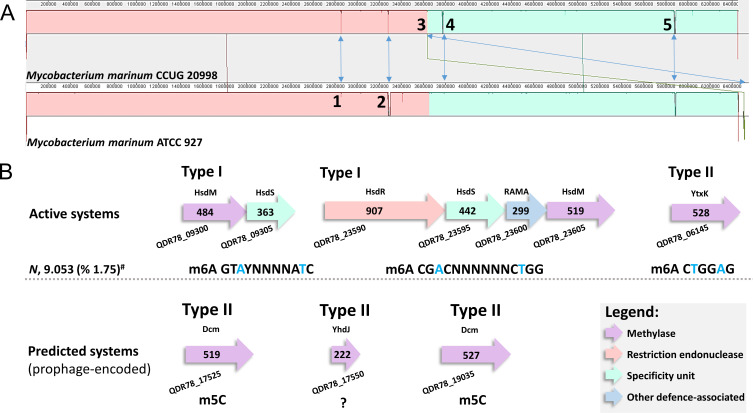 Fig 1
Fig 1| Genome | Plasmid | Origin | |||||||||||
|---|---|---|---|---|---|---|---|---|---|---|---|---|---|
| Name of the strain | Accession no. | Size (bp) | G + C (%) | No. Genes | No. CDSs | No. pgenes | No. RNAs | Accession no. | Size (bp) | No. Genes | No. tRNAs | G + C (%) | |
| ATCC 927T (NI) |
| 6,451,936 | 65.5 | 5,744 | 5,150 | 537 | 57 |
| 127,402 | 130 | 1 | 63.50 | 25 |
| CCUG 20998 (PB) |
| 6,453,310 | 65.7 | 5,411 | 5,203 | 152 | 56 | NR | 127,576 | 112 | 1 | 63.96 | 26 |
| ATCC 927T (PB) |
| 6,455,215 | 65.7 | 5,502 | 5,300 | 145 | 57 |
| 127,576 | 112 | 1 | 63.96 | This study |
- —EC | H2020 | PRIORITY 'Excellent science' | H2020 Marie Skłodowska-Curie Actions (MSCA)
- —Research Council of Finland (AKA)
- —Research Council of Finland (AKA)
- —Research Council of Finland (AKA)
- —Research Council of Finland (AKA)
- —Research Council of Finland (AKA)
- —Jane ja Aatos Erkon Säätiö (J&AE)
- —Sigrid Juséliuksen Säätiö (Sigrid Jusélius Stiftelse)
- —Tampereen Tuberkuloosisäätiö (Tampere Tuberculosis Foundation)
Peer Reviews
No public reviews on file for this paper yet. If you reviewed it on a platform where reviews are public (OpenReview, ICLR, NeurIPS, ICML), you can paste yours below so the community can read it here.
Videos
No videos yet. Explain this paper in a talk, walkthrough, or lecture? Add one.
Taxonomy
TopicsMycobacterium research and diagnosis · Genomics and Phylogenetic Studies · Infectious Diseases and Mycology
ANNOUNCEMENT
Mycobacterium marinum (Mmr) strain ATCC 927^T^, a slow-growing Gram-positive bacterium, was originally isolated from spontaneous tuberculosis (TB) in fish (1, 2). Phylogenetic analysis based on 16S rRNA gene sequences revealed 99.3% identity to Mycobacterium tuberculosis (Mtb), which is the leading etiological agent of TB in humans (3, 4). Like Mtb, Mmr also survives inside its natural host (zebrafish) and triggers a positive tuberculin test during infection (5–10), making it an excellent surrogate model for Mtb.
We revised the whole-genome sequence of ATCC 927^T^ using PacBio SMRT, identified the methylation motifs, and matched them to corresponding restriction-modification (R-M) systems. Freeze-dried ATCC 927^T^, from the American Type Culture Collection, was cultured in Middlebrook 7H9 broth containing 10% Albumin−Dextrose−Catalase (Thermo Fisher Scientific) and 0.5% glycerol for 7 days at 29°C. The genomic DNA was extracted using the MagAttract HMW DNA Kit (Qiagen, Nordic). Library preparation, quality control, sequencing, and assembly were performed by Novogene (UK) using their standard operating procedures. PacBio libraries were prepared using the SMRTbell Express Template Prep Kit 2.0 (Pacific Biosciences), following the standard PacBio protocol (11) and selecting DNA fragments > 17 kb using the BluePippin system (Sage Sciences). The libraries sequenced on a PacBio Sequel II instrument using CLR mode generated a total of 334,798 reads with an average length of 77,683 bp and an N50 value of 120,575 bp. Default parameters were used for all the following software unless otherwise specified. Base calling and demultiplexing were performed using SMRT Link V11.1 software (11). Canu-1.6 (12) and HGAP-4 (13) were used for de novo assembly of the PacBio long reads, incorporating pre-processing steps for Canu and as a separate step for HGAP. Alignment of pre-assembled reads, Arrow-2.3 (14), and Circlator-1.5.3 (15) were used for error correction, polishing, and circular assembly processes, respectively. The completeness of the assemblies was assessed using BUSCO 4.0.2 (16). The resulting two scaffolds with read depths of 499× for the chromosome and 309× for the plasmid were annotated at NCBI using the Prokaryotic Genome Annotation Pipeline PGAP-6.5 (17–19). Prophage sequences were predicted using the PHASTER server (20), and SEQWARE methylome analysis at REBASE (21) was conducted as previously described (22, 23). Due to the high sequence identity (99.63%) of the plasmid to the previously published plasmid sequence of ATCC 927^T^ (24), the plasmid was named pMMRN. Table 1 lists all central genomic data of ATCC 927^T^ in comparison to other related Mmr genomes. Figure 1 illustrates the major differences between ATCC 927^T^ and its passage variant CCUG 20998, also defined by PacBio SMRT (25), as well as indicates the methylation motifs with their corresponding active and predicted R-M systems. In summary, this study provides a new reference sequence for ATCC 927^T^ and reports the first in-depth DNA methylome analysis for this non-tuberculous bacterial model.
(A) Whole genome alignment of strain ATCC 927 to its previously sequenced passage variant CCUG 20998. ProgressiveMauve (27) was used to align the indicated genomes in a step-by-step manner for the identification of conserved regions and rearrangements between the two genomes. Significant differences are indicated with arrows and numbered as follows. 1, a truncated ABC transporter permease (QDR78_11875 versus intact CCUG20998_RS12005) due to a sequence deletion, 2, a truncated PE family protein due to a frameshift (QDR78_13350 versus CCUG20998_RS28445); pseudogenes on both genomes. 3, an insertion of six genes (CCUG20998_RS15230–CCUG20998_RS15255) coding for an IS3 family transposase, recombinase (a pseudogene), cytochrome P450, TetR/AcrR family transcriptional regulator, a frameshifted TetR/AcrR family transcriptional regulator, and a frameshifted IS256 family transposase. These genes correspond to plasmid-located genes in ATCC 927T (QDR78_27190–QDR78_27215) coding for TetR/AcrR family transcriptional regulator, TetR/AcrR family transcriptional regulator, cytochrome P450, DUF308 domain-containing protein (a membrane-associated protein), a pseudogene recombinase family protein, and an IS3 family transposase, respectively. 4, a truncated non-ribosomal peptide synthase/polyketide synthase, which is also split into two parts: CCUG20998_RS28465 (AMP-binding protein, 322 amino acids) and CCUG20998_RS28470 (amino acid adenylation domain-containing protein, 1,468 amino acids), versus QDR78_13590 (9,908 amino acids). 5, another non-ribosomal peptide synthase/polyketide synthase: CCUG20998_RS15760 (12,024 amino acids) versus QDR78_15505 (9,880 amino acids). (B) Active and predicted R-M systems found in strain ATCC 927T, along with matched methylation motifs detected through SMRT whole methylome analysis. The motifs GTAYNNNNATC and CTGGAG and their corresponding R-M systems are also found in the Mycobacterium marinum strain MMA1 (REBASE org. #46029). Other PacBio-sequenced strains contain either the first (strain 050012) or the second (Mycobacterium marinum strains E11 and H01) of the R-M system-motif pairs, whereas the R-M system with recognition motif CGACNNNNNNCTGG is unique, with modified adenines (indicated as T for complementary strand) marked in blue. Strain MMA1, a human-infection-associated isolate (26), also possesses an additional Type I system with recognition motif CCACNNNNNNNTCCC that is not found in other strains. No activity was detected for the prophage-encoded methyltransferases. #, numbers of detected m6A type modifications (%, number of detected m6A modifications per total number of all detected modifications).
The reference list from the paper itself. Each links out to its DOI / PubMed record.
- 1Aronson JD. 1926. Spontaneous tuberculosis in soft water fish. J Infect Dis 39:315–320. doi:10.1093/infdis/39.4.315 · doi ↗
- 2Ackleh AS, Delcambre ML, Sutton KL. 2015. A second-order high-resolution finite difference scheme for a size-structured model for the spread of Mycobacterium marinum. J Biol Dyn 9:156–187. doi:10.1080/17513758.2014.96299825271885 · doi ↗ · pubmed ↗
- 3Akram SM, Aboobacker S. 20203 Mycobacterium marinum infection. In Statpearls. Stat Pearls Publishing, Treasure Island. https://www.ncbi.nlm.nih. gov/books/NBK 441883.28722913 · pubmed ↗
- 4Bagcchi S. 2023. WHO’s global tuberculosis report 2022. Lancet Microbe 4:e 20. doi:10.1016/S 2666-5247(22)00359-736521512 · doi ↗ · pubmed ↗
- 5Luukinen H, Hammarén MM, Vanha-Aho L-M, Parikka M. 2018. Modeling tuberculosis in Mycobacterium marinum infected adult zebrafish. J Vis Exp 8:58299. doi:10.3791/58299 PMC 623546130346391 · doi ↗ · pubmed ↗
- 6Parikka M, Hammarén MM, Harjula S-KE, Halfpenny NJA, Oksanen KE, Lahtinen MJ, Pajula ET, Iivanainen A, Pesu M, Rämet M. 2012. Mycobacterium marinum causes a latent infection that can be reactivated by gamma irradiation in adult zebrafish. P Lo S Pathog 8:e 1002944. doi:10.1371/journal.ppat.100294423028333 PMC 3459992 · doi ↗ · pubmed ↗
- 7Tobin DM, Ramakrishnan L. 2008. Comparative pathogenesis of Mycobacterium marinum and Mycobacterium tuberculosis. Cell Microbiol 10:1027–1039. doi:10.1111/j.1462-5822.2008.01133.x 18298637 · doi ↗ · pubmed ↗
- 8Takaki K, Davis JM, Winglee K, Ramakrishnan L. 2013. Evaluation of the pathogenesis and treatment of Mycobacterium marinum infection in zebrafish. Nat Protoc 8:1114–1124. doi:10.1038/nprot.2013.06823680983 PMC 3919459 · doi ↗ · pubmed ↗