Whole-genome sequencing of SARS-CoV-2 from the initial cases of domestic cat infections in Canada
Asma Sultana, Dorothee Bienzle, Scott Weese, Brad Pickering, Peter Kruczkiewicz, Greg Smith, Mathieu Pinette, Oliver Lung

TL;DR
This study sequenced SARS-CoV-2 from two infected cats in Canada, revealing new mutations and close genetic ties to human cases.
Contribution
The discovery of a previously unreported SARS-CoV-2 lineage in cats adds to understanding of viral transmission and evolution.
Findings
One cat was infected with a novel SARS-CoV-2 lineage A.23.1 not previously seen in animals.
Both cat samples showed multiple spike gene mutations and clustered closely with human-derived SARS-CoV-2 sequences.
The study provides insights into zoonotic transmission and viral evolution in domestic cats.
Abstract
Two cat nasal swabs from Canada’s earliest confirmed SARS-CoV-2 positive domestic cats were sequenced to over 99% SARS-CoV-2 genome coverage. One cat had lineage A.23.1 SARS-CoV-2 not reported before in animals. Both sequences have multiple spike gene mutations and clustered closely with human-derived sequences in the global SARS-CoV-2 phylogenetic tree.
Genes, proteins, chemicals, diseases, species, mutations and cell lines named across the full text — each resolved to its canonical identifier and authoritative record.
Click any figure to enlarge with its caption.
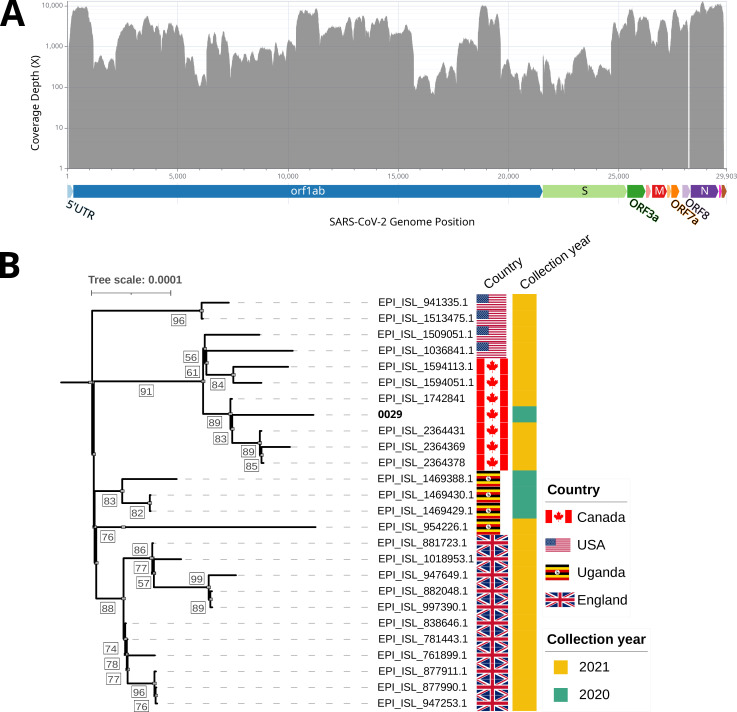 Fig 1
Fig 1| Sample | Gene | Nucleotide mutation | Amino acid mutation |
|---|---|---|---|
| WIN-AH-2021-OTH-Kari-0029-OS-1 | ORF1ab | G1820A | G519S |
| (29,655 nucleotides) (38% GC content) | ORF1ab | C10038T | T3258I |
| ORF1ab | G10540A | M3425I | |
| ORF1ab | G11230T | M3655I | |
| ORF1ab | G11266T | L3667F | |
| ORF1ab | G11521T | M3752I | |
| ORF1ab | C16575T | T5437I | |
| ORF1ab | C17745T | T5827I | |
| ORF1ab | A18102G | H5946R | |
| S | G21777A | G72E | |
| S | G21867T | R102I | |
| S | C22033A | F157L | |
| S | G22661T | V367F | |
| S | G23401T | Q613H | |
| S | C23604G | P681R | |
| ORF8 | T28144C | L84S | |
| N | G28307A | A12T | |
| N | G28878A | S202N | |
| NCFAD-2020-0085 | ORF1a | C1059T | T265I |
| (29,786 nucleotides) (38% GC content) | ORF1a | G8083A | M2606I |
| ORF1a | C10319T | L3352F | |
| ORF1b | C14407T | P314S | |
| ORF1b | C14408T | P314L | |
| ORF1b | A18424G | N1653D | |
| ORF1b | C21304T | R2613C | |
| S | A23403G | D614G | |
| S | G23593T | Q677H | |
| ORF3a | G25563T | Q57H | |
| ORF3a | G25907T | G172V | |
| M | G26775T | A85S | |
| ORF8 | C27964T | S24L | |
| N | C28472T | P67S | |
| N | C28869T | P199L | |
| N | G29402T | D377Y |
Peer Reviews
No public reviews on file for this paper yet. If you reviewed it on a platform where reviews are public (OpenReview, ICLR, NeurIPS, ICML), you can paste yours below so the community can read it here.
Videos
No videos yet. Explain this paper in a talk, walkthrough, or lecture? Add one.
Taxonomy
TopicsSARS-CoV-2 and COVID-19 Research · Animal Virus Infections Studies · Viral gastroenteritis research and epidemiology
ANNOUNCEMENT
Severe acute respiratory syndrome coronavirus 2 (SARS-CoV-2) (genus Betacoronavirus, family Coronaviridae), the causative agent of the COVID-19 pandemic, had a profound impact on public health. Natural and experimental infections confirmed the susceptibility of 29 species, including free-living, domestic, captive, and farmed animals (1–6). Natural infections have been reported in nine feline species, including domestic cat (Felis catus), tiger (Panthera tigris), lynx (Lynx lynx and L. canadensis), and lion (P. leo) (6–8). Furthermore, animal-to-human transmission of SARS-CoV-2 has been reported for hamsters, mink, cats, and white-tailed deer (3, 8–10). Characterization of SARS-CoV-2 in animals improves our understanding of potential intermediate hosts.
From October 2020 to April 2021, the Animal Health Laboratory, University of Guelph, sent 11 samples (oral, nasal, and rectal swabs) from four cats to the National Centre for Foreign Animal Disease for confirmatory testing. RNA was extracted from the swab samples using the MagMax CORE Nucleic Acid Purification Kit (ThermoFisher Scientific), and qRT-PCR targeting the E (3) and RdRp genes [Forward primer-GTGAAATGGTCATGTGTGGCGG, Reverse primer- CAAATGTTAAAAACACTATTAGCATA and probe-FAM/BHQ-1-CAGGTGGAACCTCATCAGGAGATGC) of SARS-CoV-2 was performed (unpublished)].
The qRT-PCR-positive samples (n = 9, Ct values 26–36) were amplified using a 1,200 bp tiled PCR amplicon protocol (11). Amplicons for four samples, including sample NCFAD-2020-0085 (0085; sampled in November 2020), were sequenced on a FLO-MIN106 flow cell with a GridION sequencer following library preparation with the Native barcoding (EXP-NBD104) and Ligation sequencing (SQK-LSK109) kits (Oxford Nanopore Technologies) (12). SPRI beads were used for the selection of >1,200 bp fragmented DNA. Basecalling, barcode demultiplexing, adapter trimming, and read quality control were performed with Guppy (v4.0.11) using the high-accuracy model. 1.6M reads were generated and the estimated N50 was 1.24 kb. Error correction was not performed since a high allele fraction threshold of 75% was selected for calling high-confidence variants from read alignments. Amplicons for the other five samples, including sample WIN-AH-2021-OTH-Kari-0029-OS-1 (0029) from Ontario, were sequenced on an Illumina MiSeq after processing with the Nextera XT DNA kit, producing 150 bp paired-end reads. Nanopore and Illumina sequencing reads were analyzed with the Nextflow (v23.10.0) (13) pipelines, CFIA-NCFAD/nf-virontus (v2.0.0dev1) (14), and nf-core/viralrecon (v2.6.0) (15, 16), respectively, using SARS-CoV-2 Wuhan-Hu-1 reference sequence (MN908947.3). Nextclade was used to find mutations from the consensus sequence. Over 99% of the genomes were recovered from 0029 and 0085, with 2543.7X and 14,164X depth of coverage, respectively (Fig 1).
Pangolin (v4.2) (17) classified sample 0085 as lineage B.1.2 and 0029as lineage A.23.1. The A.23.1 lineage was first reported in Uganda in late 2020 (18) but has never been reported in animals (GISAID and SARS-ANI VIS database search on 2024-01-24) 26 synonymous and non-synonymous mutations were present in 0029, whereas 22 mutations were identified in 0085 (Table 1). Phylogenetic placement analysis with UShER (19) using 16,490,767 SARS-CoV-2 sequences from GISAID, GenBank, COG-UK, and CNCB (2023-12-05) revealed that the human-derived SARS-CoV-2 sequence Canada/2021/EPI_ISL_1742841 (lineage A.23.1; Fig. 1) was the most closely related to 0029 while USA/2020/MZ908099.1 (lineage B.1.2) was the most closely related human derived sequence to 0085. Default parameters were used for all data analysis software.
(A) A barplot of the sequencing coverage depth across the SARS-CoV-2 genome of the lineage A.23.1 sequence recovered from a Canadian cat (sample WIN-AH-2021-OTH-Kari-0029-OS-1) generated using wgscovplot (https://github.com/nhhaidee/wgscovplot). The x-axis shows the SARS-CoV2 genome position, and the y-axis shows genome coverage depth. At the bottom, the whole genome of the SARS-CoV2 reference strain, including gene features, is attached. (B) A maximum-likelihood phylogenetic tree using the whole genome of lineage A.23.1 SARS-CoV-2 sequence from a Canadian cat (sample WIN-AH-2021-OTH-Kari-0029-OS-1; denoted as 0029 in the tree) along with 25 most closely related lineage A.23.1 sequences from GISAID (20) as identified by UShER phylogenetic placement analysis (2023-12-07) which are collected from different geographic regions but at the similar time. Sequence alignment was performed using MAFFT (v7.511) under the default settings (Method- FFT-NS-2) (21), and the maximum-likelihood phylogenetic tree was inferred using IQ-TREE (v1.6.12) with the K3Pu + F model (determined by IQ-TREE’s ModelFinder) and 1,000 ultra-fast bootstraps (22–24). SARS-CoV-2 Wuhan-Hu-1 reference sequence (MN908947.3) has been used as the outgroup.
The reference list from the paper itself. Each links out to its DOI / PubMed record.
- 1Segalés J, Puig M, Rodon J, Avila-Nieto C, Carrillo J, Cantero G, Terrón MT, Cruz S, Parera M, Noguera-Julián M, Izquierdo-Useros N, Guallar V, Vidal E, Valencia A, Blanco I, Blanco J, Clotet B, Vergara-Alert J. 2020. Detection of SARS-Co V-2 in a cat owned by a COVID-19−affected patient in Spain. Proc Natl Acad Sci USA 117:24790–24793. doi:10.1073/pnas.201081711732948692 PMC 7547282 · doi ↗ · pubmed ↗
- 2Sit THC, Brackman CJ, Ip SM, Tam KWS, Law PYT, To EMW, Yu VYT, Sims LD, Tsang DNC, Chu DKW, Perera RAPM, Poon LLM, Peiris M. 2020. Infection of dogs with SARS-Co V-2. Nature 586:776–778. doi:10.1038/s 41586-020-2334-532408337 PMC 7606701 · doi ↗ · pubmed ↗
- 3Pickering B, Lung O, Maguire F, Kruczkiewicz P, Kotwa JD, Buchanan T, Gagnier M, Guthrie JL, Jardine CM, Marchand-Austin A, et al.. 2022. Divergent SARS-Co V-2 variant emerges in white-tailed deer with deer-to-human transmission. Nat Microbiol 7:2011–2024. doi:10.1038/s 41564-022-01268-936357713 PMC 9712111 · doi ↗ · pubmed ↗
- 4Sia SF, Yan L-M, Chin AWH, Fung K, Choy K-T, Wong AYL, Kaewpreedee P, Perera RAPM, Poon LLM, Nicholls JM, Peiris M, Yen H-L. 2020. Pathogenesis and transmission of SARS-Co V-2 in golden hamsters. Nature 583:834–838. doi:10.1038/s 41586-020-2342-532408338 PMC 7394720 · doi ↗ · pubmed ↗
- 5Shi J, Wen Z, Zhong G, Yang H, Wang C, Huang B, Liu R, He X, Shuai L, Sun Z, Zhao Y, Liu P, Liang L, Cui P, Wang J, Zhang X, Guan Y, Tan W, Wu G, Chen H, Bu Z. 2020. Susceptibility of ferrets, cats, dogs, and other domesticated animals to SARS–coronavirus 2. Science 368:1016–1020. doi:10.1126/science.abb 701532269068 PMC 7164390 · doi ↗ · pubmed ↗
- 6Nerpel A, Käsbohrer A, Walzer C, Desvars-Larrive A. 2023. Data on SARS-Co V-2 events in animals: mind the gap!. One Health 17:100653. doi:10.1016/j.onehlt.2023.10065338024278 PMC 10665207 · doi ↗ · pubmed ↗
- 7Qiu X, Liu Y, Sha A. 2023. SARS‐Co V‐2 and natural infection in animals. J Med Virol 95:e 28147. doi:10.1002/jmv.2814736121159 PMC 9538246 · doi ↗ · pubmed ↗
- 8Yen H-L, Sit THC, Brackman CJ, Chuk SSY, Gu H, Tam KWS, Law PYT, Leung GM, Peiris M, Poon LLM, Cheng SMS, Chang LDJ, Krishnan P, Ng DYM, Liu GYZ, Hui MMY, Ho SY, Su W, Sia SF, Choy K-T, Cheuk SSY, Lau SPN, Tang AWY, Koo JCT, Yung L. 2022. Transmission of SARS-Co V-2 delta variant (AY.127) from pet hamsters to humans, leading to onward human-to-human transmission: a case study. Lancet 399:1070–1078. doi:10.1016/S 0140-6736(22)00326-935279259 PMC 8912929 · doi ↗ · pubmed ↗