Repeat sequence corresponding to the nucleosome length at the opposite end of the pairing center on autosomes in C. elegans
Yukimasa Shibata

TL;DR
A newly discovered repeat sequence in C. elegans may help prevent incorrect chromosome pairing during meiosis.
Contribution
The discovery of a nucleosome-length repeat sequence opposite autosomal pairing centers in C. elegans.
Findings
The NLAR repeat sequence is 185 base pairs long, matching the nucleosome repeat length.
NLAR is located opposite the pairing center on each autosomal chromosome in C. elegans.
NLAR regions show low H3K79me levels, suggesting a role in regulating chromosome pairing.
Abstract
Many repeat sequences in genomes have unknown functions, but some have features that are suggestive of one. I found a repeat sequence that has 185 base pairs as the basic unit, which is the same as the length of a nucleosome repeat. The chromosomal location of this repeat sequence is opposite the pairing center of each autosomal chromosome. I named this repeat sequence Nucleosome Length Autosomal Repeat (NLAR). The NLAR regions reveal a low level of H3K79me, which is required for chromosome pairing. I hypothesize that NLAR inhibits chromosome pairing of autosomes from inappropriate ends during meiosis.
Genes, proteins, chemicals, diseases, species, mutations and cell lines named across the full text — each resolved to its canonical identifier and authoritative record.
Click any figure to enlarge with its caption.
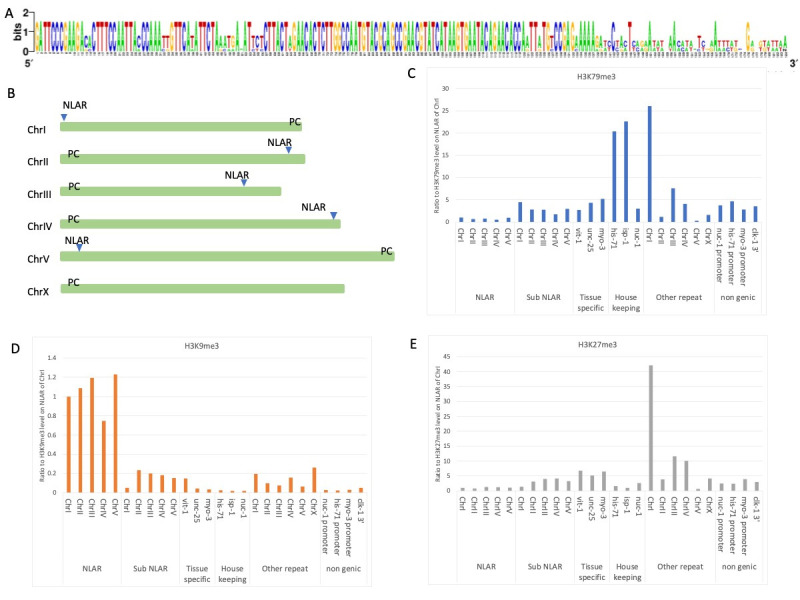 Figure 1
Peer Reviews
No public reviews on file for this paper yet. If you reviewed it on a platform where reviews are public (OpenReview, ICLR, NeurIPS, ICML), you can paste yours below so the community can read it here.
Videos
No videos yet. Explain this paper in a talk, walkthrough, or lecture? Add one.
Taxonomy
TopicsGenetics, Aging, and Longevity in Model Organisms · DNA Repair Mechanisms · Genetic Mapping and Diversity in Plants and Animals