Novel Development of a Large Cerebral Cavernous Malformation in an Adolescent With a History of Familial Cerebral Cavernous Malformation Syndrome
Mary G McIntosh, Laura L Hayes

TL;DR
A 16-year-old girl with a family history of cerebral cavernous malformations developed a new large lesion in her brain during adolescence.
Contribution
This case highlights the potential for new cavernoma development in adolescents with familial CCM syndrome.
Findings
A large cavernoma was found in the right frontal lobe of a 16-year-old girl with familial CCM.
The lesion was not present in an MRI scan from eight years earlier.
The case shows that new cavernomas can develop later in adolescence.
Abstract
Cerebral cavernous malformations (CCM) are capillary vascular malformations of the central nervous system (CNS). These lesions can be either familial or sporadic. We present a case of a 16-year-old girl with familial CCM syndrome who presented with a six-month history of chronic headaches. A magnetic resonance imaging (MRI) scan revealed a large cavernoma in the right frontal lobe that had not been present on a prior scan performed eight years earlier. This case presentation demonstrates the possibility of significant novel cavernoma development further into adolescence.
Genes, proteins, chemicals, diseases, species, mutations and cell lines named across the full text — each resolved to its canonical identifier and authoritative record.
Click any figure to enlarge with its caption.
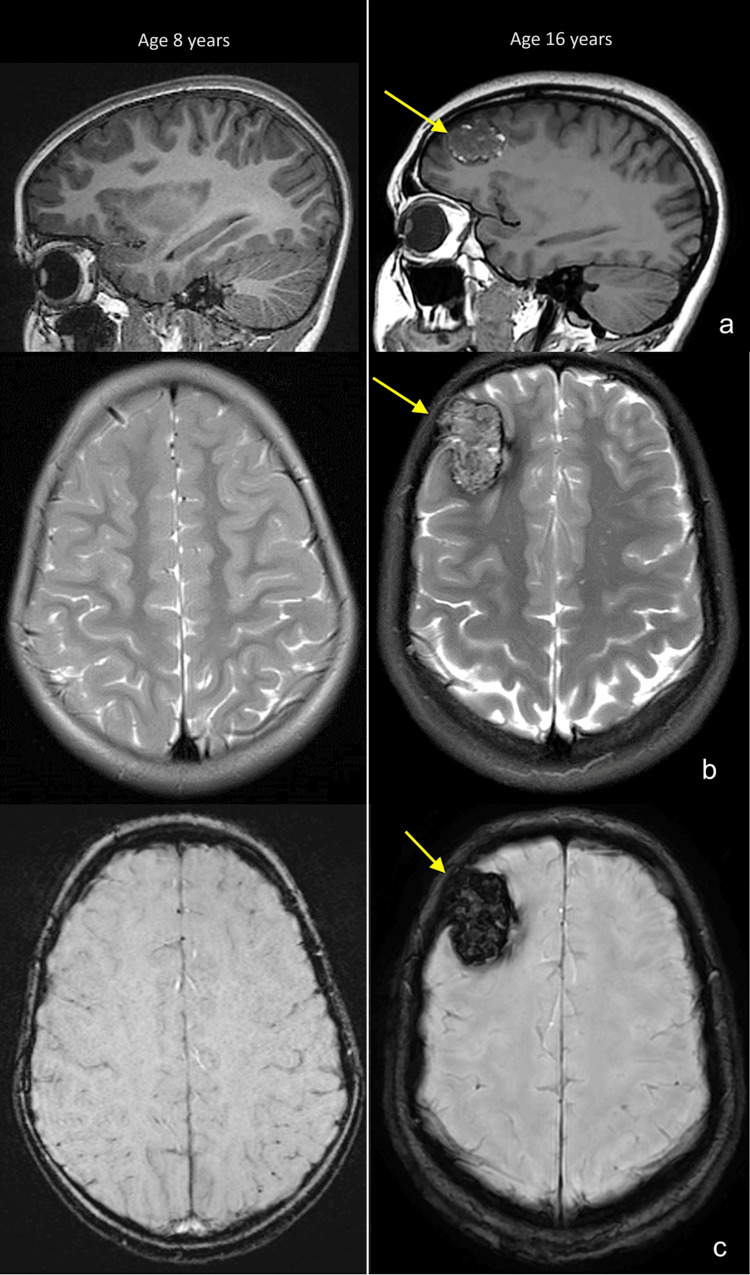 Figure 1
Peer Reviews
No public reviews on file for this paper yet. If you reviewed it on a platform where reviews are public (OpenReview, ICLR, NeurIPS, ICML), you can paste yours below so the community can read it here.
Videos
No videos yet. Explain this paper in a talk, walkthrough, or lecture? Add one.
Taxonomy
TopicsVascular Malformations Diagnosis and Treatment · Intracranial Aneurysms: Treatment and Complications · Intracerebral and Subarachnoid Hemorrhage Research