An Extended Follow-Up on Blood Pressure in a Patient With New-Onset Essential Hypertension: Early-Morning Home, Morning Home, and Office Readings
Yukihito Higashi, Shinji Kishimoto

TL;DR
A 63-year-old man with long-term hypertension shows that high early-morning blood pressure doesn't significantly affect organ or heart disease if other readings are controlled.
Contribution
Demonstrates that elevated early-morning blood pressure may not contribute to disease if other readings are well-managed.
Findings
Well-regulated outpatient and morning blood pressure readings correlate with no significant organ disease.
Exceptionally high early-morning blood pressure does not notably contribute to cardiovascular disease.
Long-term follow-up suggests early-morning readings may not be a major risk factor when other metrics are controlled.
Abstract
The patient was a 63-year-old man with a 24-year history of hypertension. During long-term follow-up, when outpatient clinic blood pressure and morning blood pressure are well-regulated, exceptionally elevated early-morning blood pressure does not play a significant role in the development of hypertensive target organ disease or cardiovascular disease.
Genes, proteins, chemicals, diseases, species, mutations and cell lines named across the full text — each resolved to its canonical identifier and authoritative record.
Click any figure to enlarge with its caption.
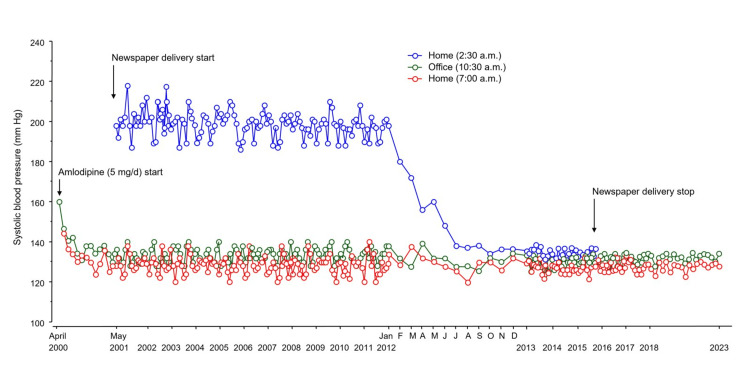 Figure 1
Peer Reviews
No public reviews on file for this paper yet. If you reviewed it on a platform where reviews are public (OpenReview, ICLR, NeurIPS, ICML), you can paste yours below so the community can read it here.
Videos
No videos yet. Explain this paper in a talk, walkthrough, or lecture? Add one.
Taxonomy
TopicsBlood Pressure and Hypertension Studies · Sodium Intake and Health · Cardiovascular Health and Disease Prevention